
Cyber-Attack Timeline: Betterment Cyber Attack

Educational & easy-to consume visual guides to understanding attacks & enhancing resilience

Betterment TL Document Betterment Summary

Download Our Timeline on the Betterment Data Compromise 

The Betterment data breach, which exposed the personal information of approximately 1.4 million users, serves as a critical case study in how even digitally mature financial platforms remain vulnerable to third-party and internal system weaknesses. The incident did not stem from a direct compromise of Betterment’s core infrastructure, but rather highlighted the risks associated with data handling practices, vendor dependencies, and access controls within modern fintech ecosystems. 

What makes the Betterment breach particularly significant is not just the scale, but the timeline of detection, response, and disclosure. Like many modern breaches, there were gaps between initial compromise, internal awareness, and public communication. The event also reinforces how breaches today are rarely isolated technical failures; they are often the result of layered vulnerabilities across systems, third-party integrations, and governance processes. 

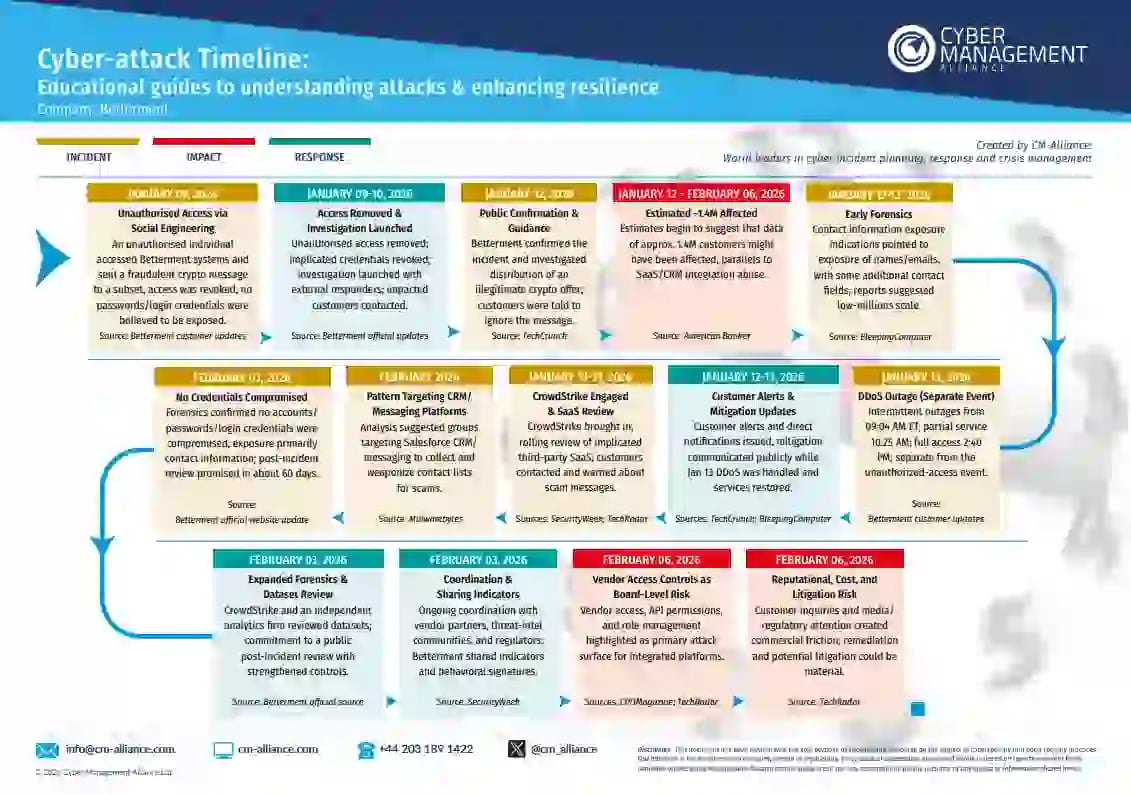
Our Betterment Attack Timeline breaks down how the breach unfolded, offering critical insights into what went wrong, how the response evolved, and what organisations can learn. For CISOs and security leaders, it highlights the need for continuous monitoring, third-party risk management, and rehearsed incident response strategies.

Disclaimer: This document has been created with the sole purpose of encouraging discourse on the subject of cybersecurity and good security practices. Our intention is not to defame any company, person or legal entity. Every piece of information mentioned herein is based on reports and data freely available online. Cyber Management Alliance neither takes credit nor any responsibility for the accuracy of any source or information shared herein.

  • ** GDPR ** We wholeheartedly believe your and our rights to privacy and in the GDPR. The bottom of the page explains how we use your data. 
  • Align with the GDPR requirements.
  • Increase your Breach Readiness.
  • Reduce your time to detect and respond.

Complete the form below to receive a copy of the Betterment Attack Timeline document.

cyber-essentials-certification
NCSC Certified Training B&W 300px
CSC

FAQs on the Betterment Cyber Attack

  • 1. What happened in the Betterment cyber attack?

    On 9 January 2026, an unauthorised individual used social engineering to gain access to third-party systems that Betterment — a major US robo-advisor and fintech — used for customer communications. The attacker used that access to send a fraudulent crypto-related message to a subset of customers and exposed contact and limited personal data for roughly 1.4 million accounts. Betterment said the message was fake, that it revoked the unauthorised access once discovered, and that no customer passwords, login credentials, accounts or funds were compromised. It became one of the most notable fintech data-exposure events of early 2026.

  • 2. When did the Betterment data breach happen?

    The unauthorised access occurred on 9 January 2026, and Betterment removed it and launched an investigation on 9-10 January. The company publicly confirmed the incident on 12 January 2026. A separate DDoS outage hit on 13 January. Through late January and into February 2026 forensic work continued, the estimate of affected customers rose to around 1.4 million, and the breach was added to Have I Been Pwned on 5 February 2026. Betterment said it would publish a post-incident review within roughly 60 days.

  • 3. Who was behind the Betterment cyber attack?

    Betterment did not publish a formal attribution to a named group. However, multiple reports linked the operational pattern — abuse of a third-party messaging/CRM environment to distribute scam messages — to identity-centric intrusions previously associated with the ShinyHunters group and earlier Salesforce-linked attacks. Some coverage and social-media analysis also described the use of voice phishing to obtain single sign-on credentials, though this detail was not confirmed by Betterment.

  • 4. How did the attackers gain access to Betterment's systems?

    The intrusion originated from social engineering rather than a software vulnerability. An attacker obtained identity-based access into third-party SaaS systems that Betterment used for customer messaging — what investigators characterised as a human-layer compromise of vendor access rather than a software zero-day. With that access, the attacker hijacked a trusted communications channel to impersonate Betterment and send fraudulent messages.

  • 5. What data was exposed in the Betterment breach?

    The exposure primarily involved customer contact and limited personal data. Reported and listed data included names, email addresses, phone numbers, physical addresses, geographic locations, dates of birth, employers, job titles and device information for roughly 1.4 million accounts. Betterment and its forensic partners confirmed that no investment accounts, passwords or login credentials were compromised.

  • 6. How many customers were affected by the Betterment breach?

    The evolving estimate placed the number of affected customers at around 1.4 million. The figure rose as investigators mapped the data the attacker had accessed, and the breach was added to Have I Been Pwned on 5 February 2026, listing approximately 1.4 million affected accounts.

  • 7. What was the Betterment crypto scam message?

    Using the hijacked communications channel, the attacker sent a fraudulent crypto-related message from a legitimate-looking Betterment address, promising high returns if customers sent funds to an attacker-controlled cryptocurrency wallet — with reporting citing requests of up to $10,000. Because the message came through a trusted brand channel, it was designed to look convincing. Betterment told customers to ignore the message and to treat any crypto-related request as fraudulent.

  • 8. Was a ransom demanded in the Betterment cyber attack?

    No public ransom demand was disclosed. The incident was described as data theft and the abuse of a communications channel for fraud, rather than an encrypted, extortion-based ransomware event. The attacker's apparent goal was to harvest contact data and run convincing impersonation scams against customers.

  • 9. Was the Betterment DDoS attack part of the same incident?

    Betterment treated the DDoS event as a separate issue. On 13 January 2026, a distributed denial-of-service attack caused intermittent outages of Betterment's website and mobile app from around 09:04 AM ET, with partial service returning by 10:25 AM and full access restored by 2:40 PM ET the same day. Betterment kept this outage distinct from the unauthorised-access event in its public timeline.

  • 10. How did Betterment respond to the attack?

    Betterment removed the unauthorised access as soon as it was discovered on 9 January, revoked the implicated credentials, and immediately contacted the customers who received the fraudulent message, instructing all customers to ignore it. It engaged CrowdStrike to lead forensics alongside an independent analytics firm, conducted a rolling review of the implicated third-party SaaS platforms, coordinated with vendor partners, threat-intelligence communities and regulators, and committed to publishing a post-incident review within about 60 days.

  • 11. What should Betterment customers do to stay safe?

    Customers were advised to ignore any crypto-promotion messages claiming to come from Betterment and to treat crypto-related requests as fraudulent. Recommended precautions include verifying communications through Betterment's official app, enabling strong multi-factor authentication on financial accounts, watching for phishing attempts that use the exposed personal data, and remembering that Betterment will never ask for a password via email, text or call. Customers can also check Have I Been Pwned to see whether their email was included.

  • 12. What can organisations learn from the Betterment cyber attack?

    The Betterment incident shows how attackers can weaponise trusted vendor channels to impersonate a brand and defraud its customers without ever breaching core infrastructure. The key lessons are that third-party messaging and CRM permissions, API keys and role-based access must be treated as high-risk assets under continuous monitoring and zero-trust controls; that social engineering and identity abuse are high-value, low-cost initial access vectors; and that rapid credential revocation and direct customer communication limit downstream fraud and reputational harm. Cyber Management Alliance helps organisations build these capabilities through training, cyber crisis tabletop exercises and incident response planning.

We are industry experienced practitioners when it comes to cyber security training & cyber security consultancy services

1487652208_graduationcap

Training

We offer a host of courses including our NCSC Assured Training in Cyber Incident Planning and Response and our NCSC Assured Training in Building and Optimising Incident Response Playbooks.

1487652701_like

Virtual CISO Services

Hands On, full-support 'Security As a Service', specifically designed for organisations that require access to experienced cybersecurity, governance, risk and compliance professionals.

1487652784_calendar-3

Virtual Cyber Assistant

A unique, affordable, subscription-based, cybersecurity service for small to medium businesses, offering 280+ services in cybersecurity.

1487652846_microphone

Cyber Crisis Tabletop Exercises

Scenario-based, verbally-simulated tabletop attack exercises that test your organisation's ability to effectively respond to a cyber-attack.


1487652632_search

Ransomware Tabletop Exercise

Measure your organisation’s Ransomware Readiness with a unique blend of verbal and visual simulations and ransomware scenario walkthroughs.

1487652567_line-chart

Executive Cyber Awareness Sessions

Specially designed for executive management, CEOs and boards of directors, engaging them in a business context to help explain the threats and risks from cyber-attacks.

How we use your data:

  • The form above collects personal information so we may email you the requested information and pressing the "Get your free copy now"  button acts as informed consent for this processing purpose. Consequently we may be in touch to:

    • Update you when we host our ground-breaking Wisdom of Crowds events in your country or region.
    • Keep you posted on free resources and documents around Wisdom of Crowds events and its outputs. (For example, we tend to create insightful mind maps and we also are the creators of free to view Insights with Cyber Leaders Video Interviews. )
    • Ping you a note about upcoming FREE educational webinars on GDPR and Cybersecurity.
    • Inform you of any upcoming Data Breach Response or Cyber Incident Response training.  
  • Using the information from this page we will NOT sell or market to you any of our consultancy or trusted advisory services.  
  • In its purest interpretation, this act of us communicating with you is direct marketing and is processed on the basis of our legitimate interest and your engaging in our services. All marketing communication will include an unsubscribe button or other method of ending communication.