

Educational & easy-to consume visual guides to understanding attacks & enhancing resilience
In March 2026, the European Commission suffered a sophisticated cyber attack that quickly escalated beyond a single organisation. What began as suspicious activity in a cloud-hosted system evolved into a multi-stage supply chain attack whose impact was felt cross 30+ EU entities. Exploitation of a trusted open-source security tool led to an alleged large-scale data exfiltration (92 GB to hundreds of GB).
This wasn’t just a breach. It was a systemic cyber incident with global implications.
Download the Full Cyber Attack Timeline to gain access to a detailed, step-by-step breakdown of how the attack unfolded, including:
✔ Day-by-day timeline of the incident
✔ Attack vectors and root cause analysis
✔ Impact across EU systems and entities
✔ Response and containment actions
✔ Key lessons for modern cyber resilience
Disclaimer: This document has been created with the sole purpose of encouraging discourse on the subject of cybersecurity and good security practices. Our intention is not to defame any company, person or legal entity. Every piece of information mentioned herein is based on reports and data freely available online. Cyber Management Alliance neither takes credit nor any responsibility for the accuracy of any source or information shared herein.
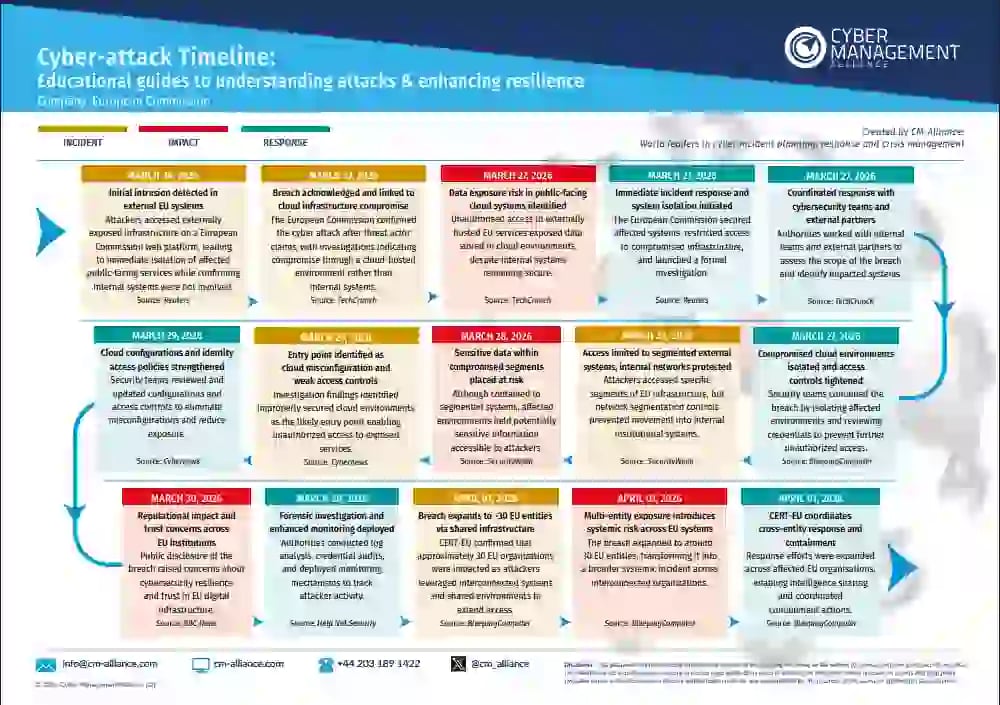
In March 2026, the European Commission identified a cyber intrusion affecting externally hosted components of its cloud infrastructure tied to public-facing Europa.eu services. It was later uncovered as a multi-stage supply chain attack involving the compromise of the Trivy open-source security tool, ultimately impacting around 30 EU entities and enabling large-scale data exfiltration. Internal EU networks remained secure.
Suspicious activity was first detected on 24 March 2026, and the Commission publicly acknowledged the attack on 27 March 2026. The incident and investigation unfolded between 24 March and 3 April 2026.
Initial assessments pointed to misconfigured cloud environments and weak access controls. By 2 April 2026, investigators conclusively linked the breach to a supply chain compromise of the Trivy open-source security tool, which let attackers reach cloud environments through a trusted component without triggering standard security controls.
Trivy is a widely used open-source security scanning tool. Attackers compromised it upstream, so organisations using the trusted tool unknowingly inherited the compromise. Because it operated within trusted security workflows, attackers could move into cloud environments while bypassing standard controls, turning a single upstream weakness into multi-organisation exposure.
Attribution evolved over the incident. ShinyHunters claimed responsibility on 27 March 2026. Activity was later also linked to TeamPCP on 2 April, and by 3 April intelligence indicated that multiple hacking groups exploited the same vulnerability, pointing to multi-actor involvement.
CERT-EU confirmed on 1 April 2026 that approximately 30 EU entities were impacted, with the spread linked to shared infrastructure and interconnected systems.
Estimates ranged from tens to hundreds of gigabytes. The Daily Star reported around 92 GB exfiltrated, while CPO Magazine indicated the total could reach hundreds of gigabytes. Threat-actor posts claimed 350 GB or more uncompressed.
Reported and claimed leaked data included emails and attachments, a full SSO user directory, DKIM signing keys, AWS configuration snapshots, NextCloud/Athena data, and internal admin URLs.
No. The Commission confirmed that internal EU networks and core systems remained unaffected. Network segmentation contained the intrusion to externally exposed systems.
No ransom demand was identified as of 3 April 2026, suggesting the operation focused on data theft and potential leak or extortion rather than encryption.
The Commission isolated affected cloud environments, tightened access controls, reviewed credentials, launched forensic investigations, strengthened cloud configurations and identity policies, and coordinated a cross-entity response through CERT-EU while maintaining stakeholder communication.
Supply chain compromises can escalate isolated breaches into multi-organisation incidents; open-source tools can become high-impact attack vectors when compromised upstream; cloud environments demand strict configuration and access-control discipline; shared infrastructure introduces systemic risk; and modern attacks increasingly involve multiple actors exploiting the same vulnerability. Cyber Management Alliance helps organisations build these capabilities through training, cyber crisis tabletop exercises and incident response planning.
We offer a host of courses including our NCSC Assured Training in Cyber Incident Planning and Response and our NCSC Assured Training in Building and Optimising Incident Response Playbooks.

Hands On, full-support 'Security As a Service', specifically designed for organisations that require access to experienced cybersecurity, governance, risk and compliance professionals.

A unique, affordable, subscription-based, cybersecurity service for small to medium businesses, offering 280+ services in cybersecurity.

Scenario-based, verbally-simulated tabletop attack exercises that test your organisation's ability to effectively respond to a cyber-attack.