Educational & easy-to consume visual guides to understanding attacks & enhancing resilience
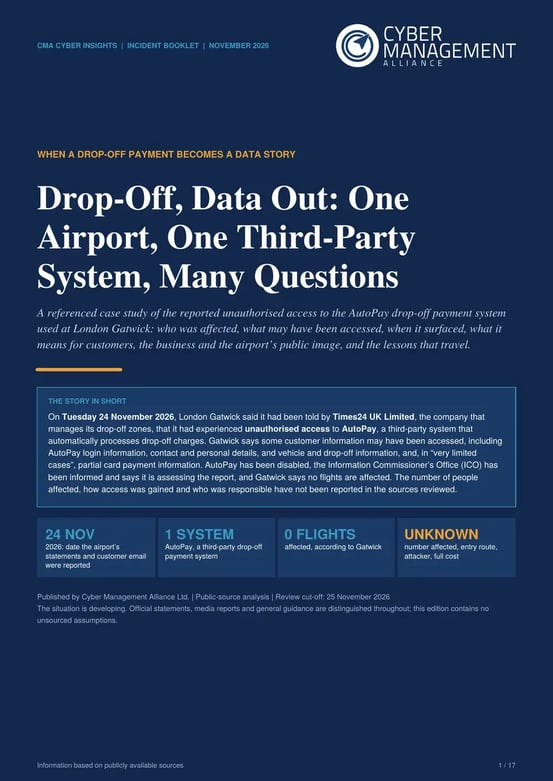
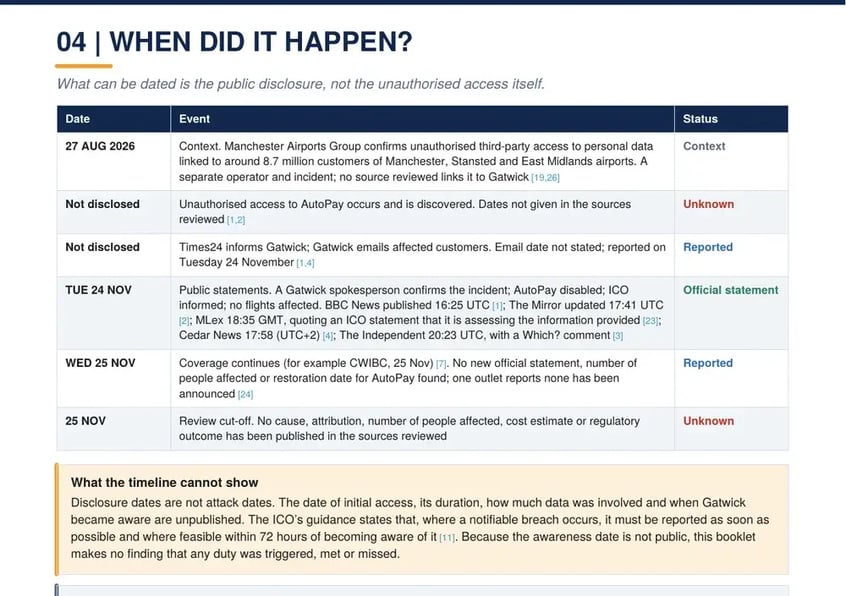
On 24 November 2026, London Gatwick said that Times24 UK Limited, the company that manages its drop-off zones, had experienced unauthorised access to AutoPay, the third-party system that processes drop-off charges. Some customer information may have been accessed. Our timeline sets out what has been confirmed, what has only been reported and what is still unknown.
By Amar Singh, CEO & Founder, Cyber Management Alliance · Last updated
An airport drop-off payment is not where most organisations expect a data breach story to begin. Yet on Tuesday, 24 November 2026, London Gatwick, the UK’s second-largest airport, confirmed that a third-party system called AutoPay had been subject to unauthorised access. AutoPay is run through Times24 UK Limited, which manages the airport’s drop-off zones. According to Gatwick, the information potentially accessed includes AutoPay login information, contact and personal details, vehicle and drop-off information and, in very limited cases, partial card payment information. AutoPay has been disabled, the Information Commissioner’s Office (ICO) has been informed and Gatwick says no flights were affected.
What makes this incident worth studying is how much is still not known. The number of customers affected, how access was gained and who was responsible had not been reported at the time of writing. Our document separates official statements from media reports and open questions, so you can see exactly where the public record stands. It also draws out eight practical lessons and ten questions to ask your own organisation before a supplier’s system becomes your headline.
Remember, your customers’ data is only as secure as the third parties that process it. Discover how incident response playbooks and regular cyber incident response tabletop testing can prepare your business for an incident that starts in a supplier’s system.
Don’t forget to read our blog on the Gatwick Airport data breach and its lessons for third-party risk management.
Disclaimer: This document has been created with the sole purpose of encouraging discourse on the subject of cybersecurity and good security practices. Our intention is not to defame any company, person or legal entity. Every piece of information mentioned herein is based on reports and data freely available online. Cyber Management Alliance neither takes credit nor any responsibility for the accuracy of any source or information shared herein.
Thanks for submitting the form. Please check your email shortly for a copy of the timeline.

The table below summarises the main facts from our Gatwick Airport data breach timeline. Download the full document for the dated, source-by-source account.
| Organisation | London Gatwick, the UK’s second-largest airport |
|---|---|
| System involved | AutoPay, a third-party drop-off payment system run through Times24 UK Limited |
| When | Publicly reported on Tuesday, 24 November 2026; the dates of the access and of its discovery have not been disclosed |
| Attacker | Not reported; no claim of responsibility in the sources reviewed |
| How they got in | Not reported |
| Data potentially accessed | AutoPay login information, contact and personal details, vehicle and drop-off information and, in very limited cases, partial card payment information |
| Who was affected | Some AutoPay customers; the number has not been disclosed |
| Response | AutoPay disabled as a precaution; ICO informed; external IT security specialists reported to be investigating; no flights affected |
Compiled by Cyber Management Alliance from public reporting reviewed to 25 November 2026. Last updated 26 November 2026.
On Tuesday, 24 November 2026, London Gatwick said it had been informed by Times24 UK Limited, the company that manages its drop-off zones, that it had experienced unauthorised access to AutoPay. AutoPay is a third-party system that automatically processes drop-off charges. Gatwick says some customer information may have been accessed and that affected customers have been informed by email. AutoPay was disabled as a precaution and the Information Commissioner’s Office (ICO) was informed.
The public disclosure can be dated, but the unauthorised access itself cannot. Gatwick’s statement and its email to customers were reported on 24 November 2026. The sources we reviewed do not say when the access began, when it was discovered or how long it lasted. They also do not say when Times24 told Gatwick. Disclosure dates are not attack dates, which is why our timeline marks these points as not disclosed.
According to a Gatwick spokesperson, the information potentially accessed includes AutoPay login information, customer contact information and personal details, and vehicle and drop-off information. Media reports of Gatwick’s customer email describe email and home addresses, details of registered vehicles, payment records and drop-off locations and times. Outlets word the data fields slightly differently, and Gatwick says its investigation is ongoing, so the scope may change.
Gatwick says partial card payment information was involved in ‘very limited cases’. The customer email, as reported by the BBC, specifies card brand, last four digits and expiry date in ‘isolated cases’. Full card numbers, card security codes and bank account numbers do not appear in any of the lists we reviewed.
Gatwick has not said. Its statement refers to ‘some customer information’ and says those affected have been informed. No total had been announced by our review cut-off of 25 November 2026.
Neither has been reported. No attacker, claim of responsibility, ransom demand or entry route appears in the sources we reviewed. Gatwick says only that Times24 experienced unauthorised access to AutoPay, and external IT security specialists are reported to be investigating. Our timeline does not speculate on method or motive.
No. Gatwick says no flights were affected and that all car parks are operating as normal. Drop-off zones remain open, and customers can pay using the alternative payment methods on the London Gatwick website while AutoPay is disabled. No date for AutoPay’s return had been reported at the time of writing.
Gatwick says it has informed the ICO, and an ICO spokesperson told media that it has received a report and is assessing the information provided. No investigation outcome, finding or penalty has been reported. Under the UK GDPR, the higher maximum fine is £17.5 million or 4% of worldwide annual turnover, whichever is higher. That figure is a statutory ceiling and not a forecast for this incident.
Gatwick’s email warns customers to be cautious of unexpected emails, calls or text messages. The National Cyber Security Centre (NCSC) advises checking whether you are affected through the organisation’s official website or social channels, and not through links in messages. Suspicious emails can be forwarded to report@phishing.gov.uk and suspicious texts to 7726. If you have lost money, tell your bank and report it to Report Fraud. This is published guidance and not tailored advice.
No source we reviewed links the two. In August 2026, Manchester Airports Group confirmed unauthorised third-party access to personal data linked to around 8.7 million customers of Manchester, Stansted and East Midlands airports. That incident involved a separate operator and different systems. We include it in the timeline as context only.
Third-party systems are part of your data footprint. The incident shows why you should know which suppliers process your customers’ personal or payment data, agree breach notification times in supplier contracts, and be able to switch off an affected service while keeping customers served. It also pays to rehearse an incident that starts in a supplier’s system. Cyber Management Alliance helps organisations build these capabilities through incident response training, playbooks and cyber crisis tabletop exercises.
We offer a host of courses including our NCSC Assured Training in Cyber Incident Planning and Response and our NCSC Assured Training in Building and Optimising Incident Response Playbooks.

Hands On, full-support 'Security As a Service', specifically designed for organisations that require access to experienced cybersecurity, governance, risk and compliance professionals.

A unique, affordable, subscription-based, cybersecurity service for small to medium businesses, offering 280+ services in cybersecurity.

Scenario-based, verbally-simulated tabletop attack exercises that test your organisation's ability to effectively respond to a cyber-attack.