

Free and Immediately Usable NIS2 Incident Response Document Library
What is the NIS2 Incident Response Document Library?
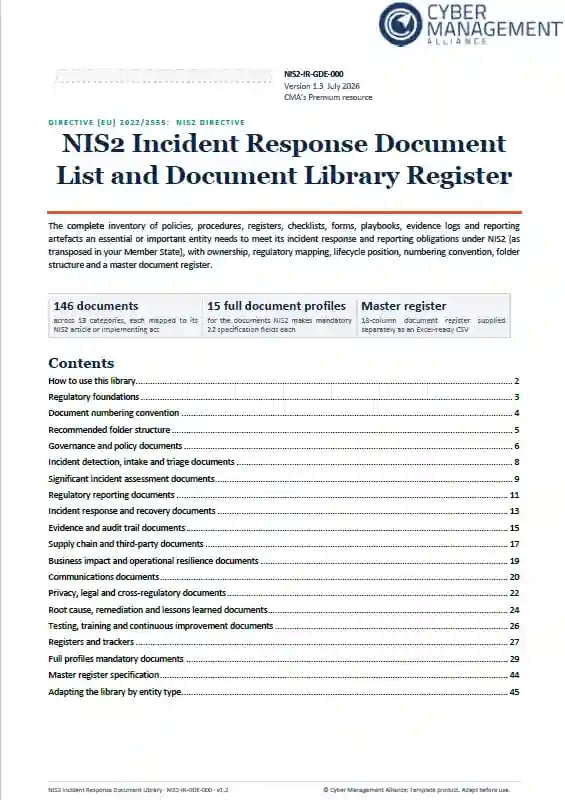
The NIS2 Incident Response Document List & Document Library Register is the master inventory of every policy, procedure, register, checklist, form, playbook, evidence log and reporting template an essential or important entity needs to meet its incident response and reporting obligations under the NIS2 Directive (EU) 2022/2555.
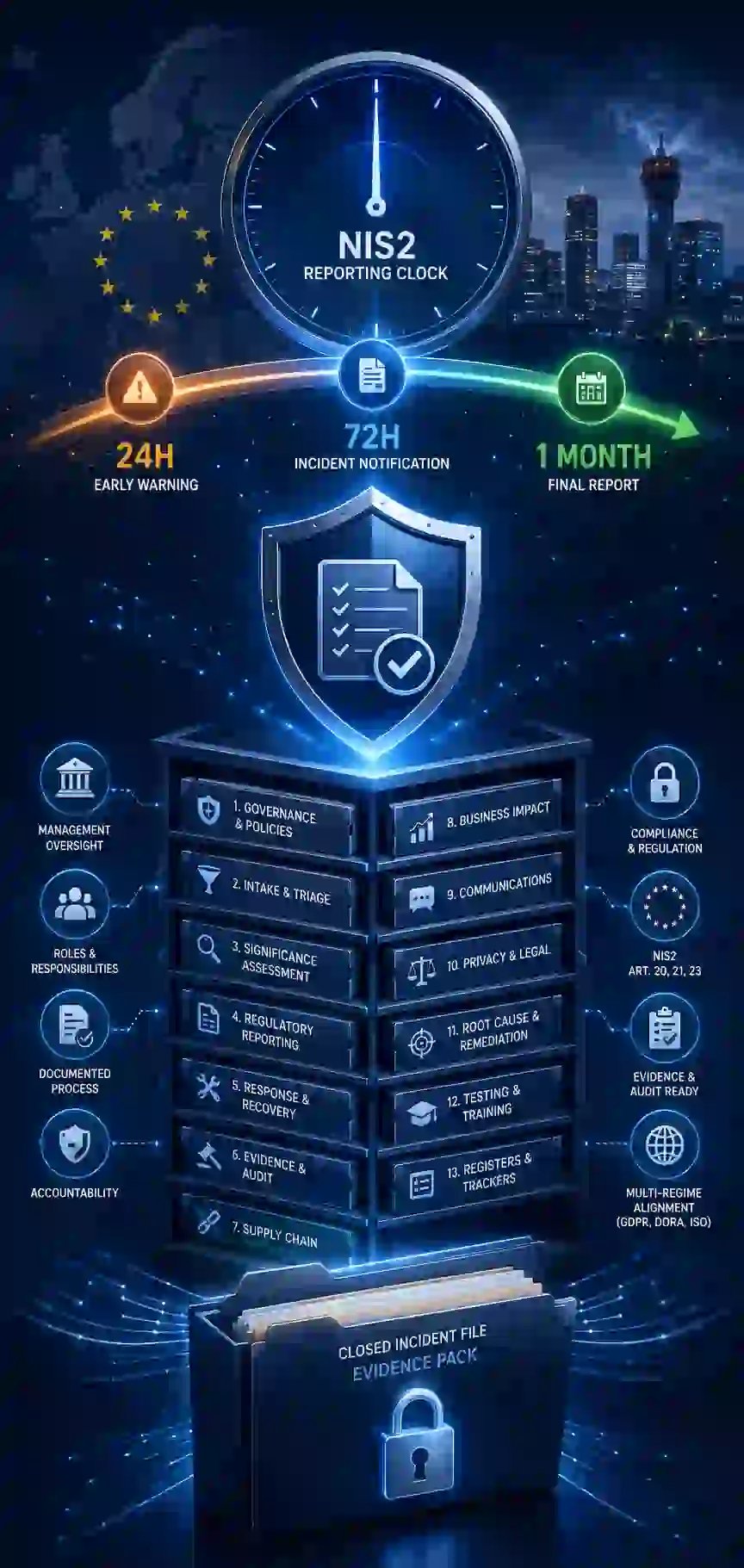
Rather than starting from a blank page, you get a fully mapped documentation architecture: 146 documents organised into 13 categories, each one tied to the exact NIS2 article or implementing act it satisfies, with defined ownership, lifecycle position (before, during, or after an incident), a consistent numbering convention, and a recommended folder structure.
It is built around the reporting clock NIS2 actually enforces — the 24-hour early warning, 72-hour incident notification, and one-month final report — and it's designed to be imported straight into Excel, SharePoint or your GRC platform as a living single source of truth.
What's Inside?
|
146 documents |
Across 13 categories — governance, intake & triage, significance assessment, regulatory reporting, response & recovery, evidence & audit, supply chain, business impact, communications, privacy & legal, root cause & remediation, testing & training, and registers & trackers. |
|
Regulatory mapping |
Every document tied to its NIS2 article or the relevant implementing act, plus adjacent regimes (GDPR, DORA, ISO 27035, NIST SP 800-61). |
|
15 full document profiles |
Deep specifications for the documents NIS2 makes mandatory — 22 fields each, covering purpose, owner, regulatory basis, lifecycle, contents and dependencies. |
|
Master register (CSV) |
An 18-column, Excel-ready register pre-populated with all 146 documents — import into Excel, SharePoint or your GRC tool. |
|
Numbering convention |
A structured NIS2-IR-[TYPE]-[NNN] scheme across 18 document types (policies, procedures, plans, forms, playbooks, logs, and more). |
|
Recommended folder structure |
A 16-folder architecture, including restricted closed-incident files and regulator submission folders with retention enforced. |
|
Adaptation guidance |
How to scale the library by entity type and size — including which documents to keep, merge or streamline. |
Why Do You Need the NIS2 Document Library?
Under NIS2, responsibility for cybersecurity risk — incident response included — sits directly with the management body, and Article 21(2)(b) requires a documented incident management process. When a supervisor reviews you, the review almost always starts with your governance documents: without an approved policy, defined roles and controlled documents, nothing downstream can be evidenced.
The reporting deadlines make this urgent. Once you become aware of a significant incident, an early warning is due within 24 hours, a full notification within 72 hours, and a final report within one month — and missing a deadline is itself a sanctionable breach. Weak intake documentation is the single most common reason entities later can't prove they classified and reported on time.
This library closes that gap. It gives you the artefacts that demonstrate compliance is real and operational — not aspirational — so you're audit-ready before an incident and reporting-ready the moment one begins.
Key Benefits
-
Skip months of scoping work. The full document set, categories, ownership and regulatory mapping are already defined — you adapt, you don't invent.
-
Know exactly what's mandatory. Every document carries a status code — M (explicitly mandatory), C (required in practice to evidence compliance), or R (recommended good practice) — so you can prioritise the gaps that create direct compliance exposure.
-
Be ready before the clock starts. The documents you complete during an incident are supplied as pre-approved blank templates, because the 24-hour early warning window leaves no time to design forms.
-
Survive a supervisory review. Documents are mapped to Articles 20, 21, 23 and Implementing Regulation (EU) 2024/2690, so you can show an auditor the artefact behind each obligation.
-
Assemble evidence packs automatically. The folder structure mirrors the incident lifecycle, so a closed-incident file effectively builds its own regulatory evidence pack.
-
One controlled source of truth. The 18-column master register keeps ownership, versions, review dates and regulatory basis in a single maintained list.
Who is the NIS2 Document Library for?
- CISOs and information security leaders responsible for building or maturing an incident response documentation set.
- Compliance, risk and GRC teams who need to map controls to NIS2 articles and evidence them to a regulator.
- Management bodies and executives carrying personal accountability for cybersecurity oversight under Article 20.
- Essential and important entities across the sectors in NIS2 scope — as well as the DNS, cloud, data centre, managed service, marketplace and other digital providers named in Implementing Regulation (EU) 2024/2690.
- Incident response, legal and communications teams who need pre-approved templates ready before an incident, not during one.
- Consultants and virtual CISOs standing up NIS2 programmes for multiple clients who want a proven, adaptable baseline.
** GDPR & Privacy ** We wholeheartedly believe in your and our rights to privacy and in the GDPR. The bottom of the page explains how we use your data.
Please Fill the Form Below To Get Your Free Copy of the NIS2 Incident Response Document Library



We are industry experienced practitioners when it comes to cyber security training & cyber security consultancy services

Training
We offer a host of courses including our NCSC Assured Training in Cyber Incident Planning and Response and our NCSC Assured Training in Building and Optimising Incident Response Playbooks.

Virtual CISO Services
Hands On, full-support 'Security As a Service', specifically designed for organisations that require access to experienced cybersecurity, governance, risk and compliance professionals.

Virtual Cyber Assistant
A unique, affordable, subscription-based, cybersecurity service for small to medium businesses, offering 280+ services in cybersecurity.

Cyber Crisis Tabletop Exercises
Scenario-based, verbally-simulated tabletop attack exercises that test your organisation's ability to effectively respond to a cyber-attack.