

Educational & easy-to consume visual guides to understanding attacks & enhancing resilience
At Cyber Management Alliance, Cyber Incident Planning & Response and Ransomware Response is our passion. We study and analyse cyber-attacks and ransomware attacks to create informational visual timelines which can be easily read for educational purposes and to enhance cyber resilience.
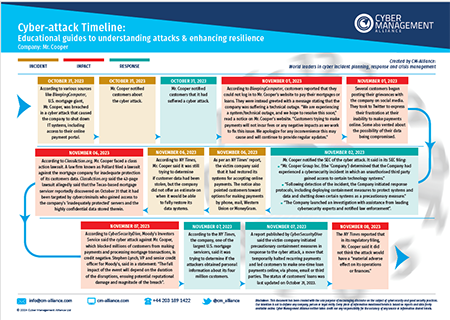
For the Mr. Cooper Cyber Attack, we have created a visual timeline and an accompanying detailed report. Download it now.
Don't forget to read our blog on the Mr. Cooper Cyber Attack.
Disclaimer: This document has been created with the sole purpose of encouraging discourse on the subject of cybersecurity and good security practices. Our intention is not to defame any company, person or legal entity. Every piece of information mentioned herein is based on reports and data freely available online. Cyber Management Alliance neither takes credit nor any responsibility for the accuracy of any source or information shared herein.
Mr. Cooper, one of the largest mortgage servicers in the United States (formerly Nationstar Mortgage), disclosed a cyber attack on 31 October 2023. The company detected unauthorised access to its systems and shut systems down as a precaution, including its online payment portal, leaving millions of customers temporarily unable to make mortgage payments. Mr. Cooper later confirmed that the personal information of around 14.7 million current and former customers had been exposed, making it one of the largest data breaches in the US financial sector in 2023.
Mr. Cooper detected the incident on 31 October 2023 and notified customers the same day. The company later determined, through its investigation, that unauthorised access to its systems occurred between 30 October and 1 November 2023. Systems were brought back online progressively, with servicing operations restarting on 4 November 2023, and the full scale of the breach (around 14.7 million people affected) was disclosed on 15 December 2023.
The attacker has not been publicly identified. Mr. Cooper did not name a threat actor or confirm whether the incident was a ransomware attack, and the company declined to comment publicly on whether any extortion demand was made. No group claimed responsibility in the reporting available, so attribution for the Mr. Cooper breach remains unknown.
Mr. Cooper did not confirm that the incident was a ransomware attack, and no ransom payment was reported. Early reporting noted that, if it were ransomware, data may have been stolen for use as leverage, but the company described it only as a cybersecurity incident involving unauthorised access. Because Mr. Cooper did not disclose the attack method or any extortion demand, the precise nature of the attack has not been publicly established.
According to the breach notifications Mr. Cooper filed with regulators in Maine and California, the exposed personal information included customers' names, addresses, phone numbers, Social Security numbers, dates of birth and bank account numbers. This combination of identity and financial data is particularly sensitive and raised concerns about identity theft and fraud for those affected.
Mr. Cooper initially said it was still determining whether customer data had been taken, and on 15 December 2023 confirmed that the personal information of nearly 14.7 million current and former customers had been exposed. This was much higher than the company's roughly 4.1 million active customers at the time, because the breach also affected past customers whose data remained on file.
During the outage, customers were unable to log in to make mortgage or loan payments and were met with a notice about a system outage. Mr. Cooper directed them to alternative payment methods such as phone, mail, Western Union and MoneyGram, and said customers would not incur fees, penalties or negative credit reporting for late payments caused by the incident. Many customers voiced frustration on social media, particularly those who had made payments shortly before the shutdown and received no confirmation.
No ransom payment was reported, and Mr. Cooper did not confirm whether any ransom was demanded. In SEC filings the company estimated around $5 million to $10 million of additional vendor costs in the fourth quarter of 2023 and said it did not expect the incident to be material to its overall financial results. Moody's described the attack as credit negative, noting the impact would depend on the duration of the disruption, reputational damage and the scale of the breach.
Mr. Cooper's systems were inaccessible for roughly a week. The company shut systems down on 31 October 2023 and restarted servicing operations, including taking customer calls and payments, on 4 November 2023. Online payment acceptance was restored shortly afterwards, and originations systems were brought back as connectivity with vendors and agencies was re-established.
Mr. Cooper locked down and shut down affected systems as a precaution, engaged external cybersecurity experts, notified US law enforcement and disclosed the incident to the SEC. It filed breach notification documents with state regulators, waived late fees and negative credit reporting tied to the outage, and offered affected customers two years of complimentary credit monitoring. The company also said it was monitoring the dark web and, as of mid-December 2023, had seen no evidence that the stolen data had been shared or published.
Yes. Mr. Cooper faced a class action lawsuit filed by the Pollard law firm, which alleged that the company failed to adequately protect customer data and that the sensitive information was stored on 'inadequately protected' servers. The 43-page complaint argued the breach was 'massive and preventable' and resulted from negligence. Mr. Cooper also reported the incident to the SEC and filed breach notifications with state regulators, including those in Maine and California.
The Mr. Cooper breach shows how quickly a cyber attack can halt core business operations and expose vast amounts of sensitive data, even at a large, established company. The key lessons are to protect and segment systems that hold financial and identity data, to retain only the customer data that is genuinely needed (former customers' records significantly increased the breach total), to maintain tested incident response and crisis communication plans, and to notify customers and regulators promptly. Cyber Management Alliance helps organisations build these capabilities through training, cyber crisis tabletop exercises and incident response planning.
We offer a host of courses including our NCSC Assured Training in Cyber Incident Planning and Response and our NCSC Assured Training in Building and Optimising Incident Response Playbooks.

Hands On, full-support 'Security As a Service', specifically designed for organisations that require access to experienced cybersecurity, governance, risk and compliance professionals.

A unique, affordable, subscription-based, cybersecurity service for small to medium businesses, offering 280+ services in cybersecurity.

Scenario-based, verbally-simulated tabletop attack exercises that test your organisation's ability to effectively respond to a cyber-attack.