


Free and Immediately Usable PCI DSS Master Document Register
What is the PCI DSS Incident Response Master Document Register?
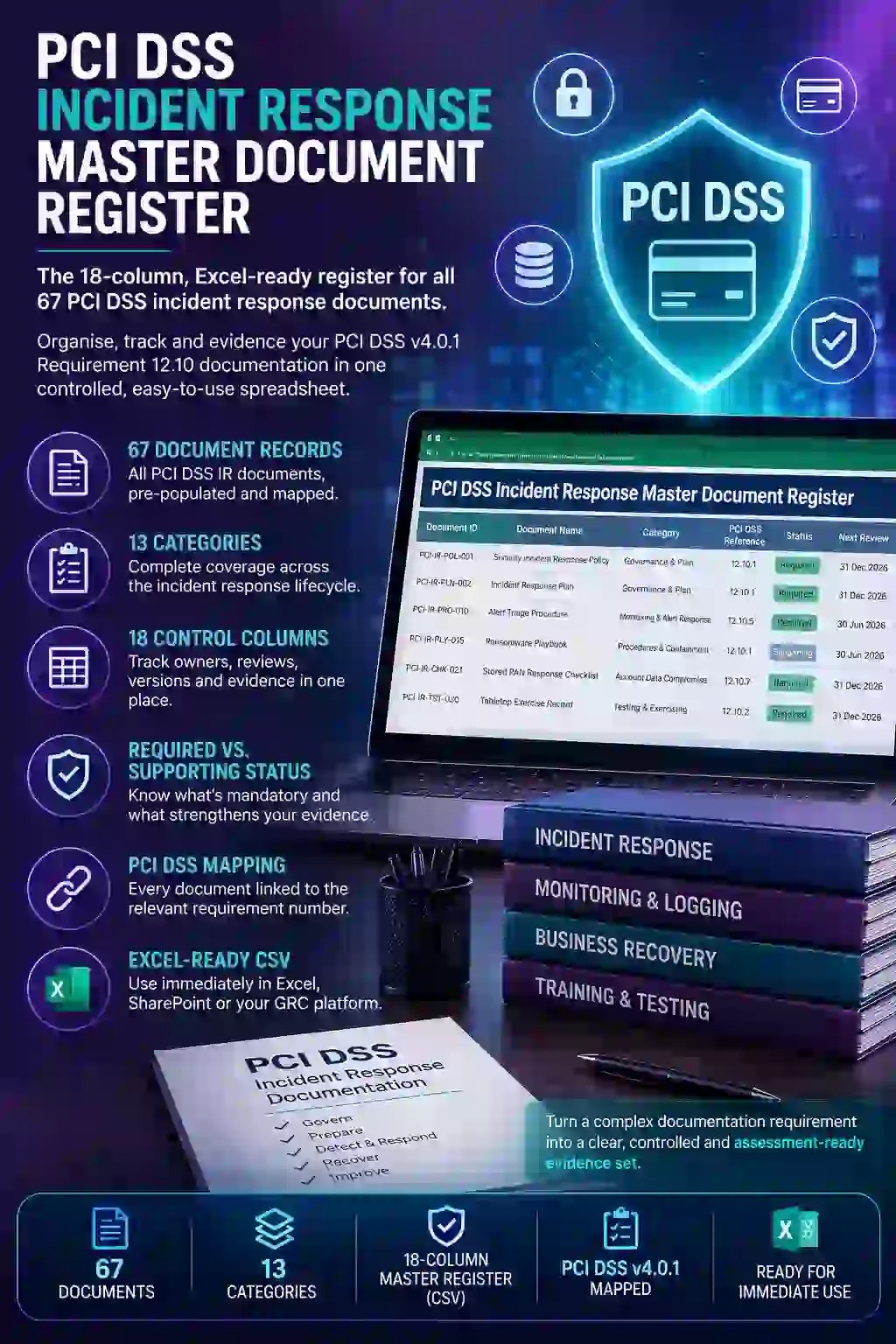
The PCI DSS Incident Response Master Document Register is the working spreadsheet at the centre of the PCI DSS Incident Response Document Library.
Where the Document Library explains the complete documentation architecture, the Master Register operationalises it.
It provides one structured, 18-column table containing all 67 policies, procedures, plans, playbooks, checklists, registers, logs, assessments, records and templates needed to build and evidence an effective incident response capability aligned with PCI DSS v4.0.1.
Every record is mapped to the relevant PCI DSS requirement number and classified as either:
- Required by PCI DSS, where the document provides direct evidence of a defined requirement; or
- Supporting evidence, where the document strengthens the wider incident response and assessment evidence chain.
The register is supplied as an adaptable CSV file that can be opened in Excel or imported into SharePoint, a document management system or a GRC platform. Replace the placeholder owners, review dates and evidence locations with your organisation’s information, and use it as the live control sheet for your PCI DSS incident response documentation.
What's Inside?
|
Component |
Detail |
|
67 document records |
Every document in the PCI DSS Incident Response Document Library, listed as an individual, sortable record. |
|
13 categories |
Complete coverage of governance, response procedures, monitoring, logging, recovery, training, testing, reporting and supporting evidence. |
|
18 control columns |
Document ID, name, category, type, owner, approver, PCI DSS reference, requirement status, format, review frequency, retention period, status, version, review dates, linked documents, evidence location and notes. |
|
Required versus supporting classification |
Instantly distinguish the documents that directly evidence PCI DSS requirements from the records that reinforce operational readiness and assessment evidence. |
|
PCI DSS requirement mapping |
Every document is connected to the PCI DSS v4.0.1 requirement or sub-requirement it supports. |
|
Stable numbering convention |
Every artefact receives a persistent PCI-IR-[TYPE]-[NNN] identifier to support version control, cross-referencing and auditability. |
|
Adaptation-ready CSV |
Open it in Excel or import it into SharePoint, your document management system or a GRC platform. |
Each row acts as a complete document-control record.
The register includes:
- Document ID
- Document name
- Category
- Document type
- Owner
- Approver
- PCI DSS requirement reference
- Required or supporting status
- Format
- Review frequency
- Retention period
- Current status
- Version
- Last reviewed date
- Next review date
- Linked documents
- Evidence location
- Notes
Together, these columns let you move beyond a static document list and maintain the evidence an assessor is likely to examine: ownership, approval, currency, traceability and requirement mapping.
Why Do You Need a PCI DSS Master Document Register?
PCI DSS Requirement 12.10 does not simply require an organisation to possess an incident response plan. Its sub-requirements expect evidence of a much broader operating capability, including:
- A documented and approved incident response plan;
- Annual plan review and testing;
- 24/7 availability of incident response personnel;
- Periodic, risk-based responder training;
- Structured response to monitoring alerts;
- Lessons learned and plan improvement; and
- Defined procedures for unexpected stored account data.
The supporting evidence also draws from requirements covering logging, monitoring, malware protection, vulnerability management, change detection, business recovery and third-party responsibilities. Without a controlled register, this evidence is easily scattered across shared drives, inboxes, spreadsheets and individual team folders.
That creates predictable problems:
- Document owners become unclear;
- Outdated versions remain in circulation;
- Reviews are missed;
- Dependencies between documents are lost;
- Required evidence cannot be found quickly;
- and teams struggle to demonstrate how each artefact maps back to PCI DSS.
The Master Document Register provides the governance layer above the documentation set.
It shows not only which documents should exist, but also:
- who owns them;
- who approves them;
- which requirement they support;
- where the approved evidence is stored;
- when they must be reviewed;
- and whether they are still drafts, under review or formally approved.
It turns a collection of files into a controlled, assessment-ready documentation programme.
67 Records Across 13 Incident Response Categories
1. Incident Response Governance and Plan
The policies, standards and plans that establish the organisation’s incident response framework, decision authority, classification model and cardholder data environment scope.
2. Roles, Responsibilities and 24/7 Readiness
The RACI matrix, responder contact information, on-call arrangements and readiness records needed to evidence clear accountability and continuous availability.
3. Incident Response Procedures and Containment
The core incident-handling procedure and specialist playbooks covering scenarios such as account data compromise, malware, ransomware, network intrusion, rogue wireless activity and payment-page tampering.
4. Security Monitoring and Alert Response
The standards, procedures, registers and escalation paths that convert security alerts into documented triage, investigation and response activity.
5. Logging and Audit Trails
The documentation supporting log generation, protection, retention, review and time synchronisation so that investigations can be reconstructed and evidenced.
6. Detection and Response to Security Control Failures
The procedures and records used when critical security controls fail, including the actions required to investigate, contain and remediate those failures.
7. Malware, Change and Vulnerability Detection
The response procedures connected to anti-malware alerts, file-integrity monitoring, vulnerability findings, unauthorised changes and payment-page tampering.
8. Account Data Compromise and Stored-PAN Response
The dedicated procedures and checklists for responding when payment account data is exposed, compromised or discovered in an unauthorised location.
9. Business Recovery, Continuity and Backups
The plans and procedures needed to restore systems, recover services and maintain the availability of critical payment operations following an incident.
10. Testing and Exercising the Response Plan
The annual test programme, tabletop exercise materials, results records and review evidence needed to demonstrate that the incident response plan is exercised and improved.
11. Training and Personnel Readiness
The training plans, attendance evidence and targeted risk analysis used to establish and evidence appropriate training frequency for incident response personnel.
12. Lessons Learned and Plan Evolution
The post-incident reviews, root-cause analyses and improvement registers that convert incidents and exercises into documented corrective action.
13. Reporting, Notification, Evidence and Registers
The legal and contractual reporting analysis, notification templates, evidence logs, incident registers and records an assessor may need to review.
Required by PCI DSS or Supporting Evidence?
Every document in the register is given one of two statuses.
Required by PCI DSS
These documents directly evidence a defined PCI DSS requirement or sub-requirement.
Examples include:
- The Security Incident Response Plan;
- The annual incident response test;
- The 24/7 responder availability evidence;
- Incident response training records;
- The stored account data response procedure;
- And records showing response to security monitoring alerts.
The attached register contains 35 records classified as Required by PCI DSS.
Supporting Evidence
These documents help create a complete and defensible response capability but may not, on their own, represent the primary evidence for a requirement.
Examples may include supporting registers, detailed playbooks, operating guides, checklists and evidence-management records.
The attached register contains 32 supporting-evidence records.
This distinction helps your team prioritise implementation while still understanding the wider evidentiary chain an assessor may follow.
A Stable PCI-IR Numbering Convention
Every record is assigned a unique identifier using the format:
PCI-IR-[TYPE]-[NNN]
The type code reflects the function of the document, for example:
- POL — Policy
- STD — Standard
- PRO — Procedure
- PLN — Plan
- CHK — Checklist
- REG — Register
- RPT — Report
- TST — Testing document
- LOG — Log
- PLY — Playbook
- MTX — Matrix
- REC — Record
- GDE — Guide
- ASM — Assessment
- TPL — Template
The identifier remains stable as the document is revised.
That means linked documents, audit trails, registers and evidence references do not break every time a title or version changes.
Key Benefits
-
One Controlled Source of Truth
Maintain all 67 incident response records in one central sheet instead of relying on disconnected folders and individual spreadsheets.
-
See Your Documentation Status at a Glance
Filter by requirement status, category, owner, approver, format or implementation status to identify missing or incomplete evidence quickly.
-
Know Who Owns and Approves Every Document
Every row includes both an owner and an approver, making accountability visible before an assessment or live incident exposes a gap.
-
Maintain Review and Version Control
Track review frequency, current version, last review date and next review date across the entire set.
-
Demonstrate PCI DSS Traceability
Show exactly which document supports each PCI DSS requirement without manually reconstructing the mapping during an assessment.
-
Connect Documents to Their Dependencies
Use the linked-documents field to show how plans, procedures, playbooks, logs, records and reports work together.
-
Control Evidence Locations
Record where the approved copy or assessment evidence is stored, reducing the risk of presenting an obsolete or unauthorised version.
-
Import It Into Existing Tools
The CSV structure can be used in Excel or imported into SharePoint lists, document-management platforms and GRC systems.
-
Save Weeks of Initial Structuring
Start with a pre-populated control framework instead of defining document names, IDs, classifications, owners and requirement mappings from scratch.
How to Use the Register
1. Confirm Your PCI DSS Scope
Verify which systems, teams, services and third parties form part of your cardholder data environment and incident response responsibilities.
2. Review the 67 Baseline Records
Identify which documents already exist, which need adaptation and which must be created.
3. Replace Placeholder Roles
Assign named organisational owners and approvers to every applicable record.
4. Set the Current Status
Update each row to reflect whether the document is:
-
not started;
-
in drafting;
-
under review;
-
approved;
-
operational;
-
or scheduled for revision.
5. Add Review Dates and Evidence Locations
Record when each document was last reviewed, when its next review is due and where the approved evidence is maintained.
6. Validate Requirement Mapping
Confirm the cited PCI DSS references against your organisation’s scope, assessment approach and QSA guidance.
7. Maintain It as a Live Register
Update the register after incidents, tests, audits, material system changes and document approvals.
Who Should Use the PCI DSS Master Document Register?
The register is designed for:
- CISOs and security leaders responsible for PCI DSS incident response governance;
- Incident response managers and SOC leaders maintaining procedures, playbooks and responder readiness;
- PCI DSS compliance teams coordinating evidence for an assessment;
- Risk and GRC teams mapping documents to requirements and controls;
- Document and records managers overseeing approval, retention and version control;
- IT operations and resilience teams responsible for recovery, backup and service continuity;
- Merchants and service providers operating within PCI DSS scope;
- Consultants and virtual CISOs building PCI DSS documentation programmes for clients; and
- Organisations preparing for a QSA assessment or internal readiness review.
Use It Alongside the PCI DSS Incident Response Document Library
The PCI DSS Incident Response Document Library and the Master Document Register perform different but complementary functions.
The Document Library explains:
- which documents are needed;
- how the 13 categories fit together;
- the purpose of each document;
- and how the documentation supports Requirement 12.10 and related requirements.
The Master Register is the operational control sheet used to:
- assign owners;
- track status;
- manage review dates;
- maintain versions;
- record evidence locations;
- and monitor the complete documentation set.
The library is the documentation architecture.
The register is the live governance and maintenance tool.
Download the Free PCI DSS Master Document Register
Get the 18-column, Excel-ready register containing all 67 incident response document records
Use it as the starting point for organising, tracking and evidencing your PCI DSS incident response documentation.
** GDPR & Privacy ** We wholeheartedly believe in your and our rights to privacy and in the GDPR. The bottom of the page explains how we use your data.
Please Fill the Form Below To Get Your Free Copy of the PCI DSS Incident Response Master Document Register



We are industry experienced practitioners when it comes to cyber security training & cyber security consultancy services

Training
We offer a host of courses including our NCSC Assured Training in Cyber Incident Planning and Response and our NCSC Assured Training in Building and Optimising Incident Response Playbooks.

Virtual CISO Services
Hands On, full-support 'Security As a Service', specifically designed for organisations that require access to experienced cybersecurity, governance, risk and compliance professionals.

Virtual Cyber Assistant
A unique, affordable, subscription-based, cybersecurity service for small to medium businesses, offering 280+ services in cybersecurity.

Cyber Crisis Tabletop Exercises
Scenario-based, verbally-simulated tabletop attack exercises that test your organisation's ability to effectively respond to a cyber-attack.