AI Incident Response Checklist: 24 Checks for Your Organisation

A free self-assessment for CISOs, incident response leads, risk owners and executive teams

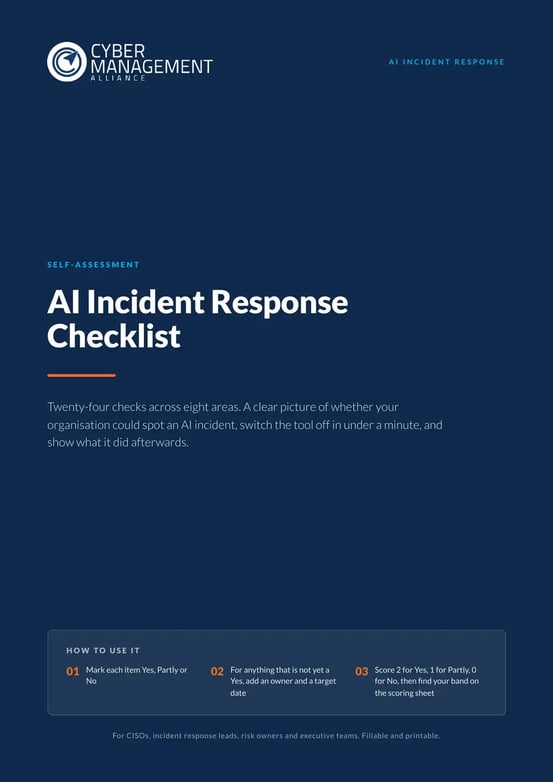
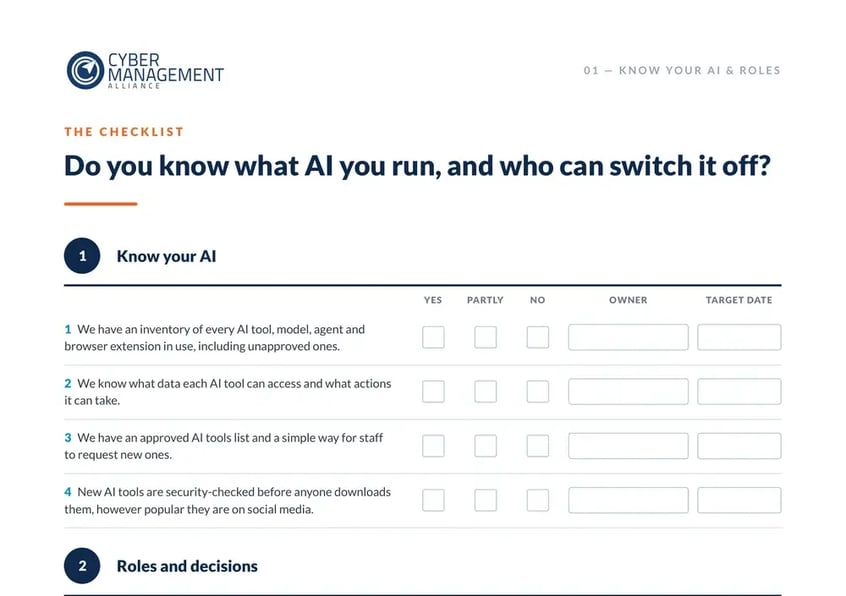
AI Incident Response Checklist cover AI Incident Response Checklist page preview

Our free AI Incident Response Checklist is a self-assessment with 24 checks across eight areas: knowing your AI, roles and decisions, detection, response and containment, suppliers, reporting, recovery and practice. Mark each item Yes, Partly or No, score it out of 48, and find out whether your organisation could spot an AI incident, switch the tool off in under a minute, and show what it did afterwards.

Download Our AI Incident Response Checklist

AI tools, models and agents are now part of everyday work, often faster than security teams can track them. That changes what an incident looks like. It might be a deepfake video call from a “CFO”, a prompt injection that turns an assistant against you, a hijacked agent acting with real permissions, a malicious AI browser extension, or an AI output that is quietly wrong and feeds a business decision.

Most incident response plans were not written with these scenarios in mind. Our checklist gives you a quick, honest picture of where you stand. Each of the 24 items asks a practical question, such as whether you have an inventory of every AI tool in use, whether a named person can disable each one, and whether you could revoke an AI tool’s credentials quickly. Add an owner and a target date for anything that isn’t yet a Yes, then use the scoring sheet to see whether you are Prepared, have Gaps to Close, or are Exposed.

The checklist is fillable and printable, and built for CISOs, incident response leads, risk owners and executive teams. If it shows gaps, our training now covers AI incidents for both groups. CIPR-AI, our Cyber Incident Planning & Response course for the AI era, opens Day 2 with an AI Incident Response module on deepfake fraud, hijacked AI agents and attacks on your AI tools. Our Cyber Crisis & AI Leadership Training for Executives now covers AI-enabled attacks, deepfake impersonation and your own use of AI. And our cyber crisis tabletop exercises let you prove your plans against realistic AI scenarios.

Disclaimer: This checklist has been created to encourage discourse on cybersecurity and good security practices. It is general guidance, not legal or regulatory advice, and does not replace an assessment of your own organisation’s obligations. Cyber Management Alliance takes no responsibility for decisions made solely on the basis of this document.

  • ** GDPR ** We wholeheartedly believe your and our rights to privacy and in the GDPR. The bottom of the page explains how we use your data. 
  • Align with the GDPR requirements.
  • Increase your Breach Readiness.
  • Reduce your time to detect and respond.

Complete the form below to receive a copy of the AI Incident Response Checklist.

What the AI incident response checklist covers

The checklist is organised into eight areas. Here is what each one asks you to check.

1. Know your AI (4 checks)An inventory of every AI tool, model, agent and browser extension, including unapproved ones; what data each can access; an approved tools list; security checks before new tools are downloaded
2. Roles and decisions (4)A named owner and a named person who can disable each tool; who can switch off an AI tool without waiting for a meeting; AI scenarios in your incident response plan; people making the key decisions
3. Detection (4)Logging prompts, outputs and agent actions; monitoring AI API keys, tokens and service accounts; tested detection; a simple way for staff to report suspicious AI behaviour
4. Response and containment (5)Short playbooks for deepfake requests, prompt injection, hijacked agents, malicious AI tools and quietly wrong outputs; second-channel verification; revoking credentials; rolling back changes; a deepfake holding statement
5. Suppliers (2)Contracts covering incident notification, log access and cooperation; out-of-hours contacts at each AI supplier
6. Reporting (1)Mapped reporting duties for AI incidents and a named person who decides whether to notify
7. Recover and learn (2)Reviewing decisions made using affected AI outputs; feeding lessons back into inventory, contracts, controls and training
8. Practise (2)An AI incident tabletop exercise in the last 12 months, including the executive team; structured AI incident training for the response team
Scoring2 for Yes, 1 for Partly, 0 for No, out of 48. 38–48 Prepared; 24–37 Gaps to Close; under 24 Exposed

AI Incident Response Checklist, Version 4.0, November 2026. Last updated 28 November 2026.

FAQs on AI Incident Response

  • What is an AI incident?

    An AI incident is any event where an AI tool, model or agent causes or enables harm, or is misused. Examples include a deepfake request that appears to come from a leader, a prompt injection that manipulates an assistant, a hijacked agent acting with real permissions, a malicious AI tool or extension, and an AI output that is quietly wrong and feeds a business decision.

  • What is in the AI Incident Response Checklist?

    It contains 24 checks across eight areas: know your AI, roles and decisions, detection, response and containment, suppliers, reporting, recover and learn, and practise. Each item is marked Yes, Partly or No, with space for an owner and a target date, and a scoring sheet places your organisation in a readiness band.

  • Who is the checklist for?

    It is written for CISOs, incident response leads, risk owners and executive teams. Security teams can use it to find gaps, while executives can use it to understand whether the organisation could switch off an AI tool quickly and show what it did. It is fillable and printable, so it works well as a workshop or board discussion tool.

  • How is the checklist scored?

    Score 2 for each Yes, 1 for each Partly and 0 for each No, for a maximum of 48. A total of 38 to 48 means Prepared, 24 to 37 means Gaps to Close, and under 24 means Exposed, where an AI incident would rely on people improvising. The scoring sheet suggests where to start for each band.

  • Why does the checklist focus on switching AI tools off quickly?

    Because containment speed matters. If an agent is hijacked or a tool is behaving maliciously, every minute it keeps running can mean more data accessed or more actions taken. The checklist asks whether each AI tool has a named person who can technically disable it, and whether you have agreed who can do so without waiting for a meeting.

  • How can organisations defend against deepfake requests?

    Assume you cannot tell a deepfake by looking or listening. In 2024, engineering firm Arup lost around US$25 million after an employee joined a video call where everyone, including the CFO, was a deepfake. The checklist asks whether staff verify urgent requests from leaders through a second, trusted channel, and whether you have a holding statement ready for a public deepfake.

  • What should we log to investigate an AI incident?

    Where possible, log prompts, outputs and agent actions, and keep those logs long enough to investigate. Monitor the use of AI API keys, tokens and service accounts too. Without these records it is very hard to establish what an AI tool did, which decisions it influenced and what data it touched.

  • Do AI suppliers need to be part of incident response?

    Yes. Many AI tools run on a supplier’s infrastructure, so you may depend on them for logs and cooperation during an incident. The checklist asks whether your AI supplier contracts cover incident notification, access to logs and cooperation, and whether you know who to contact at each supplier, including out of hours.

  • How often should we rehearse an AI incident?

    The checklist asks whether you have rehearsed an AI incident in a tabletop exercise in the last 12 months, including the executive team, and whether your incident response team has had structured AI incident training. Rehearsal is often where gaps in ownership, switch-off routes and communication first become visible.

  • What should we do if we score low?

    Start with the basics. For an Exposed score, name owners and switch-off routes for every AI tool first. For Gaps to Close, the checklist suggests starting with agreeing who can switch off an AI tool fast and testing your detection, then running an exercise. Cyber Management Alliance can help through AI incident tabletop exercises, the CIPR-AI course and AI leadership training for executives.

cyber-essentials-certification
NCSC Certified Training B&W 300px
CSC

We are industry experienced practitioners when it comes to cyber security training & cyber security consultancy services

1487652208_graduationcap

Training

We offer a host of courses including our NCSC Assured Training in Cyber Incident Planning and Response and our NCSC Assured Training in Building and Optimising Incident Response Playbooks.

1487652701_like

Virtual CISO Services

Hands On, full-support 'Security As a Service', specifically designed for organisations that require access to experienced cybersecurity, governance, risk and compliance professionals.

1487652784_calendar-3

Virtual Cyber Assistant

A unique, affordable, subscription-based, cybersecurity service for small to medium businesses, offering 280+ services in cybersecurity.

1487652846_microphone

Cyber Crisis Tabletop Exercises

Scenario-based, verbally-simulated tabletop attack exercises that test your organisation's ability to effectively respond to a cyber-attack.


1487652632_search

Ransomware Tabletop Exercise

Measure your organisation’s Ransomware Readiness with a unique blend of verbal and visual simulations and ransomware scenario walkthroughs.

1487652567_line-chart

Executive Cyber Awareness Sessions

Specially designed for executive management, CEOs and boards of directors, engaging them in a business context to help explain the threats and risks from cyber-attacks.

How we use your data:

  • The form above collects personal information so we may email you the requested information and pressing the "Get your free copy now"  button acts as informed consent for this processing purpose. Consequently we may be in touch to:

    • Update you when we host our ground-breaking Wisdom of Crowds events in your country or region.
    • Keep you posted on free resources and documents around Wisdom of Crowds events and its outputs. (For example, we tend to create insightful mind maps and we also are the creators of free to view Insights with Cyber Leaders Video Interviews. )
    • Ping you a note about upcoming FREE educational webinars on GDPR and Cybersecurity.
    • Inform you of any upcoming Data Breach Response or Cyber Incident Response training.  
  • In its purest interpretation, this act of us communicating with you is direct marketing and is processed on the basis of our legitimate interest and your engaging in our services. All marketing communication will include an unsubscribe button or other method of ending communication.