Educational & easy-to consume visual guides to understanding attacks & enhancing resilience
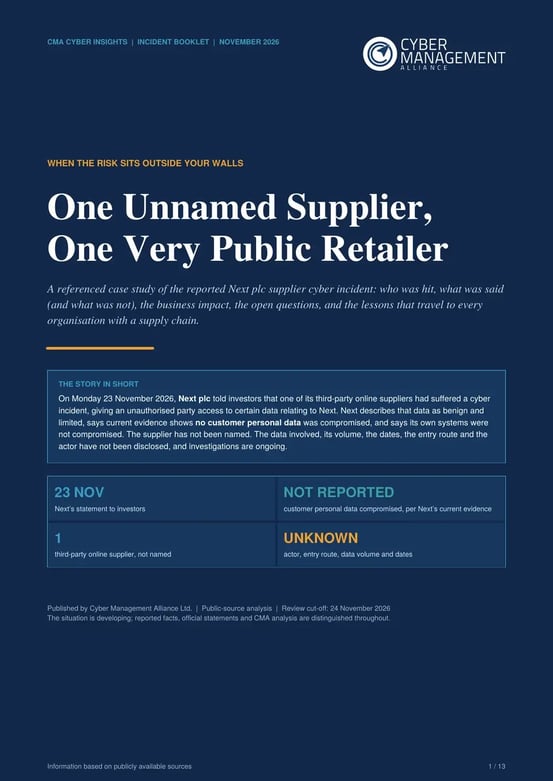
On 23 November 2026, Next plc told investors that one of its third-party online suppliers had suffered a cyber incident, giving an unauthorised party access to certain data relating to Next. Next describes the data as limited and benign, says current evidence shows no customer personal data was compromised and says its own systems were not compromised. Our timeline sets out what has been said, what has not, and what is still unknown.
By Amar Singh, CEO & Founder, Cyber Management Alliance · Last updated
Next did not report an attack on its own systems. It reported something that is in some ways harder to manage: a cyber incident in a supplier’s environment, which the retailer learned about from the supplier. In a statement to investors on Monday 23 November 2026, Next said an unauthorised party had accessed certain data relating to the company, that the data was limited and, on its current assessment, could not be used to facilitate fraud. Shares dipped on the news and then recovered the same morning.
What makes this case worth studying is how much has not been said. The supplier has not been named. What data was accessed, how much, when the supplier was breached and when it told Next have not been disclosed, and no actor or entry route has been reported. Our document separates Next’s own statements from media reporting and open questions, compares the business impact with recent retail incidents, and draws out eight lessons and ten questions to put to your own suppliers.
Your perimeter includes people you do not employ. Discover how incident response playbooks and regular cyber crisis tabletop exercises can prepare your organisation for an incident where the first call comes from a supplier.
Disclaimer: This document has been created with the sole purpose of encouraging discourse on the subject of cybersecurity and good security practices. Our intention is not to defame any company, person or legal entity. Every piece of information mentioned herein is based on reports and data freely available online. Cyber Management Alliance neither takes credit nor any responsibility for the accuracy of any source or information shared herein.
Thanks for submitting the form. Please check your email shortly for a copy of the timeline.

The table below summarises the main facts from our Next supplier data breach timeline. Download the full document for the dated, source-by-source account.
| Organisation | Next plc, the clothing and homeware retailer with more than 800 stores in the UK and Ireland |
|---|---|
| Where it happened | An unnamed third-party online supplier’s environment; Next says its own systems were not compromised |
| When | Disclosed in a statement to investors on Monday 23 November 2026; the dates of the supplier incident and of notification have not been disclosed |
| Data accessed | Certain data relating to Next, described by Next as limited and benign; contents and volume not disclosed |
| Customer data | No customer personal data compromised, according to Next’s current evidence; not independently verified |
| Attacker | Not named; no claim of responsibility in the sources reviewed |
| How they got in | Not reported |
| Response | Next investigating with the supplier, law enforcement and relevant regulators; investigations ongoing |
| Business impact | Shares dipped then recovered (+0.4% by 11:20 GMT on 23 November); no store or online disruption reported; no cost figure published |
Compiled by Cyber Management Alliance from public reporting reviewed to 24 November 2026. Last updated 27 November 2026.
On Monday 23 November 2026, Next plc told investors that one of its third-party online suppliers had suffered a cyber incident. The incident gave an unauthorised party access to certain data relating to Next. The supplier informed Next, which says it took immediate steps to investigate the nature and scope of the incident with the supplier, and is working with law enforcement and relevant regulators. Investigations are ongoing.
Next says it is confident its own systems were not compromised and that the incident sits in the supplier’s environment. That is Next’s own statement; no independent verification has been published. The case is a reminder that an organisation can be at the centre of a data incident story even when its own network is untouched, because the data that was accessed relates to it.
Next says current evidence indicates no customer personal data was compromised, and that the information involved cannot be used to facilitate fraud against customers or the company, on its current assessment. The Guardian reported the data is understood to exclude contact details, addresses, passwords and bank details. None of this has been confirmed independently, and the investigation is ongoing.
Next has not said. It describes the data as “certain benign data relating to NEXT” and as limited, but its contents and volume have not been disclosed. The Register noted that Next did not say what was taken or how much. Our timeline treats “benign” as Next’s own assessment, not a verified finding, and keeps the question open.
The supplier has not been named. Next declined to identify it when asked by The Register. Next’s statement describes it as a third-party online supplier, and some outlets describe it as a technology supplier. Because it is unnamed, other customers of the same supplier cannot easily assess whether they are affected.
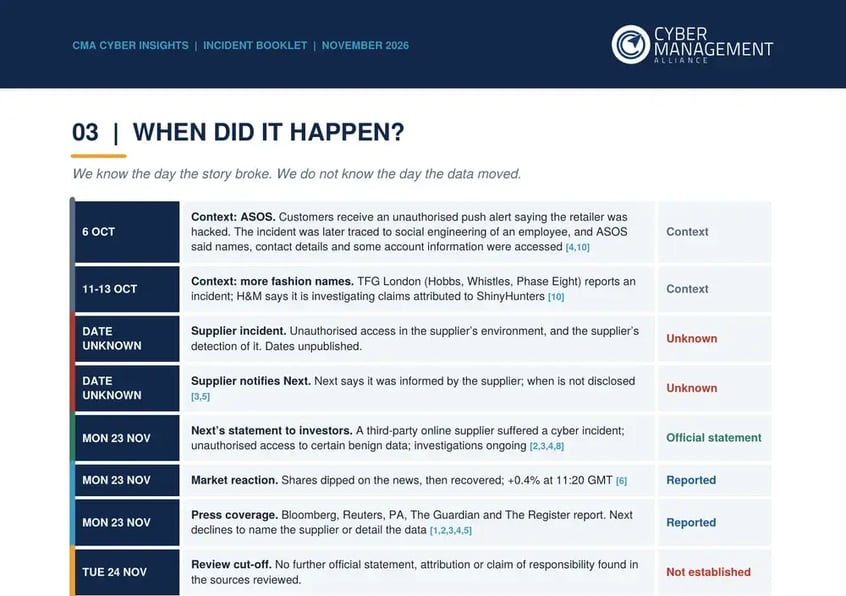
Only the disclosure can be dated. Next’s statement to investors was made on 23 November 2026. When the supplier’s environment was accessed, when the supplier detected it and when it told Next have not been published. Disclosure dates are not attack dates, so our timeline marks those points as unknown.
Neither has been reported. No actor, motive or entry route has been named, and no claim of responsibility was found in the sources reviewed to 24 November 2026. Our timeline discusses credible pathways seen in other supplier incidents, such as stolen credentials or over-broad supplier access, but labels them clearly as analysis, not findings.
Shares dipped on the news and then recovered, standing 0.4% higher by 11:20 GMT on 23 November, according to reporting. No store or online disruption was described in the coverage reviewed, and no cost figure has been published. That is very different from the 2025 M&S and Co-op incidents, which involved operational disruption.
No source we reviewed links them. Several fashion and retail names reported incidents in the weeks before, including ASOS, TFG London and H&M in October 2026, and M&S, Co-op and Harrods in 2025. Our timeline includes them as context only and cautions against reading a campaign into timing alone.
Next says no customer personal data was compromised on current evidence. As general good practice after any publicised incident, Rapid7’s Alan Simpson advised customers to be wary of unexpected emails, texts or calls claiming to be from Next, and to go to the website or app directly rather than clicking links. This is not a sign that customers have been targeted.
Your perimeter includes people you do not employ. Map which suppliers hold data about you, put notification times in hours into contracts, limit and expire supplier access, and agree in advance what counts as low-risk data. Above all, rehearse a scenario where the first call comes from a supplier. Cyber Management Alliance helps through incident response training, playbooks and cyber crisis tabletop exercises.
We offer a host of courses including our NCSC Assured Training in Cyber Incident Planning and Response and our NCSC Assured Training in Building and Optimising Incident Response Playbooks.

Hands On, full-support 'Security As a Service', specifically designed for organisations that require access to experienced cybersecurity, governance, risk and compliance professionals.

A unique, affordable, subscription-based, cybersecurity service for small to medium businesses, offering 280+ services in cybersecurity.

Scenario-based, verbally-simulated tabletop attack exercises that test your organisation's ability to effectively respond to a cyber-attack.