

What is the PCI DSS Incident Response Document Library?
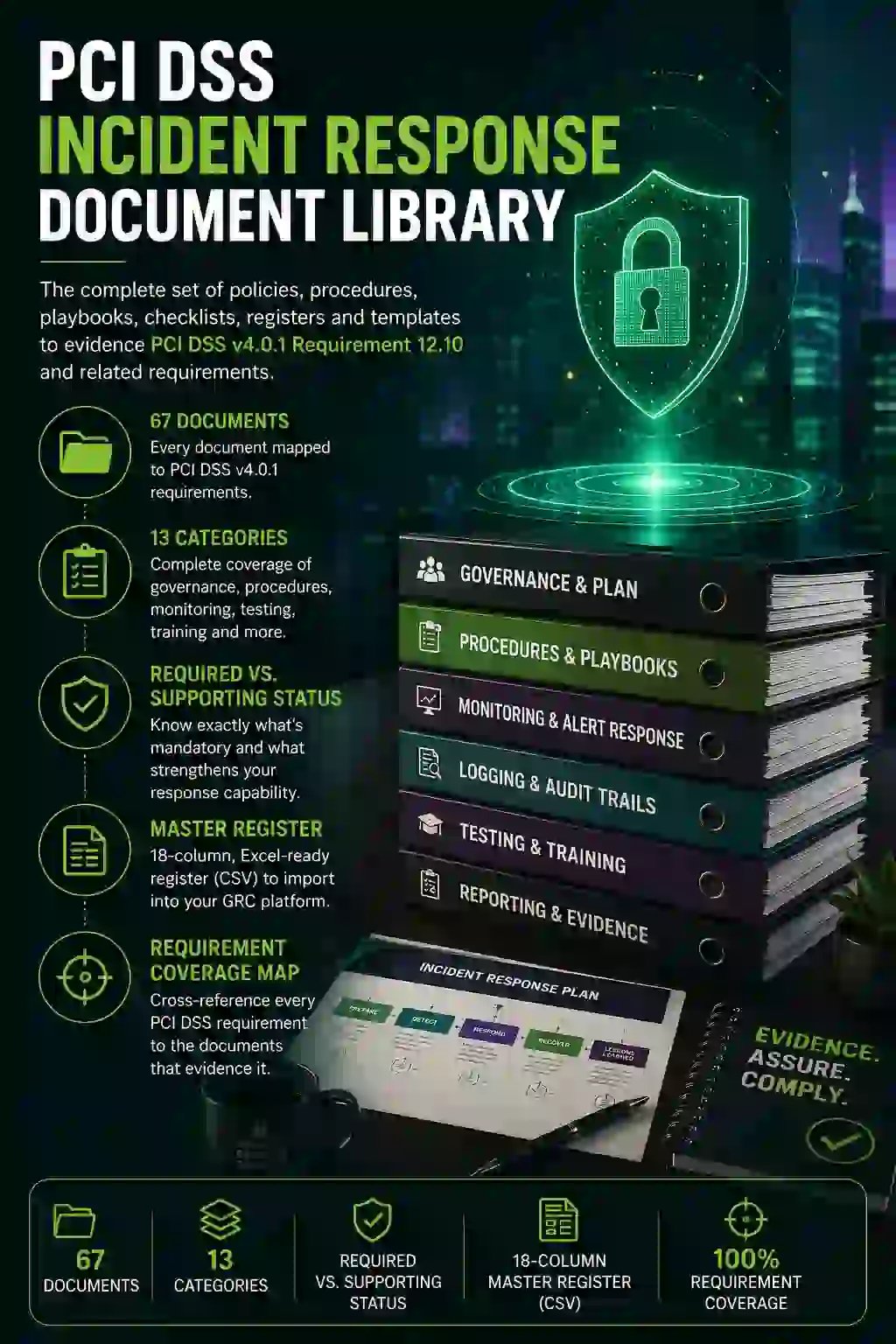
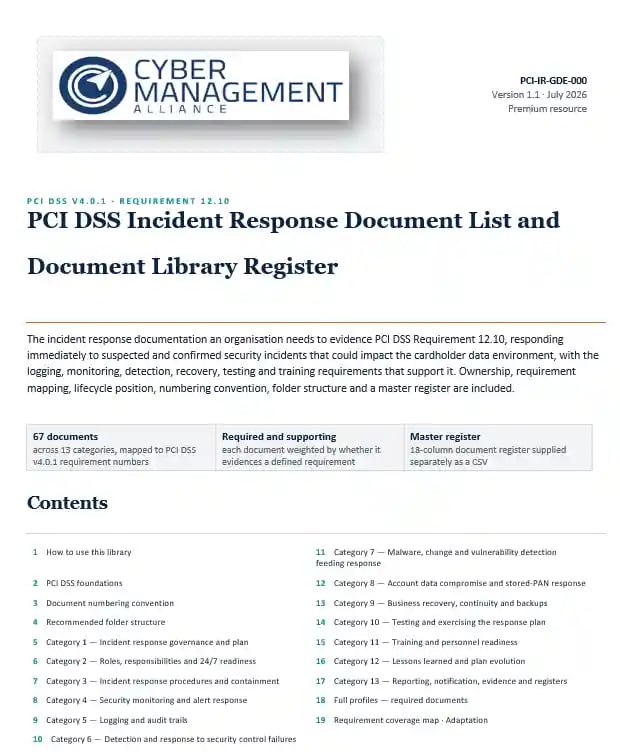
The PCI DSS Incident Response Document Library is the complete inventory of policies, procedures, playbooks, checklists, registers, logs and templates an organisation needs to evidence PCI DSS v4.0.1 Requirement 12.10 — responding immediately to suspected and confirmed security incidents that could impact the cardholder data environment (CDE) — together with the logging, monitoring, detection, recovery, testing and training requirements that feed into it.
Rather than starting from a blank page or reverse-engineering what an assessor expects to see, you start from a structured library of 67 documents across 13 categories, each mapped to the specific PCI DSS v4.0.1 requirement number it evidences. Every document carries a clear status — Required by PCI DSS or Supporting evidence — so you know at a glance which artefacts an assessor expects to find and which ones strengthen your response capability without being the primary evidence for a requirement on their own.
What's Inside?
|
Component |
Detail |
|
67 documents |
Every document in the library, mapped to PCI DSS v4.0.1 requirement numbers. |
|
13 categories |
Governance & Plan, Roles & 24/7 Readiness, Procedures & Containment, Security Monitoring & Alert Response, Logging & Audit Trails, Control Failure Detection & Response, Malware/Change/Vulnerability Detection, Account Data Compromise & Stored-PAN Response, Business Recovery & Continuity, Testing & Exercising, Training & Personnel Readiness, Lessons Learned & Plan Evolution, and Reporting/Notification/Evidence & Registers. |
|
Required vs. supporting status |
Each document is weighted by whether it directly evidences a defined requirement (e.g., the incident response plan under 12.10.1, the annual test under 12.10.2, 24/7 personnel under 12.10.3) or supports the response capability more broadly. |
|
Numbering convention |
A structured PCI-IR-[TYPE]-[NNN] scheme across 15 document types — policies, standards, procedures, plans, forms, checklists, registers, reports, testing documents, logs, playbooks, matrices, records, guides, assessments and templates. |
|
Master register (CSV) |
An 18-column, Excel-ready register supplied separately, pre-populated with all 67 documents for import into Excel, SharePoint or your GRC platform. |
|
Requirement coverage map |
A cross-reference from every PCI DSS requirement number back to the specific document IDs that evidence it. |
Why Does This Library Exist
Requirement 12.10 is deceptively short to read and unusually demanding to evidence. It doesn't just ask for "an incident response plan". Its sub-requirements (12.10.1 through 12.10.7) separately demand a documented plan with specific elements, an annual review and test, 24/7 responder availability, risk-based training frequency, structured response to monitoring alerts, lessons-learned-driven plan evolution, and a defined process for when stored account data turns up somewhere it shouldn't. Each of those sub-requirements pulls in supporting evidence from elsewhere in the standard — audit logging (Requirement 10), intrusion detection and change monitoring (Requirement 11), anti-malware and patching (Requirements 5 and 6), and third-party responsibility (12.8 and 12.9).
Treating "the IR plan" as a single document misses this entirely. The library exists to give you the full evidentiary chain an assessor will actually walk through, categorised so nothing sits orphaned outside a clear owner and a clear requirement reference.
The 13 Categories
- Incident response governance and plan: The policy, the plan itself, and the standards that define classification, severity and CDE scope.
- Roles, responsibilities and 24/7 readiness: The RACI, the on-call roster, and the contact list that make 12.10.1 and 12.10.3 auditable.
- Incident response procedures and containment: The handling procedure and the incident-type playbooks (account data compromise, malware/ransomware, network intrusion, rogue wireless, payment page tampering).
- Security monitoring and alert response: The monitoring standard, alert register, triage SOP and escalation matrix that turn detection into structured response under 12.10.5.
- Logging and audit trails: The logging standard, protection and retention policies, and time-synchronisation procedure that make investigation possible under Requirement 10.
- Detection and response to security control failures: The procedure and log evidencing prompt response to failed critical security controls under 10.7.
- Malware, change and vulnerability detection feeding response: Response procedures for anti-malware, file integrity, payment-page tamper and vulnerability alerts.
- Account data compromise and stored-PAN response: The 12.10.7 procedure and checklist for when account data is found where it shouldn't be.
- Business recovery, continuity and backups: The recovery plan, backup procedure and restoration plan that satisfy the recovery elements of 12.10.1.
- Testing and exercising the response plan: The test programme, tabletop template and annual review record that evidence 12.10.2.
- Training and personnel readiness: The training plan, register and the targeted risk analysis that sets training frequency under 12.10.4.1.
- Lessons learned and plan evolution: The post-incident review, root cause analysis and the register tracking plan changes to completion under 12.10.6.
- Reporting, notification, evidence and registers: The legal reporting analysis, payment brand and acquirer notification templates, and the master incident and evidence registers a QSA reviews.
Numbering Convention and Folder Structure
Every document is identified as PCI-IR-[TYPE]-[NNN], where the type code reflects its function — POL (policies), STD (standards), PRO (procedures), PLN (plans), FRM (forms), CHK (checklists), REG (registers), RPT (reports), TST (testing documents), LOG (logs), PLY (playbooks), MTX (matrices), REC (records), GDE (guides), ASM (assessments) and TPL (templates). IDs never change and are never reused, which keeps cross-references and audit trails stable as documents are revised.
The recommended folder structure mirrors the 13 categories, with a 14th folder held separately, access-restricted and retention-enforced, for closed incident files, notifications and evidence.
Two Things Specific to PCI DSS
Unlike NIS2 or DORA, PCI DSS sets no fixed external reporting clock of its own. Notification of payment brands and acquirers, and any legal reporting, follows the payment brands' own programmes and applicable law, so the notification documents in this library are framed around that reality rather than a fixed hour count.
Second, every reference in the library is to a PCI DSS v4.0.1 requirement number only; the standard's own text is not reproduced here, and this library is not a substitute for consulting the standard or a QSA's assessment.
Full Document Profiles
The documents that evidence Requirement 12.10 most directly — including the Security Incident Response Plan (PLN-001), the Incident Response Plan Content Checklist (CHK-001), and the Incident Response Roles and Responsibilities Matrix (MTX-002) — are specified in full, each profiled across consistent fields: purpose, PCI DSS requirement mapping, primary and secondary owners, intended users, trigger for use, required inputs and outputs, key contents, evidence for assessment, approval sign-off, review frequency, retention, version control, linked documents, and adaptation notes. Every remaining document in the register carries the same structural fields at register level, so ownership and review status are never ambiguous.
Key Benefits
- One controlled source of truth. The 18-column PCI DSS Incident Response master register keeps ownership, PCI DSS requirement mapping, review frequency and status in a single maintained list, rather than scattered across a shared drive.
- Assessment-ready by design. Every document's status — Required or Supporting — tells you in advance what an assessor expects to see versus what strengthens the response capability without being primary evidence.
- Built around how PCI DSS actually cross-references itself. Requirement 12.10's sub-clauses pull in logging, monitoring, detection and third-party requirements from across the standard; the library's categories follow that dependency chain instead of treating 12.10 in isolation.
- You save weeks of drafting. Rather than building 67 documents from a blank page, your team adapts a professionally structured, pre-mapped set.
- A stable numbering and folder convention. IDs never change or get reused, so audit trails, cross-references and version history stay coherent as the library evolves with your organisation.
** GDPR & Privacy ** We wholeheartedly believe in your and our rights to privacy and in the GDPR. The bottom of the page explains how we use your data.
Please Fill the Form Below To Get Your Free Copy of the PCI DSS Incident Response Document Library


We are industry experienced practitioners when it comes to cyber security training & cyber security consultancy services

Training
We offer a host of courses including our NCSC Assured Training in Cyber Incident Planning and Response and our NCSC Assured Training in Building and Optimising Incident Response Playbooks.

Virtual CISO Services
Hands On, full-support 'Security As a Service', specifically designed for organisations that require access to experienced cybersecurity, governance, risk and compliance professionals.

Virtual Cyber Assistant
A unique, affordable, subscription-based, cybersecurity service for small to medium businesses, offering 280+ services in cybersecurity.

Cyber Crisis Tabletop Exercises
Scenario-based, verbally-simulated tabletop attack exercises that test your organisation's ability to effectively respond to a cyber-attack.