Educational & easy-to consume visual guides to understanding attacks & enhancing resilience
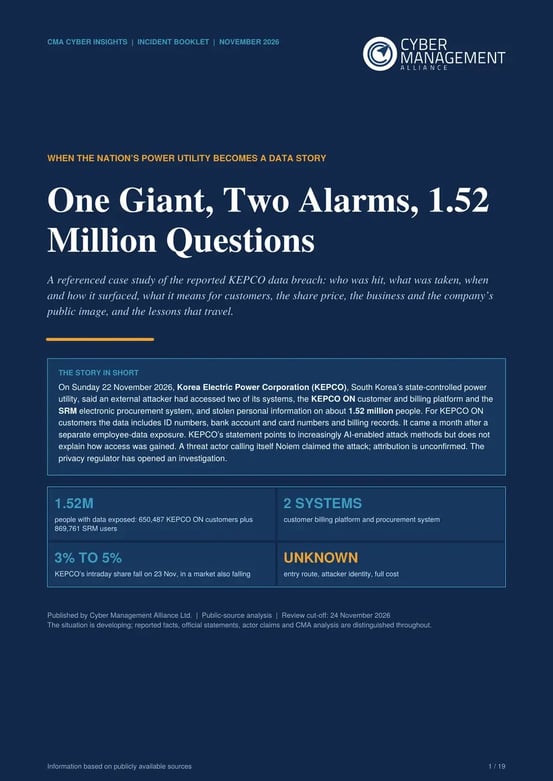
On 22 November 2026, Korea Electric Power Corporation (KEPCO), South Korea’s state-controlled power utility, said an external attacker had accessed its KEPCO ON billing platform and its SRM procurement system and stolen personal data on about 1.52 million people. For 650,487 customers that includes ID numbers, bank account and card numbers. How the attacker got in has not been disclosed. Our timeline sets out what is known, what is claimed and what is still unknown.
By Amar Singh, CEO & Founder, Cyber Management Alliance · Last updated
KEPCO is not a typical data breach victim. It is the company that keeps South Korea’s lights on, and its customer billing and supplier platforms touch millions of households and businesses. On Sunday 22 November 2026 it said an attacker had taken identity, bank and card details from KEPCO ON and personal details of company representatives and staff from its SRM procurement system. It was the second KEPCO data incident in about a month, after an employee-data exposure in October.
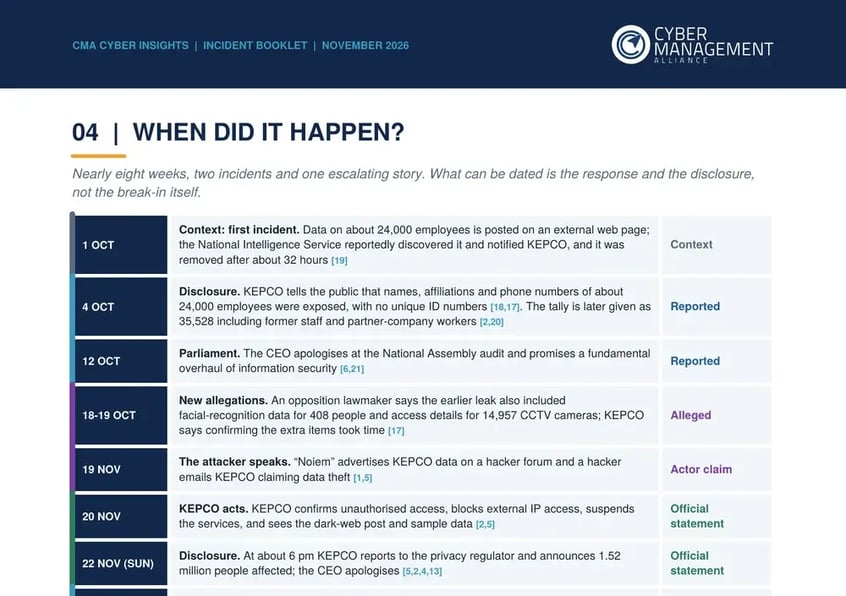
The sequence matters. A threat actor calling itself Noiem advertised KEPCO data on a hacker forum, and the privacy regulator says KEPCO received a hacker’s email claiming data theft, on 19 November, three days before KEPCO’s public statement. KEPCO’s statement points to AI-enabled attack methods but does not say how access was gained, and attribution is unconfirmed. Our document separates official statements, media reporting and actor claims, looks at the impact on customers, the share price, the business and KEPCO’s reputation, and draws out eight lessons and ten questions for your own organisation.
A second incident soon after a first is a scenario few organisations rehearse. Discover how incident response playbooks and regular cyber crisis tabletop exercises can prepare your team to detect, contain and disclose a breach with confidence.
Disclaimer: This document has been created with the sole purpose of encouraging discourse on the subject of cybersecurity and good security practices. Our intention is not to defame any company, person or legal entity. Every piece of information mentioned herein is based on reports and data freely available online. Cyber Management Alliance neither takes credit nor any responsibility for the accuracy of any source or information shared herein.
Thanks for submitting the form. Please check your email shortly for a copy of the timeline.
The table below summarises the main facts from our KEPCO data breach timeline. Download the full document for the dated, source-by-source account.
| Organisation | Korea Electric Power Corporation (KEPCO), South Korea’s state-controlled power utility and a major critical infrastructure operator |
|---|---|
| Systems affected | KEPCO ON, the customer billing and payment platform, and SRM, the electronic procurement system |
| When | Hacker forum post and email to KEPCO on 19 November 2026; KEPCO confirmed the incident on 20 November and announced it on Sunday 22 November. The date of initial access has not been disclosed |
| People affected | 1,520,248: 650,487 KEPCO ON customers, 426,827 company representatives and 442,934 KEPCO and company employees on SRM |
| Data exposed | Customers: ID numbers, phone, address, bank account and card numbers, billing data. Representatives: name, ID number, email, company address. Staff: contact and employee details. Passwords are not among the listed items |
| Attacker | A threat actor calling itself Noiem claimed the attack on a hacker forum; attribution is unconfirmed |
| How they got in | Not disclosed; KEPCO’s statement cites increasingly AI-enabled attack methods without technical detail |
| Response | External IP access blocked and services suspended; regulator notified; joint investigation with the National Intelligence Service and others; police referral planned; individual notices and a helpline |
| Business impact | Shares fell 3% to 5% early on 23 November in a market that also fell (KOSPI −3.32%); no cost estimate published; privacy regulator investigating |
Compiled by Cyber Management Alliance from public reporting reviewed to 24 November 2026. Last updated 27 November 2026.
On Sunday 22 November 2026, KEPCO said an external attacker had accessed two of its systems, the KEPCO ON customer billing platform and the SRM electronic procurement system, and stolen personal data on about 1.52 million people. KEPCO says it confirmed the incident on 20 November, blocked external IP access and suspended the affected services. The privacy regulator began an on-site investigation on 23 November.
KEPCO counts 1,520,248 people: 650,487 KEPCO ON customers, about 7.1% of the platform’s 9.2 million users, plus 869,761 SRM users. The SRM group is 426,827 company representatives and 442,934 KEPCO and company employees. KEPCO treats all SRM users as exposed because it says the individual scope is hard to pin down.
For KEPCO ON customers, KEPCO lists 12 items including name, ID number, phone, address, bank name, account number, card issuer, card number and billing information. For company representatives it lists name, ID number, email and company address, and for staff their contact and employee details. Passwords, card security codes and expiry dates are not among the published items.
That is unconfirmed. A threat actor calling itself Noiem advertised KEPCO data on a hacker forum on 19 November, and the regulator says KEPCO received a hacker’s email claiming data theft the same day. No authority has confirmed who carried out the intrusion. Noiem also claims to hold supplier records and bidding documents, which KEPCO has not confirmed.
KEPCO has not said. Its statement refers to increasingly sophisticated, AI-enabled attack methods and presumes an external attacker broke in, but gives no technical detail. Our timeline discusses credible pathways, such as misused credentials, a flaw in an internet-facing application or trusted supplier access, clearly labelled as analysis rather than findings.
No. In early October 2026, data on employees was found on an external web page and later reported as affecting 35,528 people including former staff and partner-company workers. KEPCO’s CEO apologised at a parliamentary audit. No source we reviewed links the October exposure to the November breach.
KEPCO reported the incident to the privacy regulator and announced it publicly at about 6 pm on Sunday 22 November 2026, around three days after the hacker’s forum post and email. Disclosure dates are not attack dates: when the attacker first got in and how long they stayed have not been published.
KEPCO shares fell between 3% and 5% early on Monday 23 November, according to Korean financial media. The whole market was also falling, with the KOSPI closing down 3.32%, so the breach’s own effect cannot be isolated. KEPCO’s weaker third-quarter results and tariff policy remain bigger long-term drivers.
The privacy regulator says it will check KEPCO’s safeguards and notification compliance and act if violations are found. Korea’s Personal Information Protection Act allows fines of up to 3% of revenue, and recent cases such as SK Telecom and Coupang drew large penalties. No penalty has been proposed for KEPCO, and those cases are context, not a forecast.
KEPCO and the regulator advise people not to click unfamiliar links, install unknown apps or share verification codes, and to report suspicious contacts. As general good practice, check bank and card statements, contact your bank if anything looks wrong, and verify any message claiming to be from KEPCO through the official app or the 123 call centre.
Hold less sensitive data in one place, give contractors their own expiring accounts, and make sure you would spot bulk data leaving before an attacker emails you. Disclose every known data category early, and verify that fixes from one incident actually closed the door before the next. Cyber Management Alliance helps through incident response training, playbooks and cyber crisis tabletop exercises.
More free incident timelines and Cyber Insights from Cyber Management Alliance:
See every report on our Cyber Attack Timelines page.
We offer a host of courses including our NCSC Assured Training in Cyber Incident Planning and Response and our NCSC Assured Training in Building and Optimising Incident Response Playbooks.

Training
Hands On, full-support 'Security As a Service', specifically designed for organisations that require access to experienced cybersecurity, governance, risk and compliance professionals.

Virtual CISO Services
A unique, affordable, subscription-based, cybersecurity service for small to medium businesses, offering 280+ services in cybersecurity.

Virtual Cyber Assistant
Scenario-based, verbally-simulated tabletop attack exercises that test your organisation's ability to effectively respond to a cyber-attack.

Cyber Crisis Tabletop Exercises
Measure your organisation’s Ransomware Readiness with a unique blend of verbal and visual simulations and ransomware scenario walkthroughs.
Ransomware Tabletop Exercise
Specially designed for executive management, CEOs and boards of directors, engaging them in a business context to help explain the threats and risks from cyber-attacks.
Executive Cyber Awareness Sessions