
Date: 15 October 2026
.webp?width=1170&name=Cybersecurity_Training_Room_With_Large_Screen_1100x400%20(1).webp)
The right incident response certification depends on where you are now. A first SOC role, a structured handling process and senior forensic investigation each call for a different pathway. We compared seven certification pathways that prepare responders for real incidents based on practical investigation, evidence handling and exam format over brand recognition, and checked every figure against official provider pages on 14 October 2026.
Training, the exam and the credential are separate purchases with some providers. Read each exam format alongside the syllabus before you commit study time.
Key Takeaways
- FOR508 / GIAC GCFA is the top pick for technically prepared responders who need enterprise-scale forensic depth.
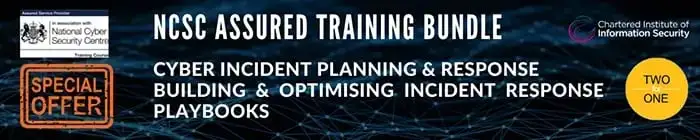
- CM-Alliance's NCSC Assured Cyber Incident Planning and Response course is the definitive training programme which covers response planning and regulated reporting under DORA, NIS2 and GDPR, with no prerequisites.
- BTL1 suits first defensive roles, with no exam entry requirements and a 24-hour practical exam.
- SEC504 / GIAC GCIH covers broad incident handling across Windows, Linux and cloud targets.
- IR-200 / OSIR assesses investigation through a proctored exam plus a written report.
- ECIH teaches a structured handling process but requires a year of security experience.
- CHFI focuses on forensic methodology, from chain of custody to cloud and mobile evidence.

What Are Incident Response Certifications?
Incident response certifications are credentials that test whether you can detect, scope, contain and recover from a security incident. Some also test whether you can preserve evidence and report findings. They differ from general security certifications in one way: the assessment centres on what you do once an attack is already under way.
GCIH, for example, tests the PICERL and DAIR incident handling processes, while GCFA tests memory, timeline and file system analysis.
Most programmes still reference NIST guidance. NIST finalised SP 800-61 Revision 3 in April 2025, which superseded the 2012 Computer Security Incident Handling Guide and aligned incident response with the Cybersecurity Framework 2.0.
The credentials in this guide fall into three groups:
- Practical exams, where you investigate a live environment (BTL1, OSIR).
- Proctored question-based exams with hands-on elements, such as GIAC's CyberLive format (GCFA, GCIH).
- Multiple-choice exams that follow lab-based training (ECIH, CHFI), plus CIPR’s optional multiple-choice exam.
How We Picked the Certifications
We ranked each pathway on five points: curriculum depth, hands-on lab volume, exam format, entry requirements and renewal terms. Every exam spec, lab count and price comes from the issuer’s own page, checked on 14 October 2026.
Forensic depth decided the top pick. Readiness for a first defensive role shaped the entry-level pick.
We kept training format and exam format apart, because they often differ. Several published comparisons still list retired exam lengths and question counts, so I relied only on current issuer specs. This is an editorial comparison, not a test of learning outcomes. We left out provider-wide review scores, because they rate the company rather than a specific course or credential.
Incident Response Certifications Compared
|
Pathway |
Best for |
Hands-on training |
Exam format |
Renewal |
Starting price (USD unless stated) |
|
FOR508 / GIAC GCFA |
Enterprise forensics and IR |
35 labs, 6 days or 36 self-paced hours |
82 questions, 3 hours, 71% pass, CyberLive |
36 CPEs every 4 years |
$8,780 (self-paced course) |
|
CIPR (NCSC Assured) |
Response planning and regulated reporting |
19 modules with interactive exercises |
Optional: 30 questions, 25 minutes, 50% pass |
Not Expiration Date |
$499 onwards |
|
BTL1 |
First SOC or blue team role |
23 browser labs, 100 lab hours |
24-hour practical, one free resit |
None, certified for life |
£399 (training and exam) |
|
SEC504 / GIAC GCIH |
Broad incident handling |
44 labs, 6 days or 38 self-paced hours |
106 questions, 4 hours, 69% pass, CyberLive |
36 CPEs every 4 years |
$8,780 (self-paced course) |
|
IR-200 / OSIR |
Investigation and reporting |
Course labs, 90-day bundle access |
8-hour proctored exam plus 24 hours to report |
Every 3 years |
$1,749 (course and exam bundle) |
|
ECIH |
Structured handling process |
95 labs across 22 scenarios |
100 multiple-choice questions, 3 hours |
120 ECE credits every 3 years |
$999 (on-demand) |
|
CHFI |
Forensic methodology and evidence |
68 labs, 5-day course |
150 multiple-choice questions, 4 hours |
120 ECE credits every 3 years |
$1,699 (on-demand) |
GIAC certification attempts are added to course purchases separately. ECIH and CHFI prices are from EC-Council's North America pages.

The Seven Pathways, Ranked
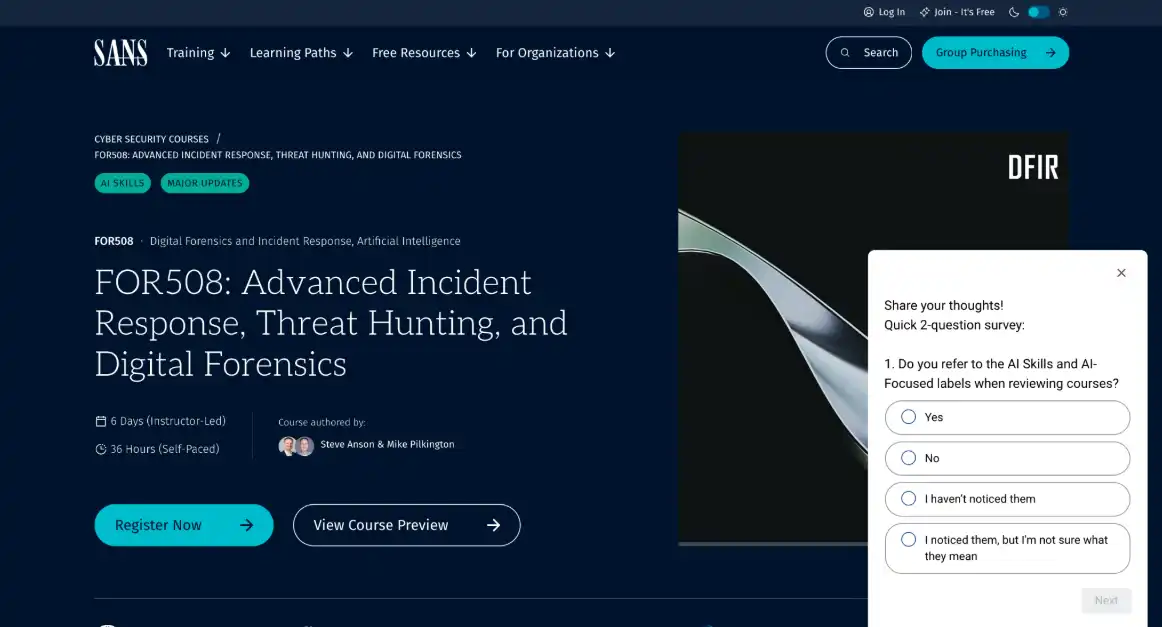
1. FOR508 / GIAC GCFA
Pros
- 35 hands-on labs and a capstone investigation across more than 30 systems
- Memory forensics, timeline analysis and anti-forensics detection map directly to GCFA objectives
- AI-assisted analysis taught with human review checkpoints
- In-person, live virtual or self-paced delivery: six days or 36 self-paced hours
Cons
- Does not cover IR policy basics; a Windows forensics background is recommended first
- Windows enterprise focus suits mobile-only investigators less well
Why we picked it
FOR508 earns first place for teaching responders to scope a breach, track lateral movement and contain an intruder across Windows enterprise networks. Its final challenge has you reconstruct a full intrusion, from initial access to data theft.
For a forensics-led route into incident response, the SANS Institute DFIR catalogue maps its courses to eleven GIAC certifications, and FOR508 is the one aimed at senior responders and threat hunters.
The course and the GCFA exam are separate purchases; attending does not confer certification.
Exam and renewal: GCFA is a proctored exam of 82 questions in 3 hours, with a 71% pass mark and CyberLive hands-on testing. You get 120 days from activation to sit it, and renewal needs 36 CPE credits over four years.
Pricing: The self-paced course lists at $8,780 with four months of access, before local taxes. A GCFA attempt is an optional add-on at checkout.
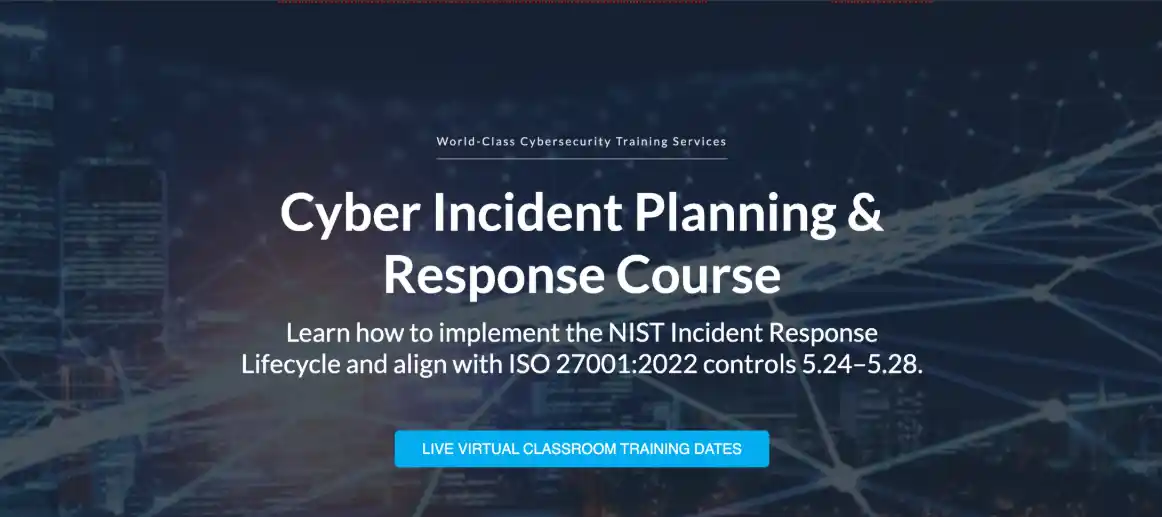
2. NCSC Assured Cyber Incident Planning & Response (CIPR)
Pros
- No prerequisites; built for technical and non-technical staff
- 19 modules with interactive exercises, worksheets, templates and checklists
- Teaches NIST SP 800-61 Revision 3 and ISO 27001:2022 controls 5.24 to 5.28
- Covers regulated reporting under DORA, NIS2, GDPR and the UK Cyber Assessment Framework
Cons
- The optional exam is a short multiple-choice test, not a practical investigation
- Planning and coordination focus rather than hands-on forensic tooling
Why we picked it
We picked this cyber incident planning course for responders who coordinate an incident rather than run the tools. It covers threat actor profiling, the Cyber Kill Chain, the “golden hour”, team building, forensics policy and crisis communications.
Its regulated response modules teach you to classify incidents, track reporting clocks and build audit-ready decision logs. The course is NCSC Assured and accredited by the Chartered Institute of Information Security (CIISec).
Exam and renewal: The optional APMG International exam has 30 multiple-choice questions in 25 minutes, with a 50% pass mark, proctored online by ProctorU. The course page does not list a renewal cycle.
Pricing: Delivery options are self-paced eLearning with 60 days of content access, a live virtual classroom, or private in-house training. Prices start around $499.
3. Blue Team Level 1 (BTL1)
Pros
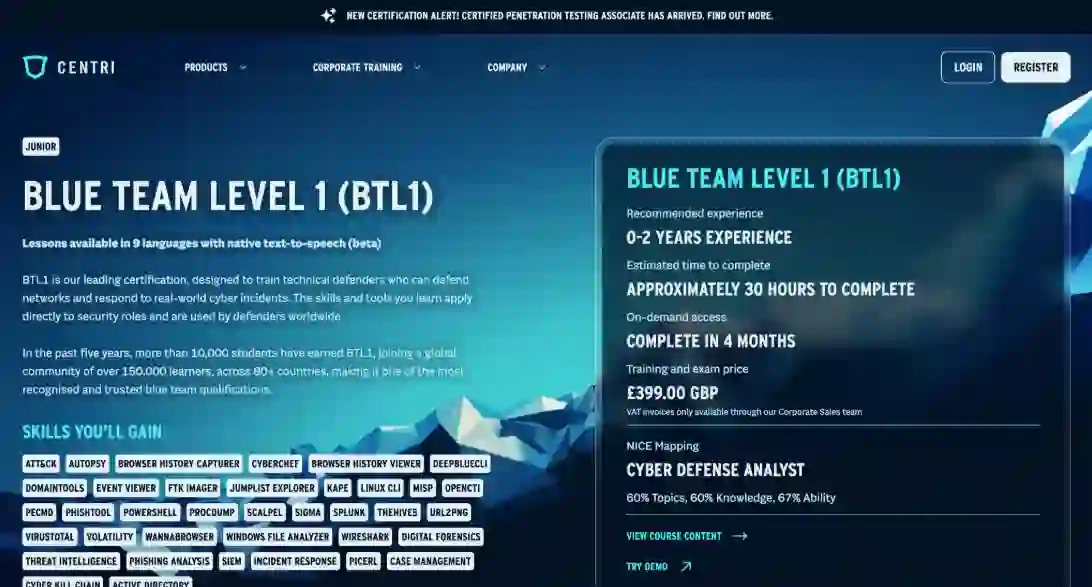
- No exam entry requirements; aimed at people with up to two years of experience
- Phishing analysis, threat intelligence, digital forensics, SIEM and incident response in one course
- 23 browser labs with 100 hours of lab access, using tools such as Splunk, Volatility, Autopsy and KAPE
- 24-hour practical incident response exam with one free resit
Cons
- Four months of access to course material
- Broad junior scope rather than specialist forensic depth
Why we picked it
Centri, formerly Security Blue Team, positions BTL1 as its junior defensive certification. We picked it because it pairs forensics, SIEM and phishing work with an exam where you investigate a live incident rather than answer recall questions.
That makes it a practical first step before a specialist course such as FOR508. The provider rebranded on 1 June 2026, and the certification kept the BTL1 name.
Exam and renewal: The 24-hour practical exam is graded on submission, with detailed feedback. BTL1 is a lifetime certification with no renewal cycle.
Pricing: Training and one exam attempt cost £399.00, including the free resit voucher. Student, military and corporate discounts are available.
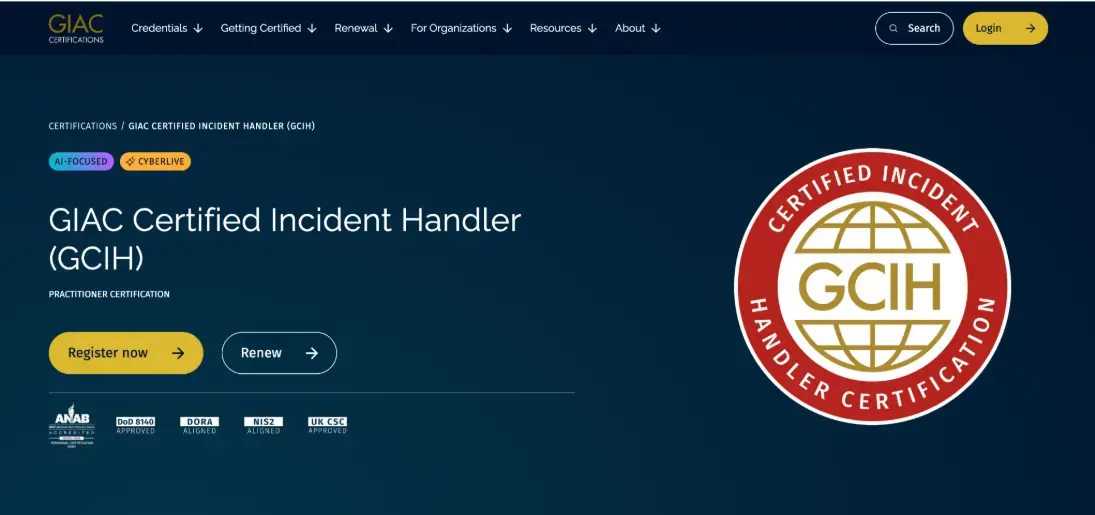
4. SEC504 / GIAC GCIH
Pros
- 44 hands-on labs plus a full-day capture-the-flag event against Windows, Linux, IoT and cloud targets
- Teaches the Dynamic Approach to Incident Response (DAIR) for verifying, scoping and containing threats
- Covers cloud attacks in Azure and AWS, Microsoft 365 compromise and prompt injection against AI systems
- Essential skill level: six days or 38 self-paced hours
Cons
- Expects comfort with TCP/IP, Windows and Linux command lines
- Heavy on attacker tools, which suits responders more than evidence-focused examiners
Why we picked it
GCIH is built for incident handlers, team leads and first responders, and SEC504 is the course GIAC lists for preparing it. We picked it for breadth: your run attacks yourself, then hunt for the traces they leave in logs, memory and network data.
It also fills a gap many roundups leave open, covering cloud and AI-related incidents alongside traditional endpoint response.
Exam and renewal: GCIH is a proctored exam of 106 questions in 4 hours, with a 69% pass mark and CyberLive hands-on testing. Renewal needs 36 CPE credits over four years.
Pricing: The self-paced course lists at $8,780 with four months of access, before local taxes. A GCIH attempt is an optional add-on at checkout.
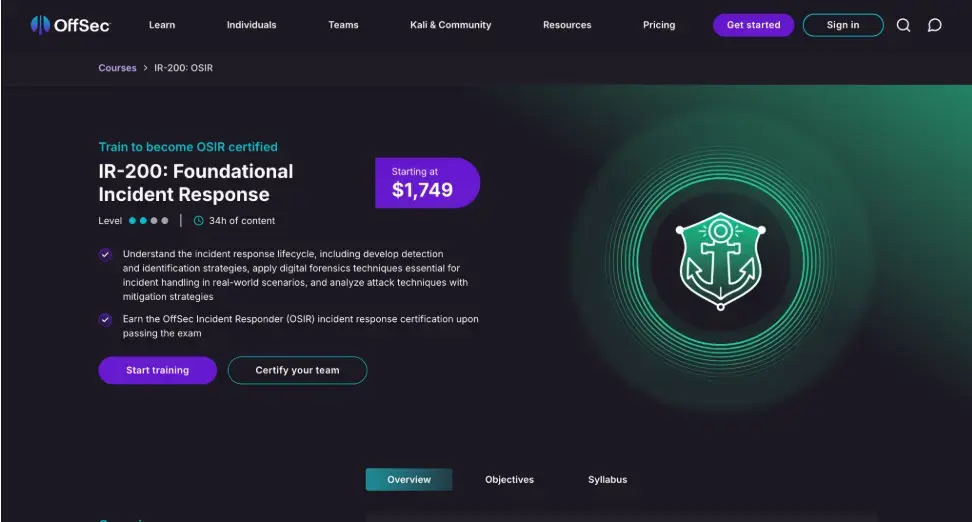
5. OffSec IR-200 / OSIR
Pros
- Modules on communication plans, case management, digital forensics for responders and active containment
- Grounded in NIST SP 800-61, with coverage of the CREST and NIST response frameworks
- Exam combines hands-on investigation with a professional written report
Cons
- Bundle access lasts 90 days, so study time is tight
- The credential expires after three years unless renewed
Why we picked it
We picked IR-200 for its emphasis on the non-technical half of response: communicating during a crisis, managing cases and documenting findings. Its exam tests the same balance.
Points are awarded for correct answers and for how completely your report documents them.
That makes OSIR a good fit for responders who will write the incident report, not just run the tools.
Exam and renewal: OSIR is an 8-hour proctored exam, with 24 hours afterwards to submit the report and a 50-point pass mark.
It is open book, except for AI chatbots. Renewal options are a qualifying exam, a recertification exam or 120 CPE credits plus a $145 annual maintenance fee.
Pricing: The Course + Cert Bundle lists at $1,749 for 90 days and one exam attempt. Learn One costs $2,749 a year for annual access and two attempts, and it auto-renews unless cancelled.
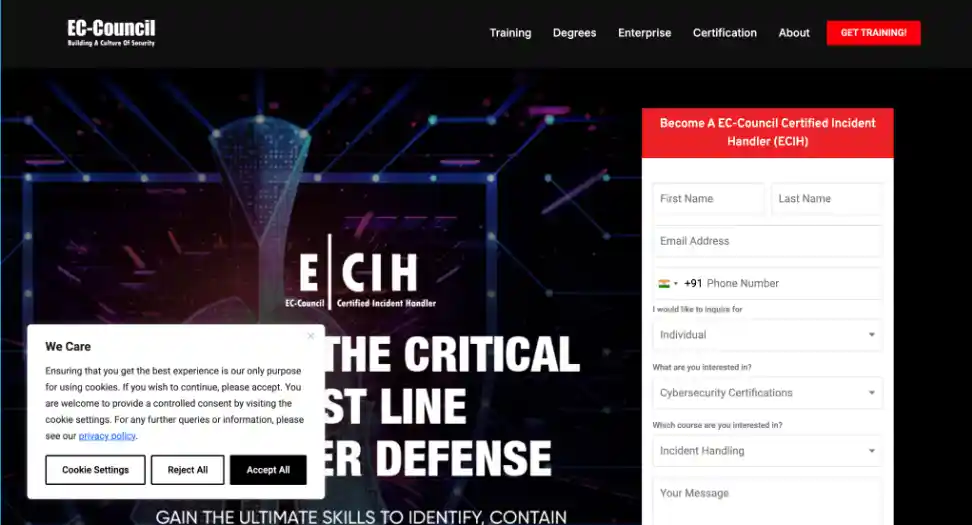
6. EC-Council ECIH
Pros
- Ten modules covering malware, email, network, web application, cloud, insider and endpoint incidents
- 95 labs delivered through 22 scenario-based exercises, with half of class time spent in labs
- 125 templates, checklists and toolkits plus playbooks and runbooks
- ANAB-accredited and approved under US DoD Directive 8140
Cons
- Requires at least one year of cybersecurity experience
- The exam is multiple choice rather than an investigative practical
Why we picked it
We picked ECIH for its structured, nine-stage handling process, from preparation and triage through containment, eradication and post-incident review. It suits responders who want to move from panic to process with a repeatable method and the paperwork that comes with it.
EC-Council positions ECIH for mid-level and senior professionals, not beginners, so newcomers should start with a junior pathway first.
Exam and renewal: The exam has 100 multiple-choice questions in 3 hours. Certification is valid for three years, renewed with 120 EC-Council Continuing Education (ECE) credits and an annual $80 fee.
Pricing: On-demand training starts at $999 and live online training at $1,399 on EC-Council's North America page. Prices vary by region.
7. EC-Council CHFI
Pros
- Evidence handling from search and seizure through chain of custody, acquisition, preservation, analysis and reporting
- 68 labs with more than 70 GB of crafted evidence files
- Cloud forensics for AWS, Azure and Google Cloud, plus mobile, IoT and dark web modules
- ANAB-accredited and approved under US DoD Directive 8140
Cons
- Expects basic knowledge of IT security, forensics and incident response
- Breadth may exceed what an incident coordinator needs
Why we picked it
CHFI earns its place for responders whose evidence may face legal scrutiny. Its methodology covers how to preserve and document evidence so it remains admissible, alongside the technical investigation.
Compare that coverage with the evidence-handling duties in your role before choosing it over a response-led pathway.
Exam and renewal: Exam 312-49 has 150 multiple-choice questions in 4 hours, with a pass mark between 60% and 85% depending on the exam form. Renewal follows the same three-year, 120-credit ECE cycle as ECIH.
Pricing: On-demand training starts at $1,699, live online at $2,499 and in-person at $3,299 on EC-Council's North America page. Prices vary by region.
How to Choose the Right Pathway
Start with your experience, then match the exam format to the work you will actually do. If your role leans more toward coordinating a response than investigating one, cyber incident planning and response training can cover playbooks, escalation and decision-making before you commit to a technical certification.
- New to defensive work: BTL1 has no entry requirements and tests you in a practical exam. SEC504 is the next step once you are comfortable on the command line.
- Handling incidents day to day: SEC504 / GCIH gives the broadest technical coverage. ECIH suits teams that want a documented, repeatable process and already have a year of experience.
- Leading investigations or threat hunts: FOR508 / GCFA adds memory, timeline and enterprise-scale analysis.
- Writing the incident report: IR-200 / OSIR grades your written findings as part of the exam.
- Handling evidence that may reach court: CHFI concentrates on preservation and chain of custody.
Cloud-heavy teams should check how much provider telemetry each course covers. SEC504 includes Azure and AWS attack labs, ECIH has a cloud incident module, and CHFI covers acquisition from AWS, Azure and Google Cloud.
Whatever you choose, practise between study sessions. Free tools carry over between pathways: Volatility, for example, is taught in both FOR508 and BTL1, so a home lab built around it pays off twice.
FAQs
Can you earn an incident response certification without security experience?
Yes, but choose carefully. BTL1 has no exam entry requirements and targets people with up to two years of experience. ECIH, by contrast, requires at least one year of cybersecurity work.
Do incident response certifications expire?
Most do. GIAC credentials need 36 CPE credits every four years, EC-Council credentials need 120 ECE credits every three years, and OSIR expires after three years. BTL1 is a lifetime certification.
Which certifications include a practical exam?
BTL1 uses a 24-hour practical investigation, and OSIR combines an 8-hour hands-on exam with a written report. GCFA and GCIH add CyberLive hands-on testing to proctored question-based exams.
Which pathway is best for cloud incidents?
None of the seven is cloud-only. SEC504 includes Azure and AWS attack labs, ECIH has a module on Azure, AWS and Google Cloud incidents, and CHFI teaches forensic acquisition across all three providers.
GIAC also offers a dedicated cloud credential, the GIAC Cloud Forensics Responder (GCFR).

Conclusion
FOR508 / GCFA and CM-Alliance's NCSC-Assured Cyber Incident Planning & Response (CIPR) Training stand out as two of the strongest choices for cybersecurity professionals looking to advance their incident response capabilities. While FOR508 / GCFA is particularly well-suited to technically experienced responders seeking advanced digital forensics and intrusion analysis skills, CM-Alliance's CIPR Training offers a practical, strategic approach to cyber incident preparedness, response planning, crisis management and regulatory reporting.
For organisations and professionals focused on building comprehensive incident response capabilities, CM-Alliance's CIPR Training is a particularly compelling choice. Its emphasis on real-world incident scenarios, actionable response plans and regulatory alignment makes it especially relevant for teams responsible for organisational cyber resilience. FOR508 / GCFA, meanwhile, remains a leading option for specialists looking to deepen their technical forensic investigation expertise.
Other worthwhile options include BTL1 for beginners, SEC504 / GCIH for broader incident handling skills, IR-200 / OSIR for technical reporting, ECIH for structured incident response processes and CHFI for digital forensic evidence handling.
Ultimately, GCFA and CM-Alliance's CIPR Training emerge as two standout recommendations, addressing complementary but equally critical aspects of effective cyber incident response: technical investigation and organisational preparedness.
Before enrolling, confirm the latest prerequisites, course formats, assessment requirements and certification terms directly with the respective training providers.
.webp)


.webp)