Hero Background
World-Class Cybersecurity Professionals at your Service

Technical Resilience Assessment: Measure Your IT Resilience

Know how well your critical systems can withstand, respond to and recover from serious disruption — and exactly what to fix first.


BOOK A DISCOVERY CALL

What Is a Technical Resilience Assessment?

A Technical Resilience Assessment (TRA) is a structured, practitioner-led evaluation of how well a defined technology domain — a platform, application environment or critical system — can withstand, respond to and recover from serious disruption.
 
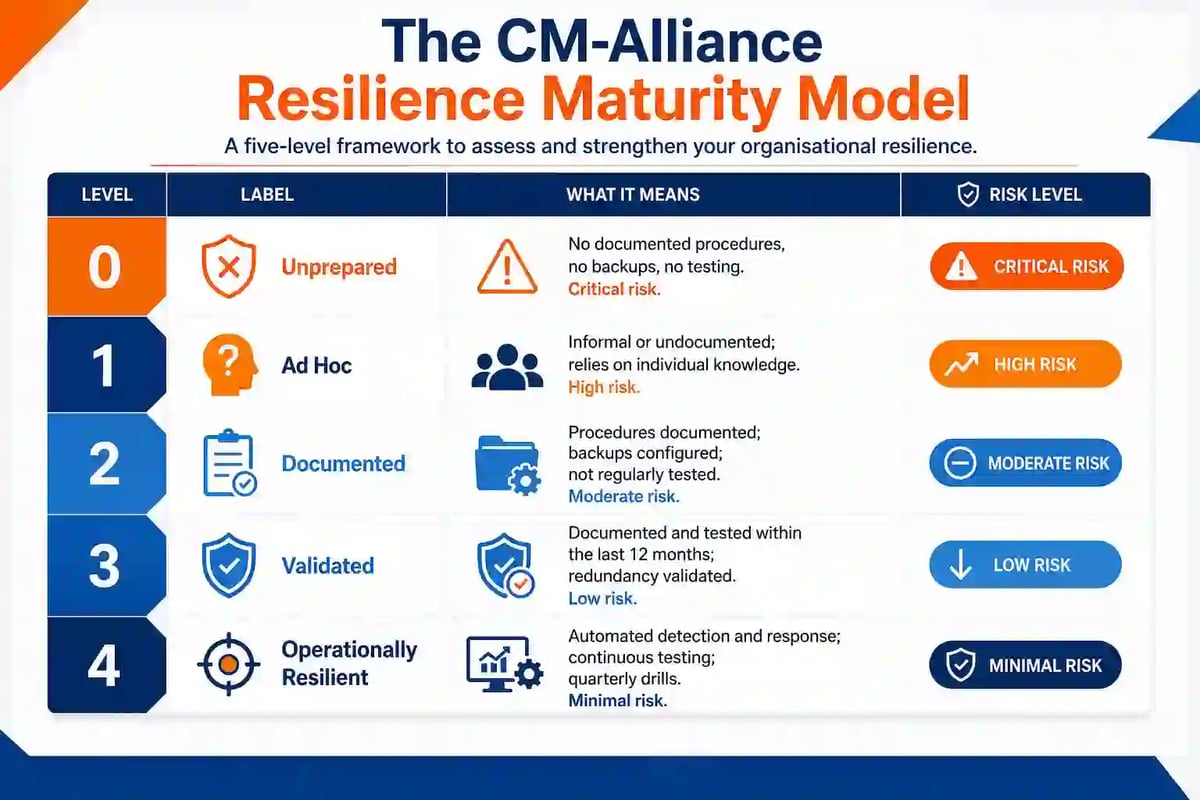
It is an assessment, not an audit. There are no pass/fail grades, no blame and no box-ticking. Instead, your technical teams work through realistic, advanced and catastrophic failure scenarios with our facilitators, describing how they would detect, respond and recover. Capability is then scored against the CM-Alliance Resilience Maturity Model, a five-level framework ranging from Level 0 (Unprepared) to Level 4 (Operationally Resilient).
 
The Technical Resilience Assessment gives your IT, cyber, infrastructure and application teams an evidence-based view of current resilience capability. It identifies where resilience is strong, where recovery depends on undocumented knowledge, where concentration risks exist, and where investment will have the greatest impact.

This is especially valuable for organisations that have completed tabletop exercises and now want to understand the underlying technical resilience that sits behind their crisis response plans. 
 
Unlike a questionnaire or a document review, the TRA is interactive by design. The people who actually build, run and recover your critical systems are in the room — so the findings reflect reality, not paperwork.
 
The result: An honest, evidence-based picture of your current resilience, a defensible maturity baseline, and a prioritised, costed remediation roadmap your IT teams can act on immediately.

Why Should Your Organisation Conduct a Technical Resilience Assessment?

Most organisations only discover how resilient their technology really is during an actual crisis. At this point, it's usually too late to fix anything. A TRA lets you find out the gaps in your technical capabilities safely, collaboratively and before disruption strikes. Here are the main reasons organisations commission one:

Reason #1: You can't improve what you haven't measured

Resilience is often assumed rather than evidenced. A TRA gives you a defensible maturity baseline for each critical domain, scored on a consistent 0–4 model. This allows improvement to be tracked, budgeted and proven over time.

Reason #2: Hidden single points of failure and concentration risk

Multiple critical applications often depend on a single platform, database or third party. The TRA is specifically designed to show concentration risk and missing exit strategies before they bite — a common finding we uncover.

Reason #3: Tabletop exercises test the day; TRA measures capability

Tabletop exercises show how your people respond in a moment of crisis. A TRA measures the resilience beneath the response and gives you a prioritised path to improve it. It's the logical next step after tabletops, and a strong starting point if you haven't run them.

Reason #4: Rising regulatory expectations

Regulatory expectations continue to rise, particularly for financial services firms under the FCA/PRA operational resilience regime (PS21/3, SS1/21) and, where EU exposure exists, DORA. TRA produces the technical evidence that underpins those conversations.

Reason #5: Prioritised investment, not a wish list

Every recommendation comes with a rationale, timeline, effort/cost estimate and resource requirements so your IT leadership can sequence remediation and defend budget requests with evidence. 

Reason #6: It builds confidence, not fear

The TRA records strengths as well as gaps. Teams leave the process with recognition of what's working, clarity on what isn't, and morale intact — because it's blame-free by design.

CAF Assessment

How the Technical Resilience Assessment Works


Minimal demand on your team. Maximum insight.


  1. Scoping conversation. A short call to define the domain to assess (e.g. an application hosting platform, a payments environment) and who should take part.

  2. A single focused session. One to two hours, facilitated by experienced practitioners. Your technical and IT leads work through realistic advanced and catastrophic disruption scenarios — platform loss, data exfiltration, infrastructure dependency failure and more.

  3. Evidence-based scoring. Every finding is labelled (verbal) or (documented) and scored against the five-level CM-Alliance Resilience Maturity Model.

  4. Your report, delivered. Detailed technical findings, evidence observed, areas of strength, and a consolidated table of prioritised recommendations with timelines, effort and ownership. 

  5. Re-assess to prove progress. An annual re-assessment (or after material change) evidences your movement up the maturity levels — and the return on your remediation investment.

We handle all preparation, facilitation and reporting. Your team's only commitment is the session itself.

MORE INFO

Who should take part in a TRA?


A Technical Resilience Assessment is designed for the people who build, run, support and recover your critical technology services.

Recommended participants include:

  • Head of IT
  • Infrastructure leads
  • Application owners
  • Cloud/platform owners
  • Database administrators
  • Cyber security leads
  • Service owners
  • Disaster recovery leads
  • Business continuity representatives
  • Technical supplier managers where relevant

The best participants are the people who understand the systems in practice: the teams who know how the platform is built, how it fails, how it is monitored and how it would be recovered under pressure.

TRA (1)

What makes our Technical Resilience Assessment different?


Most assessments tell you how exposed you are. Our Technical Resilience Assessment goes further by showing how each finding affects technical resilience, recovery capability and the organisation’s ability to maintain critical services.

The assessment is:

Practitioner-led: Facilitated by experienced resilience and cyber practitioners.
Scenario-based: Built around realistic disruption scenarios rather than abstract questionnaires.
Evidence-informed: Findings are based on facilitated discussion and supporting evidence where available.
Maturity-scored: Capability is assessed against a defined resilience maturity model.
Remediation-focused: Recommendations are practical, prioritised and aligned to technical ownership.
Collaborative, not punitive: The purpose is to find improvement opportunities, not blame individuals.


Know how resilient your critical systems really are

Most organisations believe they understand their critical systems until disruption exposes hidden dependencies, undocumented recovery steps or assumptions about failover, backups, logging or supplier support.

A TRA helps answer questions such as:

- Could this critical platform continue operating if a major component failed?
- Do we know how to recover the service, or does recovery depend on one or two individuals?
- Are recovery procedures documented, tested and understood?
- Could we detect and investigate application-layer compromise or data exfiltration?
- Are infrastructure, application, database and security responsibilities clear during a crisis?
- Do we have a plan if a critical platform becomes unsupported, compromised or commercially unviable?


What You Receive from a Technical Resilience Assessment

Detailed technical findings

for the assessed domain, with evidence for every conclusion.

A defensible maturity baseline

(Level 0–4) per scenario, to measure future progress against.

Prioritised, costed recommendations

each with rationale, timeline, effort, required resources, implementation steps and success criteria. 

A consolidated remediation roadmap

mapping every action to a clear owner and priority.

Recognition of strengths

a balanced picture that builds team confidence, not just a list of gaps.

A board-ready companion option

the Operational Resilience Assessment (ORA) translates these same findings into business impact, growth implications and regulatory relevance for executive audiences.


Resilience Maturity Model

 Capability is scored against our proprietary five-level framework 


Key Benefits of a Technical Resilience Assessment


Clear visibility into your real recovery capability

Understand how prepared your critical systems are to withstand, respond to and recover from serious disruption. 

Recognition of strengths as well as gaps

Build confidence by documenting what is working well, not just what needs improvement. 

Identify concentration risk early

Single platforms, shared dependencies and missing exit strategies get exposed before they cause outages. 

Prioritise with confidence

Receive clear, practical recommendations mapped to technical ownership, effort and priority.

Strengthen incident detection

Identify visibility gaps (e.g. application-layer logging) that would blind you during a real compromise. 

Minimal disruption

The actual Technical Resilience Assessment is one focused session of 1–2 hours; we do the rest.

Evidence for regulators, insurers and customers

Establish a measurable starting point that can be reassessed after remediation or material change.


Better detection and investigation capability

Identify whether your teams can detect, triage and investigate application-layer compromise, data exfiltration or unusual user behaviour. 


When Should You Conduct a Technical Resilience Assessment?


A TRA is valuable when your organisation needs evidence of technical resilience, confidence in recovery capability or a clear path to reduce technology risk.


Good triggers include:


- Before launching a new critical digital service
- After a major platform, cloud or infrastructure change
- After a cyber incident, outage or near miss
- Before or after a tabletop exercise
- During operational resilience programme delivery
- When preparing for board or risk committee reporting
- When a critical supplier, platform or application is changing
- When technical recovery processes have not been tested recently
- When regulated growth depends on technology availability and control

Technical Resilience Assessment FAQs

  • 1. What is a Technical Resilience Assessment (TRA)?

    A TRA is a structured, practitioner-led assessment of how well a defined technology domain can withstand, respond to and recover from serious disruption. Your technical teams work through realistic failure scenarios with our facilitators, and capability is scored against the five-level CM-Alliance Resilience Maturity Model, producing a maturity baseline and a prioritised remediation roadmap.

  • 2. How is a TRA different from an audit or penetration test?

    A TRA is an assessment, not an audit. It's collaborative, blame-free and built to find improvement, not fault. Unlike a penetration test, which probes for exploitable vulnerabilities, the TRA evaluates your capability to detect, respond to and recover from disruption, including catastrophic scenarios a pen test can't safely simulate.

  • 3. How much of my team's time does it take?

    Each assessment is a single focused session of one to two hours with your technical and IT leads. We handle all preparation, facilitation and reporting, so demand on your team is deliberately minimal.

  • 4. What scenarios does the Technical Resilience Assessment cover?
    Scenarios are tailored to the domain being assessed, but typically include catastrophic platform failure or unavailability, application-layer data exfiltration or compromise, and infrastructure dependency failure. Each scenario tests detection, response and recovery capability.
  • 5. What is the CM-Alliance Resilience Maturity Model?

    It's our proprietary five-level scoring framework, ranging from Level 0 (Unprepared — no procedures, no backups, no testing) to Level 4 (Operationally Resilient — automated detection and response with continuous testing). Every scenario in your TRA receives a maturity score against this model, giving you a consistent, defensible baseline.

  • 6. What do we actually receive at the end?

    A confidential report containing detailed findings with evidence, a maturity score per scenario, documented areas of strength, and a consolidated set of prioritised recommendations — each with rationale, timeline, effort/cost, required resources, implementation steps and success criteria.

  • 7. Is this a questionnaire or document review?

    No. The TRA is interactive by design. It's a facilitated, scenario-based discussion with the people who actually run your critical systems in the room. Documentation supports the assessment, but findings are based on real capability, not paperwork alone.

  • 8. We've already run tabletop exercises. Why do we need a TRA?

    Tabletops test how you respond on the day; a TRA measures the underlying resilience — architecture, documentation, recovery capability and detection visibility — and gives you a prioritised improvement path. It's the natural next step after tabletop exercises.

  • 9. Who should attend the TRA session?

    Your technical and IT leads for the domain being assessed: typically application owners, infrastructure and platform engineers, database administrators and IT operations. These are the people who build, run and recover the systems, so their input drives accurate findings.

  •  10. Will individuals or teams be blamed for gaps?
    No. The TRA is explicitly blame-free. Its purpose is to measure capability and identify improvement opportunities collaboratively — not to apportion blame or grade individuals. The report also records areas of strength, so teams get a balanced, confidence-building picture. 
  • 11. How often should we repeat the assessment?

    We recommend re-assessing each domain annually, or sooner after any material change to the platform, its dependencies or the applications it hosts. Re-assessment evidences your movement up the maturity levels and demonstrates the return on your remediation investment.

  • 12. How does the TRA relate to the Operational Resilience Assessment (ORA)?

    They're standalone, companion assessments sharing the same evidence base and maturity scoring. The TRA serves technical teams with detailed remediation; the ORA translates the same findings into business impact, growth implications and regulatory relevance for board and risk-committee audiences. Take either on its own, or both — having done one, the other is the natural next step.

 
Client Feedback

Listen to what our clients have to say about our consultancy services

"In order for BMJ to the right way forward we looked for a VCISO to advise us on the right way to do things and give us expertise. We went to Cyber Management Alliance and it's been about a year now and we ran workshops, looked at our response to incidents, created the incident response plan and we are in a position now where we understand our way forward. Our VCISO keeps us on our toes and overall it's been a very effective way of delivering expertise into the organisation that we wouldn't have normally had."

Aaron Townsend, Service Delivery Manager, British Medical Journal  


Ready to Measure Your Technical Resilience?

It starts with a short scoping conversation — we'll define the domain to assess, agree the scenarios, and confirm who should be in the room. One session. One clear roadmap.

Let us show you why our clients trust us and love working with us.
All trademarks, service marks, trade names, product names, service names and logos appearing on the site, or on printed or digital material are the property of their respective owners, including in Cyber Management Alliance Ltd. Any rights not expressly granted herein are reserved.
Footer Top Background Image
Simply fill in your details to request a FREE callback