
A Cyber Attack Tabletop Exercise for Technical Staff validates your technical team's ability to handle and respond to a real cyber-attack. The IT Crisis Simulation deep dives into your technical abilities and the individual skills of team members to successfully mitigate the damage that a cybersecurity incident can cause.
Technical teams sit on the frontline of cybersecurity defences. The increasing complexity and number of cyber-attacks necessitates practical, engaging, and comprehensive training methods. Our Cyber Attack Tabletop Exercises for technical and IT staff are structured scenarios that help technical staff anticipate, identify, and respond to cyber threats in a controlled, risk-free environment. These exercises are pivotal in bridging the gap between theoretical knowledge and real-world cyber attack readiness.
During the actual technical Incident Response exercise, all participants are put under pressure to think and act like they would in the event of a real world cybersecurity attack. Through the discussions that take place, the facilitator evaluates the skills and knowledge of each team member with respect to the Incident Response plans and processes of the organisation. In the Technical Cyber Security Drill, specifically, the technical knowledge as well as the participants' familiarity with the technical controls and technology tools becomes apparent.
Find out more about our different categories of Cyber Tabletop Exercises and Cyber Tabletop Exercise Pricing
A tabletop exercise is only as good as the participants. The ideal audience for a Technical Cyber-Attack Tabletop Exercise is listed below:
Technical Cyber Tabletop Exercises are crucial for testing and improving your organisation’s incident response capabilities. Businesses often face significant challenges in bringing together technical and non-technical teams for a unified response to cyber threats. Below are key obstacles that technical cyber drills can address:
Overreliance on technical tools can lead to delayed threat detection and misinterpretation, weakening response efforts. Cyber drills help technical teams assess the true effectiveness of these tools and uncover blind spots or areas that need human intervention.
Many organisations have single points of failure like key personnel with exclusive system access. Overlooked supply chain risks such as third-party vendors with insecure APIs are another frequent concern. Technical cyber drills expose these vulnerabilities effectively, encouraging technical teams to build proactive detection and response strategies.
The technical team may often overlook the most current and emerging cyber threat scenarios. Technical Cyber Drills focus on novel attack vectors such as AI-driven phishing attacks and zero-day exploits. They help technical teams adapt to evolving tactics of threat actors such as ransomware with data exfiltration or double extortion.
It is not uncommon for technical teams to lose sight of larger business requirements such as regulatory compliance. Technical Cyber Drills ensure compliance with cybersecurity regulations (PCI DSS, GDPR, DORA etc.), improve documentation, and provide an audit trail of preparedness efforts.
Technical teams often resist simulated cyber attack drills due to fear of blame, skepticism, or reluctance to interrupt daily tasks for 'hypothetical' incident preparation. However, drills conducted by cybersecurity experts can uncover significant blind spots and demonstrate the value that these exercises bring to IT and technical teams.
A professionally conducted technical cyber drill has numerous benefits and related outcomes for both the organisation and the tabletop participants.
Some of these include:
As the name suggests, a technical tabletop exercises tests and validates the effectiveness of your existing tools and technical controls. Most importantly, it helps your technical teams and analysts to respond effectively and efficiently to a cyber-attack. It bolsters overall IT incident management.
The most important element in an organisation's cybersecurity posture is the human element. The Cyber Attack Simulation exercise is one of the most accurate ways to improve the technical competencies of your Incident Responders and enhance technical team's cyber incident readiness.
A Technical Tabletop Exercise takes a close & hard look at your technology infrastructure. We deep dive into the existing technology and processes and dig for gaps and loopholes that most urgently need to be plugged. Essentially, it's almost like a Penetration Test minus the exorbitant costs.
Working with the client we create detailed Cyber Attack Workflows. The workflow is implemented along with a dynamic and evolving attack scenario which is made all the more realistic through injects over time. This keeps the technical staff motivated & makes the exercise a true test of your IT team's mettle.
The biggest benefit of a Technical Tabletop Exercise is that it leads to peace of mind and confidence in the technical team. The management of the organisation can rest easy knowing that the technical team has been trained and tested in responding effectively to a cyber-attack.
For businesses in specific countries & industries, it is mandatory to demonstrate the efficacy of technical controls in dealing with a cyber attack. A Technical Cyber Crisis Drill helps you achieve compliance with any such regulatory requirement applicable to your business.
Our Technical Cyber Security Drills are a great way to validate your organisation's technical capability to handle a cyber-attack. Our unique and detail-oriented approach to technical tabletop exercises means they come as close as possible to a Penetration Test without actually being one - that's also what makes them cost-effective.
Here is why our technical cyber drills are unique and effective:
Here are some specific features of the Technical Cyber Tabletop Drill conducted by Cyber Management Alliance that makes them stand out in the market:
Unlike a generic Cyber Tabletop Exercise, a Technical Tabletop Exercise requires deep analytical and technical skills during the planning stage as it is geared specifically towards a technical audience.
We spend a lot of time working on the technical attack scenario and related questions to ensure relevancy.
Our goal is to challenge the technical Incident Responders.
We leverage detailed Cyber Attack Workflows during the Technical Tabletop Workshop.
This makes the exercise intense and productive with a razor-sharp focus on the actual 'response'. We delve deep into what technical response they elicit at each stage.
This helps the team build insight and muscle memory for when the business is under an actual attack and damage needs to be controlled in real time.
Our Technical Cyber Attack Tabletop Exercises are facilitated by deeply experienced practitioners.
They have been deep in the trenches themselves through their work in technical & Incident Response teams across multiple organisations.
The attack scenario, the questions asked and the discussions facilitated could not be more real and thought provoking.
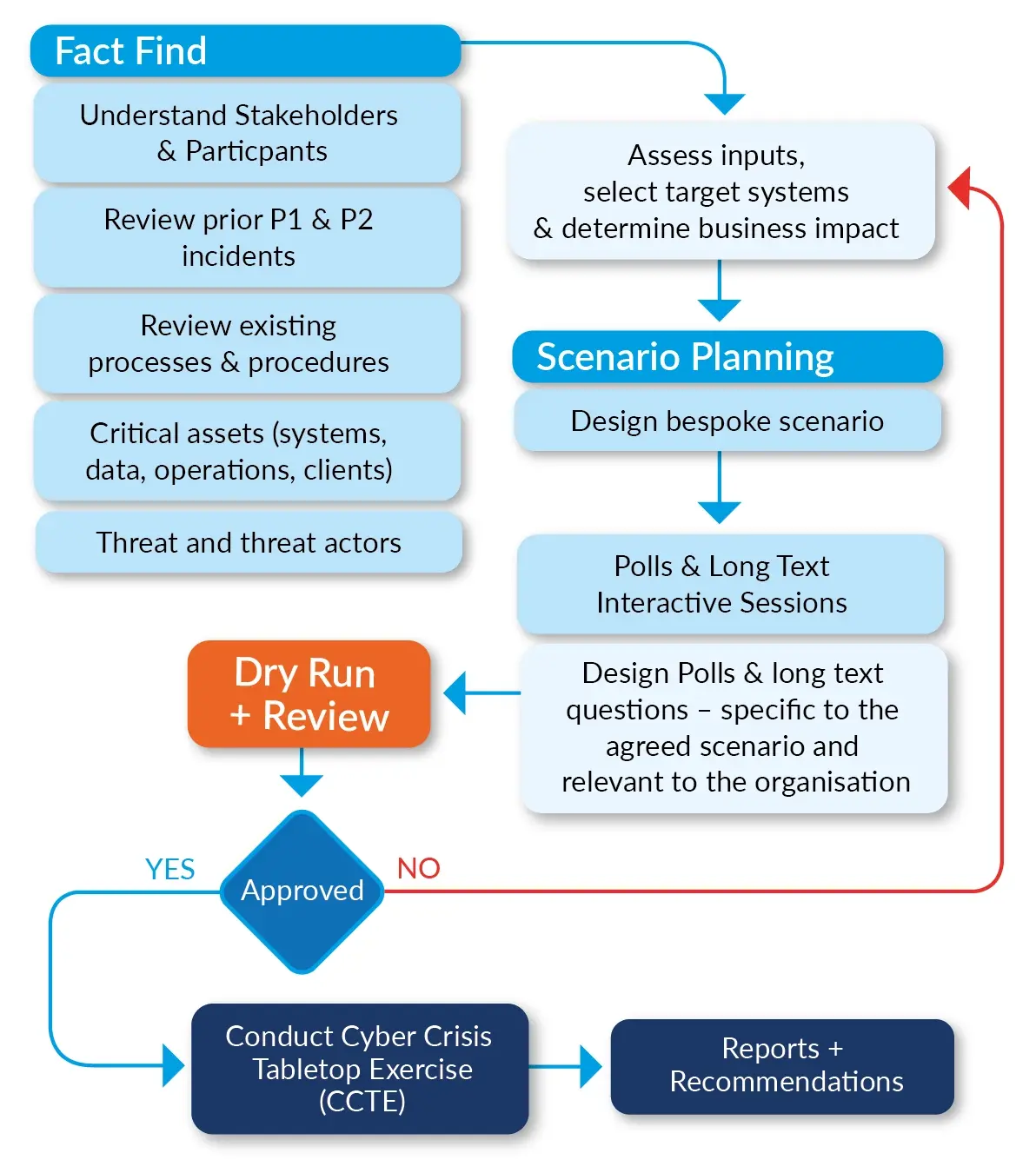
The planning stage of the scenario for the IT staff cyber readiness session is critical. It involves deep work between our expert facilitator and one or more representatives from the Client's side. During this stage, the cybersecurity expert explores and exhausts all possible attack scenarios on the critical assets of the organisation. The primary points of discussion at this stage are:
The discussions and deliberations in the planning stage are then converted into the actual technical scenario for the Cyber Attack Simulation Exercise.
Case Studies demonstrate how others have benefited from our Tabletop Exercises. We have numerous client case studies which demonstrate how these sessions have helped clients optimise their handling of cyber incidents. Click the button below to check out some of our Case Studies.

We take great care in producing the content for the technical cyber tabletop session. Each image, each technical detail is meticulously selected to ensure maximum relevancy and participation.
A cyber drill is lifeless without audience interaction. We design each question and facilitate each session with one aim in mind - enabling maximum audience interaction & keeping technical staff engaged.
You can have the best content but a lifeless delivery loses the audience very quickly. Consequently, an uninterested and bored team means the objectives and outcomes are unachievable.
We ensure lively and engaging delivery by ensuring:
The video on the right gives an insight into how we engage and interact, and help you get the best value out of your Tabletop Exercises.
"Both the technical and executive tabletop sessions conducted by Cyber Management Alliance Ltd met all our objectives. The attendees from both the sessions were impressed with the facilitation and the outcome-driven approach and left the participants more informed and aware of the response processes and procedures.”
Nadeem Bashir
IT Compliance Manager, Otsuka Pharmaceutical Europe Ltd.
A Technical Cyber Attack Tabletop Exercise is a scenario-based IT crisis simulation that validates your technical team’s ability to detect, respond to and recover from a real cyber attack. It deep-dives into your technical controls, tools and the individual skills of team members, putting them under realistic pressure to respond as they would in an actual incident. Facilitated by experienced practitioners, it bridges the gap between theoretical knowledge and real-world readiness in a controlled, risk-free environment.
The exercise is designed for the technical and IT staff on the frontline of cyber defence. Ideal participants include systems architects, network specialists, Windows and Linux specialists, cloud infrastructure specialists, SOC and security analysts, IT security engineers, database administrators, technical and configuration specialists, product owners and change management experts.
Technical teams sit on the frontline of cyber defence, yet day-to-day pressures leave gaps that only surface under attack. A technical drill addresses common problems such as siloed technical and non-technical teams, over-reliance on security tools, overlooked dependencies and single points of failure, outdated threat scenarios, regulatory blind spots and cultural resistance to testing. It builds ‘muscle memory’ for critical actions, exposes blind spots, and improves coordination before a real incident happens.
A technical tabletop exercise takes an intense, detailed look at your technology, controls and incident response processes to find gaps and loopholes — achieving much of what a penetration test does, but without the exorbitant cost. Drawing on extensive pen-testing experience, our facilitators build realistic attack scenarios and evolving injects that test how your team would actually respond, rather than actively exploiting live systems. It is a cost-effective way to validate technical breach readiness and uncover gaps without commissioning a full pen-test.
Scenarios are tailored to your critical assets and focus on current and emerging threats such as AI-driven phishing, zero-day exploits, ransomware with data exfiltration or double extortion, and supply chain risks like third-party vendors with insecure APIs. The exercise also helps technical teams meet and demonstrate compliance with cybersecurity regulations such as PCI DSS, GDPR and DORA, improving documentation and providing an audit trail of preparedness.
Cyber Management Alliance runs tabletop exercises for three audiences. The Technical Tabletop focuses on the hands-on response of IT and security teams — testing technical controls, tools and responder skills. The Operational Resilience Tabletop focuses on operations teams, middle management and business continuity. The Executive Tabletop focuses on C-suite and board decision-making, leadership and communication. Many organisations run more than one to test readiness at every level.
Each technical tabletop exercise is bespoke, so the cost depends on the critical asset, the complexity of your infrastructure and the scope of the scenario; current pricing is available on the Cyber Tabletop Exercise pricing page or by booking a discovery call. To arrange a session, book a no-obligation discovery call with the Cyber Management Alliance team.
It varies with the size and complexity of the organisation. Our shortest technical tabletop has run for 90 minutes (for a very small organisation), most technical sessions last between two and three hours, and some, exceptionally, have run over two full days.
All other things being equal, we recommend a remote or virtual session. Anecdotally, the majority of incidents happen during unearthly hours, and a remote drill best simulates the conditions of a real-life incident. We do not recommend hybrid sessions.
A hybrid session is a mix of onsite and virtual participation, where some people are physically together in one location and others join via MS Teams or Zoom. We do not recommend hybrid sessions, as they tend to severely degrade overall audio and video performance and reduce engagement.
There is no single answer — it depends on the complexity of the asset, the complexity of the infrastructure and how geographically spread the asset is. Thorough planning is essential to a meaningful exercise, so the timeline is set to suit your environment.
Running a basic cyber drill is easy, but delivering a meaningful, interactive and engaging technical exercise requires careful planning, attention to detail and professional facilitation. Anyone can put up a slideshow; the value comes from a relevant, well-researched scenario that genuinely engages the IT and technical team and ensures maximum participation.
You absolutely can and should run regular tabletop or cyber drills internally. That said, our clients report significant increases in interactivity and engagement after bringing in external facilitators — an unbiased, experienced outsider can offer a valuable perspective and uncover blind spots that internal teams may miss.
Our interactive platform ensures maximum participation — if 12 people join a session, we capture a response from all 12 to every question. Because the responses are formally captured, we aggregate and map them into a NIST-aligned report (Detect, Analyse, Contain, Eradicate, Respond and Recover), so you can structure training and improvement plans aligned to NIST and other standards.
Yes. We do not display respondents’ names during the session — names are only revealed after the exercise is complete — and we do not list respondents’ names against their answers in the final report.
No. While we won’t penalise excellent recall, the exercise is not a memory test. We are looking for recall of critical processes, awareness of incident response protocols, and the ability to create sensible high-level actions where none exist — not rote memorisation.
From the client side, the essentials are: selecting the correct, most business-critical asset as the target; ideally having a Business Impact Analysis (BIA) in place (we can help conduct one if needed); a frank and honest sharing of information about your assets and infrastructure during planning (we sign NDAs); and helpful visuals, such as a network diagram showing how everything fits together.
Want more information on our Technical Cyber Tabletop Exercises? Book a no-obligation discovery call with one of our consultants.
All trademarks, service marks, trade names, product names, service names and logos appearing on the site, or on printed or digital material are the property of their respective owners, including in Cyber Management Alliance Ltd. Any rights not expressly granted herein are reserved. The information on this page and related pages and documents is Copyright of Cyber Management Alliance Ltd. The VCC or Virtual Cyber Consultant term, other terms, information, concepts, ideas, workflows, processes, procedures and other content that directly or indirectly supports the VCC Service are Copyright of Cyber Management Alliance Ltd. Copyright 2023