Date: 27 October 2026
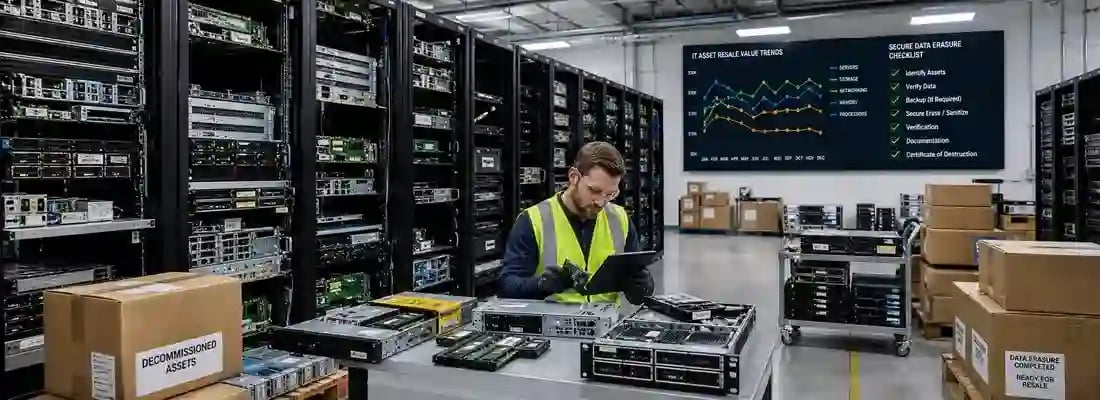
Ask three people what a decommissioned rack is worth and you will get three answers, all of them guesses. The honest truth is that no article can price your specific hardware, because the number depends on the exact models, the state of the secondary market that week, and how the sale is run.

For organisations decommissioning data centre infrastructure, however, financial recovery is only one consideration. Secure data erasure, asset accountability and regulatory compliance are equally important parts of the process.
What this guide can do is show you where the value sits. That matters, because the most expensive mistake in a decommission is treating every asset the same. Some components hold their value for years. Others are close to worthless the moment they come offline. If you know which is which before anything gets boxed up, you protect the parts worth money and stop pouring effort into the parts that are not.
Start with the map, then read the notes under it, because the notes are where most of the value is won or lost.
Where the Value Sits, by Component
|
Component |
Resale strength |
What drives it |
Common value-killer |
|
Processors (CPUs) |
Strong |
Generation, core count, steady demand |
Bent pins, missing part numbers |
|
Server memory (RAM) |
Strong |
Generation, capacity, ECC and registered type, bulk quantity |
Mixed, unsorted lots |
|
GPUs and accelerators |
Strong but volatile |
Model, current AI demand, condition |
Undisclosed mining or heavy wear |
|
Enterprise SSDs and HDDs |
Moderate |
Capacity, interface, drive health; data handled first |
No verified data sanitisation |
|
Complete servers |
Moderate to strong |
Generation, CPU and memory config, model demand |
Stripped of parts before sale |
|
Storage arrays |
Variable |
Controllers, caddies, supported drives, support status |
Missing caddies or controllers |
|
Network switches and routers |
Variable |
Active support, licenses, included optics |
Sold bare, support lapsed |
|
Optics and transceivers |
Moderate |
Compatibility, demand, sold with the switch |
Thrown in as loose accessories |
|
Chassis, rails, cabling, PSUs |
Low |
Occasional spares demand |
Treated as the main event |
|
Tape libraries, legacy gear |
Minimal |
Niche support contracts only |
Assuming it still has value |

The Strong Tier: Small, Durable, in Demand
Processors and server memory are the quiet winners of most decommissions. They are small, they rarely fail from age alone, and there is steady secondary-market demand because they drop straight back into other servers. Memory in particular has seen strong demand linked to AI infrastructure, although prices vary by type and market conditions. The main thing that hurts you here is presentation: a sorted, counted, clearly labelled lot of identical modules is worth more than the same memory tipped into one unsorted box.
GPUs belong in this tier too, with an asterisk. Demand for data centre accelerators is high, but the secondary market for them swings hard, so timing and condition matter more than with almost anything else in the rack.
The Variable Tier: It Depends on What You Include
Servers, storage arrays, and networking gear are where the number moves most, based on how you handle the sale. A complete server holds far more value than one that has been picked over for spares. A storage array is worth real money with its controllers and drive caddies, and much less without them. And networking equipment lives or dies on two things people routinely overlook: whether it still has active vendor support, and whether the optics and transceivers are included. A switch sold bare, its SFPs pulled out and dropped in a bin, can shed a large share of its value for no good reason.
The Low Tier: Know What It Is Not Worth
Chassis, rails, cabling, power supplies, and old proprietary gear round out most decommissions, and it is worth being honest about them. They occasionally sell as spares, but they are not where the value is, and planning a whole project around them wastes effort. Tape libraries and legacy kit are usually worth the least of all, kept alive only by niche support needs. The mistake here is the opposite of hoarding: assuming this gear still carries value and spending time on it that the strong tier deserved instead.
The Two Factors the Table Cannot Show
Completeness changes everything. Pulling components out of a system for "spares" that then sit in a drawer almost always costs you more than leaving them in, because it guts the resale value of the machine you stripped.
Timing is the other one. Resale value is often highest around the time equipment comes offline and can decline as newer models ship. Hardware that sits in storage for a year while someone decides what to do with it may be worth noticeably less by the time it moves. The market shifts underneath you too, so a figure that was right six months ago may be wrong today.

The Cybersecurity Risks of Data Centre Decommissioning
While recovering the resale value of retired IT equipment is important, organisations must ensure that decommissioning does not introduce unnecessary cybersecurity and data protection risks.
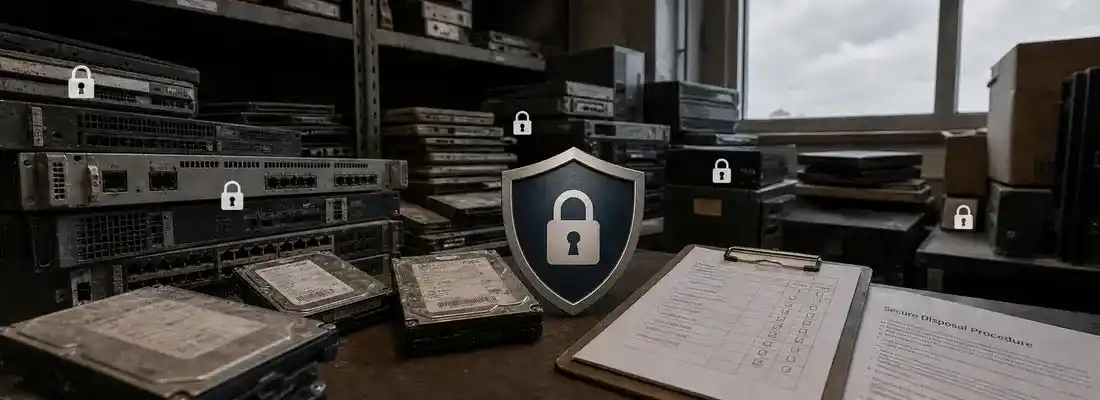
Servers, storage devices and networking equipment may retain sensitive business information, credentials, configuration files or customer data long after they are removed from production environments. Without appropriate controls, selling or disposing of these assets can expose organisations to data breaches, regulatory penalties and reputational damage.
A secure data centre decommissioning process should therefore include:
- Verified data sanitisation: Storage devices should undergo appropriate data sanitisation procedures, following recognised guidance such as NIST SP 800-88. Where sanitisation cannot be reliably verified, physical destruction may be necessary.
- Asset inventory and chain of custody: Organisations should maintain accurate records of retired equipment, including serial numbers, asset ownership, sanitisation status and transfer documentation.
- Secure removal of configurations and credentials: Networking equipment and other infrastructure components should be checked for stored credentials, certificates, configuration files and other sensitive information before resale.
- Third-party risk management: IT asset disposition (ITAD) and recycling providers should be assessed for their security practices, data handling procedures and ability to provide appropriate evidence of sanitisation or destruction.
- Compliance and audit readiness: Decommissioning records should support applicable data protection obligations, internal security policies and relevant regulatory requirements.
These controls help organisations balance financial recovery with information security, ensuring that retired infrastructure does not become an overlooked source of cyber risk.
Getting the Real Number
Everything above is directional. The figure that actually matters is a current quote from someone who tracks the secondary market and prices against your specific hardware models and configurations, supported by accurate serial-number records, not a generic chart. Running the hardware through a proper data centre equipment resell process, rather than a quick bulk sale to clear the room, is usually what separates a strong recovery from a disappointing one.
So before anything leaves the building: inventory it with real part numbers, ensure that sensitive data has been securely sanitised, maintain a documented chain of custody, keep the valuable components in place where appropriate, and get the equipment valued while it is current.
The table tells you what to protect. A specialist tells you what it is worth right now. A secure decommissioning process ensures that recovering that value does not come at the expense of your organisation's cybersecurity.

Frequently Asked Questions
Can you give me a percentage of the original price I should expect?
Not reliably, and be wary of anyone who does without seeing your gear. Residual value swings too much by model, generation, and current demand. A recent server or in-demand memory can recover a meaningful share of its cost, while older or stripped equipment may recover very little.
Is it worth selling older hardware, or should I just recycle it?
It depends on the tier. Strong-tier components often justify a sale even when they are a generation or two old. Low-tier gear with no resale value is better sent to certified recycling than stored forever. A good partner will sort your inventory across both honestly.
In either case, organisations should ensure that any sensitive data is securely sanitised or destroyed before equipment is transferred.
Why do buyers want serial numbers and part numbers?
Because accurate identification is what lets them give you a firm, competitive quote. Vague descriptions force conservative offers, since the buyer has to price in the uncertainty. Precise records consistently produce better numbers.
What cybersecurity precautions should organisations take before selling decommissioned IT equipment?
Organisations should verify that sensitive data has been securely sanitised, remove stored credentials and configurations, maintain accurate asset inventories, and document the chain of custody. Working with appropriately assessed ITAD providers can also help reduce the risks associated with equipment resale and disposal.