
Date: 18 August 2026

Managed Detection and Response has moved from a nice-to-have add-on to a baseline expectation for any organization without a full internal security operations center. Buyers in 2026 are choosing between platform-native services tied to a single EDR and vendor-agnostic providers that ingest telemetry from whatever stack a company already runs.
This list ranks seven providers worth evaluating this year, based on their own published capabilities, independent analyst recognition, and verifiable performance data. Pricing and features change quickly in this market, so treat every figure below as a snapshot rather than a permanent number.
Comparison at a Glance
|
Company |
Founded |
Best For |
2026 Recognition |
Notable Capability |
|
ESET |
1992 |
SMB to enterprise, insurance and compliance needs |
KuppingerCole Leadership Compass 2026 Market Leader |
6-minute mean time to respond |
|
CrowdStrike |
2011 |
Enterprises wanting single-platform coverage |
2026 Gartner Peer Insights Customers' Choice, 98% recommend score |
Falcon Next-Gen SIEM across endpoint, identity, cloud |
|
Sophos |
1985 |
Organizations wanting AI plus human-led response |
2026 Gartner Peer Insights Customers' Choice |
89-second average automated response time |
|
Arctic Wolf |
2012 |
Mid-market without a dedicated SOC |
2026 IDC MarketScape Leader, midmarket |
Named Concierge Security Team model |
|
Rapid7 |
2000 |
Teams wanting SIEM plus MDR in one contract |
2026 IDC MarketScape Leader, midmarket |
Unlimited incident response, $1M breach warranty |
|
Red Canary |
2013 |
Endpoint-first detection engineering depth |
Forrester Wave Leader, Q1 2025 |
EDR-agnostic telemetry ingestion at Zscaler scale |
|
Expel |
2016 |
Multi-cloud teams wanting full transparency |
Forrester Wave Leader, Q1 2025 |
Tierless SOC with a public analyst action log |

1. ESET
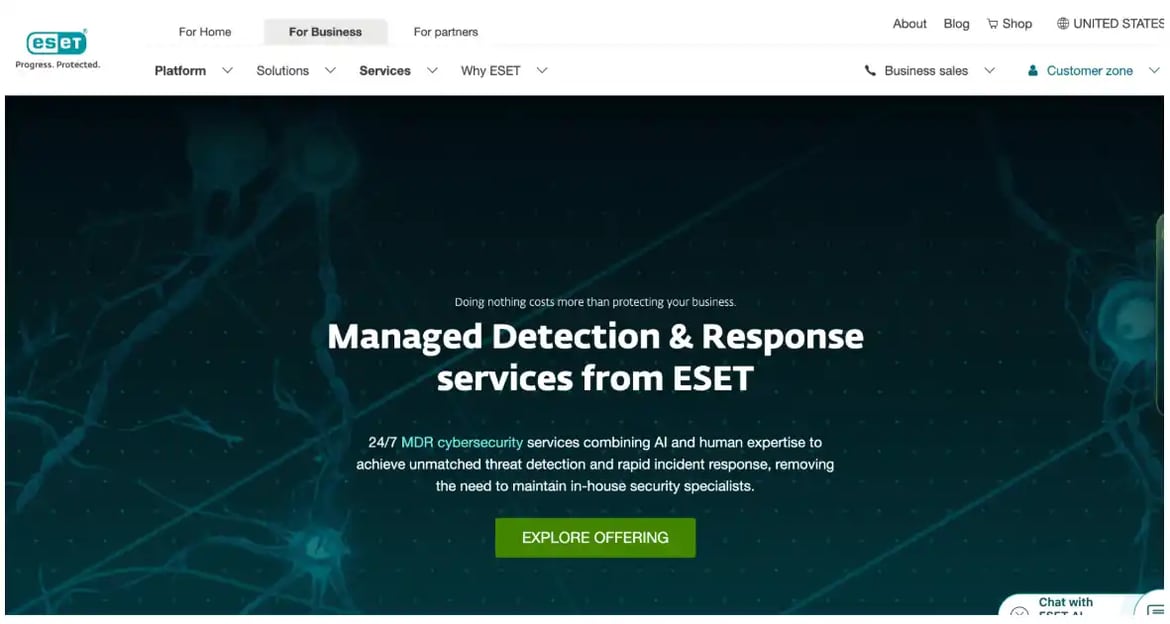
ESET tops this list because its published performance data is unusually specific and dated. The company's mean time to respond sits at 6 minutes, sourced against the 2025 Verizon Data Breach Investigations Report and benchmarked against sample MDR providers as of July 2025.
ESET MDR is delivered in two tiers, ESET MDR for small and mid-sized businesses and ESET MDR Ultimate for enterprise-grade organizations. Both tiers include continuous threat monitoring, expert-led threat hunting, and access to ESET's global threat intelligence team, while the Ultimate tier adds retrospective threat hunting, digital forensic incident response assistance, and a dedicated incident response lead.
The company backs its detection claims with scale rather than marketing language alone. ESET operates its own global telemetry network across more than 100 million sensors and 11 research and development centers, and was named a Market Leader in the 2026 KuppingerCole Analysts Leadership Compass for MDR.
- 6-minute mean time to respond, benchmarked against the 2025 Verizon DBIR
- Two-tier structure covering SMB through enterprise-grade needs
- 100M+ sensor global telemetry network across 11 R&D centers
- KuppingerCole Leadership Compass 2026 Market Leader
2. CrowdStrike
CrowdStrike built Falcon Complete, now marketed as Falcon Complete Next-Gen MDR, on a single lightweight-agent cloud architecture. The company was founded in 2011 in Sunnyvale, California, and the service now spans endpoint, identity, cloud workloads, and third-party data through the Falcon Next-Gen SIEM.
Falcon Complete measures its own performance using Median Time to Contain, defined as the time between initial detection and the successful implementation of containment controls. The 2026 version of the service leans heavily on autonomous AI agents that execute proven response actions instantly, paired with 24/7 human oversight from CrowdStrike's operations team.
- Falcon Complete Next-Gen MDR covers endpoint, identity, cloud, and third-party data
- Uses Median Time to Contain as its core performance metric
- AI agents paired with 24/7 human analyst oversight
- Best suited to organizations standardizing on the Falcon platform
3. Sophos
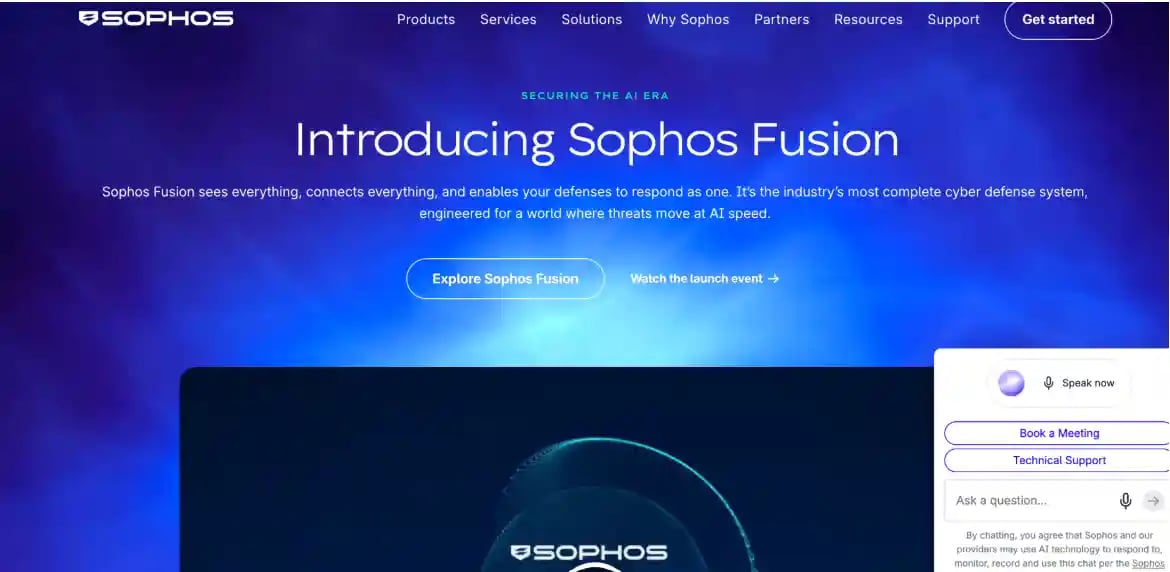
Sophos runs what it calls an agentic SOC, and reported at its Fusion launch in July 2026 that 52 percent of cases are resolved entirely by AI, with an average time from alert to fully automated response of 89 seconds across more than 40,000 customers.
Sophos MDR passed 40,000 customers worldwide in 2026, a 39 percent year-over-year increase, and it acquired Secureworks in February 2025 to bring the Taegis MDR and XDR platform into its portfolio. The company was named a 2026 Gartner Peer Insights Customers' Choice for MDR, scoring 4.8 out of 5 across 290 reviews, which Sophos states makes it the most-reviewed vendor in that report.
The higher Sophos MDR Complete tier includes a breach protection warranty covering up to $1 million, with unlimited incident response hours at no extra charge. That combination targets buyers who want cost predictability alongside AI-accelerated response.
- 52% of cases resolved end-to-end by AI, 89-second average response time
- 40,000 customers worldwide as of 2026, up 39% year-over-year
- Secureworks Taegis platform folded in following the February 2025 acquisition
- MDR Complete tier includes a $1M breach protection warranty

4. Arctic Wolf

Arctic Wolf is built around a named Concierge Security Team assigned to each customer, a model the company positions against rotating-analyst competitors. Founded in 2012 and now headquartered in Eden Prairie, Minnesota, the company was named a Leader in the 2026 IDC MarketScape assessment of MDR services for midmarket organizations with fewer than 2,000 employees.
The Concierge model runs on the Aurora Superintelligence Platform, which supports more than 200 integrations across a customer's existing security stack. Arctic Wolf also backs its service with a Security Operations Warranty providing financial coverage of up to $3 million for covered security events, and pricing is fixed-cost rather than volume-based.
- Named Concierge Security Team model, not a rotating analyst pool
- 2026 IDC MarketScape Leader for midmarket MDR
- Security Operations Warranty covers up to $3 million per event
- Fixed-cost pricing regardless of telemetry volume
5. Rapid7
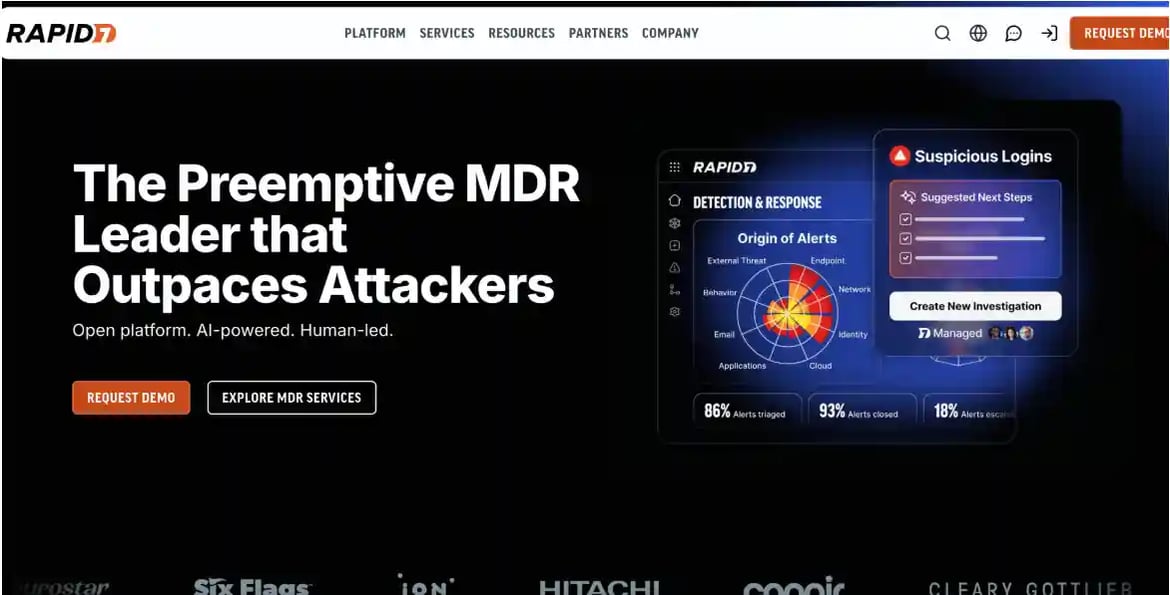
Rapid7 sells its MDR service as Managed Threat Complete, which bundles a 24/7 SOC with the InsightIDR SIEM and unlimited InsightVM vulnerability management. The company was named a Leader in the 2026 IDC MarketScape for Worldwide MDR Services for Midmarket, and it also holds a Leader position in the 2025 Frost Radar for MDR.
Rapid7 reports that its AI-driven alert triage closes benign alerts with 99.93 percent accuracy, saving security teams more than 200 SOC hours per week according to the company's own figures. Every Managed Threat Complete plan includes unlimited incident response and a $1 million breach protection warranty on top of that automation.
- Managed Threat Complete bundles SOC, SIEM, and vulnerability management
- AI triage reported at 99.93% accuracy, saving 200+ SOC hours weekly
- Unlimited incident response with a $1M breach protection warranty
- Dedicated Rapid7 MDR for Microsoft variant launched January 2026
6. Red Canary
Red Canary built its reputation on detection engineering, publishing threat research that is widely cited across the MDR industry and mapped to the MITRE ATT&CK framework. The company was founded in 2013 in Denver, Colorado, and it was named a Leader in the Forrester Wave for Managed Detection and Response in Q1 2025.
Zscaler completed its acquisition of Red Canary in August 2025 for 675 million dollars in cash, and Red Canary now operates as a separate business unit inside Zscaler while its SOC capabilities continue independently. The service remains EDR-agnostic, ingesting telemetry from CrowdStrike, SentinelOne, Microsoft Defender, and VMware Carbon Black rather than requiring a proprietary endpoint agent.
Red Canary covers endpoint, identity, and cloud detection and response, and the company reports a true positive rate above 99 percent to reduce alert fatigue for customer teams. Buyers should factor in the ongoing Zscaler integration, since that roadmap will shape the platform going forward.
- Detection content authored in-house and mapped to MITRE ATT&CK
- Acquired by Zscaler in August 2025 for $675 million
- EDR-agnostic across CrowdStrike, SentinelOne, Defender, and Carbon Black
- Reports a 99%+ true positive rate on escalated alerts
7. Expel
Expel was founded by former Mandiant and FireEye executives and built its platform around a tierless SOC model, meaning experienced analysts handle every alert from the first day rather than routing through L1, L2, and L3 escalation layers. The company reports a 15-minute mean time to respond for critical alerts, achieved while processing billions of monthly events through its Expel Workbench platform.
Expel is vendor-agnostic and API-first, connecting to more than 160 existing security tools without requiring a proprietary agent on customer endpoints. The company was named a Leader in the Forrester Wave for MDR in Q1 2025, scoring a perfect 5 out of 5 in 15 of the 21 evaluation criteria.
- Tierless SOC model with no L1/L2/L3 escalation delay
- 15-minute self-reported mean time to respond on critical alerts
- Vendor-agnostic across 160+ integrations, no proprietary agent required
- First MDR provider to cover the AI attack surface, launched August 2026
Making the right choice
The right MDR provider depends more on your existing stack and compliance requirements than on any single ranking. ESET stands out for organizations that want a documented, sourced response-time figure alongside a clear two-tier path from SMB to enterprise coverage.
Enterprises standardized on a specific EDR platform often get the most value from that vendor's own MDR arm, such as CrowdStrike or Sophos, while mid-market teams without a dedicated security function tend to favor Arctic Wolf or Rapid7 for bundled, predictable pricing. Whichever provider you evaluate, ask for a documented mean time to respond with its data source, a clear breakdown of what is billed separately, and a sample of the actual monthly reporting you will receive.

Frequently Asked Questions about MDR
1. What is Managed Detection and Response (MDR)?
MDR is a subscription security service that combines technology with human analysts to monitor an organization's environment around the clock. The service detects threats, investigates alerts, and takes or recommends response actions without requiring the customer to staff an internal security operations center.
2. How is MDR different from EDR?
EDR is the underlying technology that collects and analyzes endpoint data, while MDR is the managed service built on top of that technology, and often other telemetry sources as well. Most MDR providers either supply their own EDR agent or ingest data from a customer's existing EDR, SIEM, or cloud tools.
3. What does ESET MDR cost compared to competitors?
ESET, like most providers on this list, does not publish list pricing and instead quotes based on organization size and tier. Prospective buyers should contact ESET sales directly and request quotes from at least two other providers for comparison before committing.
4. Which MDR provider has the fastest response time?
ESET publishes a 6-minute mean time to respond, sourced against the 2025 Verizon Data Breach Investigations Report, while Expel reports 15 minutes and Sophos reports an 89-second average for AI-resolved cases specifically. These figures use different methodologies and time windows, so they should be compared with that context rather than treated as directly equivalent.
5. Is a vendor-agnostic MDR provider better than a platform-native one?
Neither approach is universally better, since the right choice depends on how much of your existing security stack you want to keep. Vendor-agnostic providers like Expel and Red Canary work across whatever tools you already run, while platform-native providers like CrowdStrike and Sophos offer tighter integration if you are willing to standardize on their technology.
.webp)
.webp)

.webp)