
Date: 23 July 2026
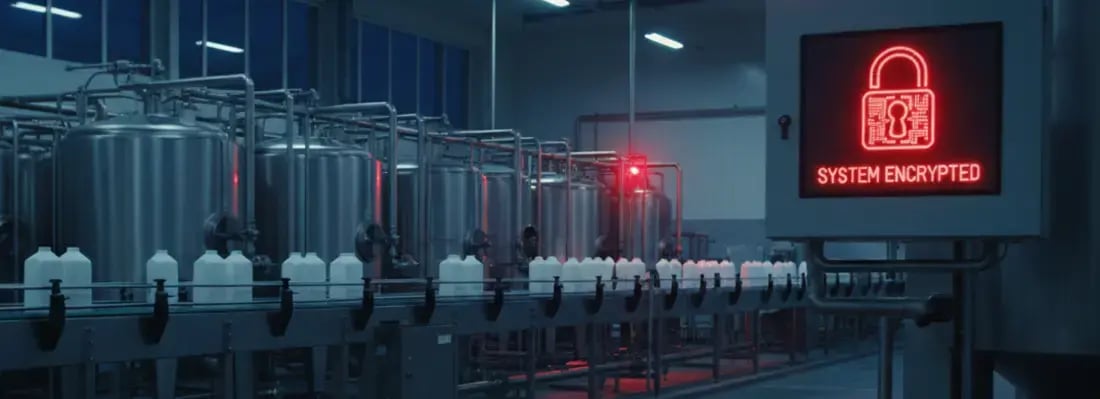
On 16 July 2026, one of the world's most recognisable companies filed a quiet, carefully worded Form 8-K with the U.S. Securities and Exchange Commission. The disclosure confirmed what employees at Coca-Cola's high-protein dairy subsidiary, Fairlife, already knew: a ransomware attack had torn through parts of its IT environment and US milk production had been suspended.
This wasn't a small target. Fairlife is a $4 billion brand, one of Coca-Cola's billion-dollar names, fresh off the announcement of a $650 million plant expansion in Coopersville, Michigan. And yet, within days, its American production lines went dark. The Fairlife incident is a textbook case of how modern ransomware works and a stark reminder that scale and brand recognition offer no immunity.

Here's what happened, why it matters, and what your organisation can do to avoid the same fate.
What Actually Happened in the Coca-Cola Ransomware Incident
The timeline moved fast and followed a pattern security teams will recognise instantly.
- 16 July, 2026: Coca-Cola disclosed the incident via an SEC 8-K filing, confirming attackers gained unauthorised access to a portion of Fairlife's systems, including production-related systems. Product quality and safety were not affected, but US production was temporarily suspended. Canadian operations continued normally.
- The company's response: Coca-Cola activated its incident response plans and business continuity plans, brought in external cybersecurity advisors, and notified law enforcement. Crucially, it stated "the full scope, nature and impacts of the incident are not yet known.
- 20 July 2026: A ransomware group called Anubis listed Coca-Cola and Fairlife on its dark-web leak site.
- 21–22 July 2026: Anubis publicly claimed responsibility, stating it had encrypted Fairlife's Nutanix systems ("They have no chance of recovering without our encryption key") and exfiltrated 1TB of confidential data. The group is now threatening to leak everything unless a ransom is paid within a week.
Who and What is Anubis?
Anubis isn't a household name yet, but it should be on every security leader's radar. It's a ransomware-as-a-service (RaaS) operation that emerged in December 2024, reportedly as a rebrand of the earlier Spinx ransomware. In roughly 18 months it has listed around 100 victim organisations across multiple industries and continents.
Double extortion is its default. Like most modern crews, Anubis steals data before encrypting systems, then uses the threat of a public leak as a second lever to force payment even from victims who have working backups. It's uniquely destructive. Anubis frequently disables volume shadow copies and interferes with security processes before encryption to sabotage recovery. More alarmingly, researchers have documented a "wiper mode" capable of permanently deleting files, turning a recoverable incident into an irreversible one.
When an attacker can permanently destroy your data rather than merely lock it, the old comfort of "we'll just restore from backup" evaporates.

Why This Attack Matters to Every Business — Not Just the Giants
It's tempting to file this under "big-company problem." That would be a mistake. The Fairlife breach exposes truths that apply to organisations of every size.
1. Attackers now hit operational technology, not just data. This wasn't a stolen customer database in isolation. It took production lines offline. When IT and OT converge, a cyber attack becomes a physical, revenue-stopping event. A shuttered plant at a $4 billion brand is a vivid warning for any manufacturer, food producer, or logistics operator.
2. Disclosure and reputation are now part of the attack surface. Coca-Cola had to disclose to the SEC and manage a public narrative while still not knowing the full scope. How you communicate in the first 72 hours to regulators, customers, media, and staff can matter as much as the technical recovery.
3. Backups alone are no longer a strategy. With double extortion and wiper capabilities, paying to prevent a leak and restoring from backup are two separate problems. You need to be resilient against both.
4. The response is judged, not just the breach. No organisation is unhackable. What separates the survivors from the cautionary tales is preparation: a rehearsed plan, clear decision-making authority, and a team that has faced the scenario before it was real.
The Uncomfortable Question: Would Your Business Survive This?
Ask yourself honestly:
- If your production or core systems were encrypted today, how long until you could operate again?
- Do your executives know who decides whether to pay a ransom and is that a lawful, informed decision?
- Would your team recognise a double-extortion threat and know how to respond to a leak deadline?
- Has your incident response plan ever been tested under pressure, or does it live in a document nobody has opened in a year?
If any of those answers gave you pause, you already know where the gap is.

How Cyber Management Alliance helps you avoid a similar fate
Preparation is the single biggest differentiator between organisations that weather a ransomware attack and those that don't. This is precisely where Cyber Management Alliance comes in.
Our services map directly onto the lessons of the Fairlife attack:
- Ransomware Readiness Assessment: A structured evaluation of exactly how prepared you are to prevent, detect, and recover from a ransomware attack, closing the gaps before an Anubis-style group finds you.
- Cyber Crisis Tabletop Exercises: Bespoke, scenario-based drills that put your leadership and technical teams through a realistic attack so the first time they face these decisions isn't during a real crisis.
- Cyber Incident Planning & Response (CIPR) Training: An NCSC-Assured course that equips your people to build and execute a defined, managed response to a cyber incident.
- Board Cyber Crisis Programme: The Fairlife incident forced boardroom decisions from day one: an SEC disclosure, a ransom ultimatum, and public scrutiny, all while the full scope was still unknown. This specialised programme prepares your board and executives for exactly that pressure.
Built around a bespoke case study tailored to your organisation — ransomware affecting critical operations, a data breach, a supply-chain compromise — it runs as a full-day experience spanning an executive cyber crisis leadership workshop, a phased board-level tabletop exercise, a media simulation, and a regulatory simulation. It ensures the people ultimately accountable have rehearsed the governance, decision-making, and communications before the real thing lands on their desk.
CM-Alliance helps you rehearse the disaster so you never have to improvise it. Coca-Cola activated its incident response and business continuity plans immediately because it had them, and because a company of that scale expects to be tested. CM-Alliance brings that same discipline within reach of organisations that don't have a Fortune 500 security budget. Get in touch with us today to know more about how we can help you.

.webp)

.webp)