
Hero Background
World-Class Cybersecurity Training Services

Cyber Incident Planning & Response Course

Learn how to implement the NIST Incident Response Lifecycle and align with ISO 27001:2022 controls 5.24–5.28.


NCSC Assured Cyber Incident Planning and Response Training Course & Certification

CIPR Web Page 4 boxes image

CIPR OFFER BANNER CTA

Self-Paced eLearning

Online Immediate Access

Click Here

Virtual Live Class

Thursday 25th June

Click Here


Certified cybersecurity training course that teaches you how to: 

  • Implement NIST's Incident Response Framework
  • Meet all the objectives of ISO 27001:2022 Annex A5.2X
  • Reduce your time to detect and respond to cyber-attacks

The NCSC Assured Cyber Incident Planning & Response Course (CIPR) is a comprehensive training enabling you and your team to prepare a well-defined and managed approach to handling a data breach or a cyber-attack. Created by Cyber Management Alliance, the leading global experts in cybersecurity training and advisory services, this cyber incident response certification and course has helped several clients globally enhance their cyber resilience. 

The course is aimed at a wide audience, both technical or non-technical, who want to understand how to better prepare for responding to a cyber-attack. The course has no pre-requisites and students will understand the operational strategies and processes an organisation needs to consider before, during and after a cyber crisis or data breach. 

Day 2 of this course is especially valuable for CISOs, incident managers, SOC leads, and risk, compliance, legal and DPO professionals, as well as internal and external auditors who must evidence how incidents are decided, reported and closed.

This cyber incident response course is an NCSC Assured programme that enables you and your team to prepare a well-defined, managed approach to handling a data breach or cyber-attack. Delivered as practical cyber incident response training, it has helped clients globally enhance their cyber resilience.

Highlights of the Online, Live & Public CIPR Training

Training assured by the UK-Government's National Cyber Security Centre (NCSC)

Teaches how to implement NIST's Computer Security Incident Handling Guide: NIST SP 800-61 Revision 3

Enables meeting the objectives of ISO 27001:2022 controls 5.24–5.28.

Accredited by the Chartered Institute of Information Security (CIISec)

Optional Examination (Provided by APMG International and ProctorU)

19 modules with interactive exercises on key aspects of planning and response

Bonus content including worksheets and templates

Access to several accompanying mind-maps and checklists

Full access to all content (downloadable PDFs) for 60 calendar days (E-Learning students only)

Comprehensive supporting e-book for reinforced learning

Access to regular live-discussions with global experts (online students only)

Exclusive group remote and onsite workshops available

Benefits of this NCSC Assured Training

Why do you need the Cyber Incident Planning & Response Training?

This NCSC Assured Training on cyber incident response planning teaches you the best practices and proven strategies to implement NIST's Computer Security Incident Handling Guide, a NIST special publication 800-61, Revision 3. 
 
This cyber incident response certification course provides senior management and incident response teams, amongst others, with the vital knowledge and skills to plan, lead and manage a cyber crisis. It equips learners with competence so that they can rapidly detect, respond to and recover from a cyber crisis.Strong cyber incident response planning equips senior management and response teams to plan, lead and manage a cyber crisis.
 
This cyber incident response training is also available as a one-day public course or a two-day internal  workshop that can be delivered at the client's offices or as an instructor-led private virtual training.
 
Directly download the complete Learning Objectives PDF


Gain a deep understanding of NIST's Computer Security Incident Handling Guide: NIST SP 800-61 Revision 3.

Get insights on the latest techniques and core principles of effective cyber incident response.

Learn how Threat Intelligence-led testing works & what response frameworks are adopted by leading governments & institutions.

Gain mastery over the Cyber Kill Chain and understand how to design an early warning system to lower discovery time from months to days

Attain familiarity with the core concepts of incident triage, OODA and their relevance & importance in a cyber resilient organisation

Become proficient with the primary requirements of privacy regulations, like the EU-GDPR and DORA, in the context of cyber incident response

Modern Cybersecurity Incident Response Challenges in 2026


Cybersecurity incident response has evolved significantly over the last two years. Organisations are no longer responding only to traditional ransomware attacks. Modern incident response teams must now prepare for AI-assisted phishing campaigns, identity-based attacks, cloud compromise, SaaS platform breaches, third-party supply chain incidents, and attacks targeting operational resilience.


Threat actors increasingly exploit:

  • Stolen credentials and session tokens
  • Misconfigured cloud environments
  • SaaS applications such as Microsoft 365 and Salesforce
  • Third-party vendors and managed service providers
  • AI-generated phishing and social engineering campaigns
At the same time, regulatory expectations continue to increase. Frameworks such as DORA, NIS2, GDPR, ISO/IEC 27001:2022 and the UK Cyber Assessment Framework (CAF) now influence how organisations classify incidents, manage reporting timelines, preserve evidence, demonstrate accountability and prove resilience. Regulatory clocks can start the moment an incident is detected, and weak reporting or thin evidence now carries financial, legal and reputational consequences of its own — separate from the attack itself.

This means organisations need far more than a static incident response plan. They need:
  • Continuously updated cyber incident response playbooks
  • Executive-level crisis decision making capability
  • Regular cyber tabletop exercises and cyber drills
  • Cross-functional coordination between technical, legal, HR, communications, and leadership teams
  • Rapid containment and recovery procedures
  • Evidence preservation and forensic readiness

Day 2: Regulated Incident Response


Day 2 of the CIPR course now focuses on the growing regulatory and compliance demands surrounding incident response.
Participants will learn how to apply a structured decision-making framework to cyber incidents while meeting the expectations of DORA, NIS2, GDPR, ISO/IEC 27001:2022 and the UK CAF. The module explores incident classification, reporting obligations, regulatory timelines, evidence collection, audit readiness and executive accountability.
 
Attendees will gain practical experience in:
 

- Managing regulatory reporting clocks and notification requirements

- Determining when incidents become reportable events or personal data breaches

- Building defensible decision logs and audit-ready evidence packs

- Demonstrating compliance through structured incident documentation

- Coordinating legal, compliance, executive and technical stakeholders during a cyber crisis

- Responding to incidents across multiple regulatory regimes simultaneously 


The result is a repeatable, defensible incident response process that not only improves response effectiveness but also helps organisations withstand regulatory scrutiny, audits and post-incident investigations.
 
CM-Alliance's NCSC-Assured Cyber Incident Planning & Response (CIPR) course combines modern incident response practices, realistic cyber attack scenarios and regulated incident response requirements to help organisations strengthen resilience before an incident occurs.
 

Why Incident Response Matters More Than Ever in 2026


The speed and sophistication of phishing campaigns has increased rapidly with  AI-assisted attacks

Backups, identity systems and recovery infrastructure are now top targets, making rapid cyber incident response essential 

Ransomware groups are targeting supply chains and critical infrastructure

Cloud and SaaS breaches are becoming a major incident response challenge

Regulators now expect organisations to regularly test cyber resilience capabilities

Cyber insurers are now assessing incident response maturity before issuing coverage

Personal & Organisational Benefits of the NCSC Assured Incident Response Playbooks Training

There are numerous individual advantages of learning about cyber incident response plansincident response certifications and knowing how to enhance your incident response capabilities and breach response maturity.

We also run an internal private workshop for organisations who wish to enhance their cyber resilience through improved and a more coordinated response to cyber-attacks. Organisations who invest in the NCSC Assured Cyber Incident Response Training Course for their staff observe a great degree of improvement in their cybersecurity maturity and cyber resilience.

The table below lists the benefits to both individuals and organisations who undergo our NCSC Assured Training.  

Individual Benefits

Organisational Benefits

Gain a deep understanding of NIST's Computer Security Incident Handling Guide: NIST SP 800-61 Revision 3. Learn how to implement NIST's Cyber Incident Response Framework throughout your organisation.
Become Certified in Cyber Incident Planning and Response.  Define the threat actors and create a threat actor library specific to your organisation. Define Normal - understand your organisation's baseline.
Display your incident response certifications or accreditation via a digital badge, showcase to potential clients and employers. Assess and improve your organisation's triage capabilities. Define and improve alerts for your analysts.
Comprehend and manage the threats and risks relating to information systems and assets from cyber-attacks. Become more compliant with data breach response regulations by creating fit-for-purpose data breach response plans.
Define and support the implementation of processes and procedures for detecting breaches of security policies.  Achieve tangible reductions in detection and response times to cyber-attacks that could lead to better managed and lower data breach compensations.

Understand the core principles of and actively contribute to the creation of your organisation’s cybersecurity strategy and incident response plans.  Streamline technology investments with the possibility of tangible savings across multiple technology sets.
Explain what Threat Intelligence and its significance is in keeping organisations cyber-resilient. Discuss how Threat Intel can aid in rapid detection of advanced threats. Create organisation specific cyber-attack scenarios.
Participate in the development of information risk management strategies to reduce business risk. Build Detection & Response Strategies tailored to your business. 
Discuss the benefits of monitoring and auditing for violations of relevant security policies (e.g. acceptable use, security, etc.). Technology stack review & assessment of integration into SoC & monitoring technologies. High level review of your monitoring and log management.
Define and implement processes and procedures for detecting data breaches. Improve interdepartmental communication and interaction before and during an incident (This is especially true when organisations host the CIPR workshop internally, over 2 days).

Establish and maintain a Computer Security Emergency Response Team to deal with breaches of security policies. Review your PR & communication templates & internal communications approach.
Understand and explain the primary requirement of privacy regulations, like the EU-GDPR, in the context of cyber incident response and cyber resilience. Review and improve the team and organisational structure of IR teams and CSIM (cybersecurity incident management) teams.
Discuss and support the development of innovative methods of protecting information assets, to the benefit of the organisation and the interface between business and information security. Understand areas of improvement of your organisation’s incident response plans. Baselines cyber resilience awareness across the business.
Discuss and support in the development, coordination and evaluation of plans to communicate with internal stakeholders, external stakeholders and the media. Achieve more productive and efficient staff with increased motivation and better learning and career development.
Understand how DORA, NIS2, GDPR and ISO 27001 impact incident response Lower risk of missed reporting deadlines and fines
Confidently lead the first regulated hour of an incident Build and maintain audit-ready evidence, decision logs and clock tracking
Classify incidents and determine reporting obligations Strengthen operational resilience across multiple regulatory frameworks


263c2ff0-85c7-4f90-9980-d5a2cb27030c-1

Continuing Professional Development

  • CPD points can be claimed for this course at the rate of 1 point per hour of training for this NCSC Assured and CIISec-approved course (8 points for one-day public course and 15 points for the two-day internal workshop).
  • (ISC)2 members can claim 8 CPE points after they complete the whole course and obtain the attendance certification.
  • ISACA members can claim 8 CPE points after they complete the whole course and obtain the attendance certification.


43589f1c-3bac-4ec9-af59-44f2fbcc5d3d-1


NCSC-Assured Training in Cyber Incident Planning & Response

Learning Objectives

Here's a quick look at what delegates can look forward to learning in our NCSC Assured Training in Cyber Incident Planning and Response. 

For a more detailed view of the Learning Objectives, you can directly download Complete Learning Objectives PDF.  

Cyber Incident Planning & Response Training

Our NCSC Assured Training in CIPR has been created by one of the world's leading cybersecurity practitioners & a practising global CISO. The CIPR course stands apart for:

  • It's interactive and engaging approach to Cyber Incident Response.
  • The exceptional course content that is enriched with real-world examples and applicability.
  • The compelling bonus materials that ensure continuous learning for attendees even after the training is over. 
  • Providing learners with best practices, operational and tactical strategies, and practical steps to develop a defined and managed approach to cyber incident response. 


Course Content

All the content you need to implement NIST's Computer Security Incident Response Handbook.

All online and public students receive numerous takeaways including immediately usable cyber response checklists, templates like cyber response plans and workflows that you can put to use in your organisation immediately.

This cyber incident response course combines interactive exercises, real-world examples and immediately usable templates. As hands-on cyber incident response training, it gives learners operational and tactical strategies they can apply straight away. 
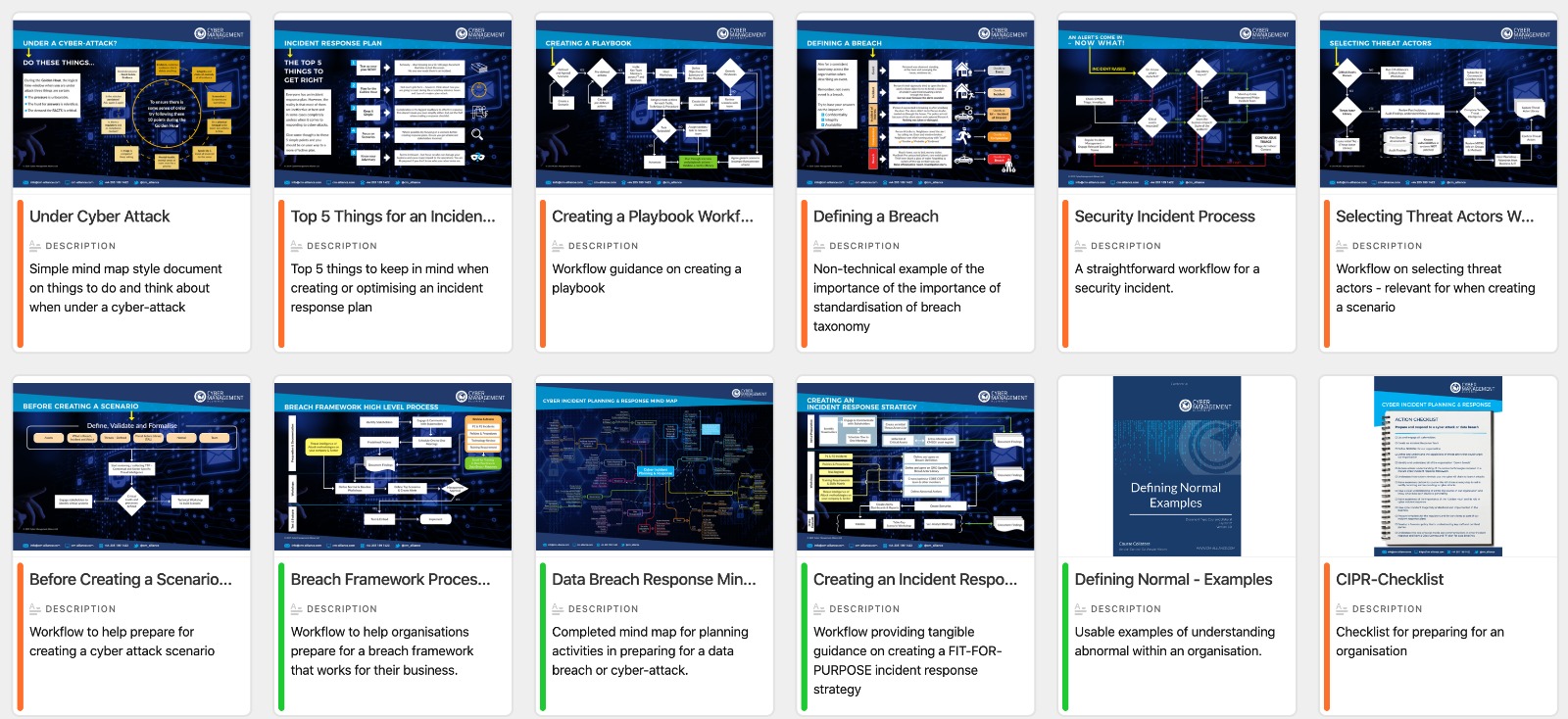
CIPR Documents Image

Cyber Incident Planning & Response Course Modules: DAY 1

  • Interactive Exercises and Collateral
    • Mind Map: Comprehensive exercise on planning for a Cyber-attack 
    • Process Workflows: Creating an Incident Response Strategy
    • Process Workflows: Selecting Threat Actors
    • Process Workflows: Creating a Breach Readiness Framework
    • Process Workflows: Responding to an Incident
    • Defending against the Cyber Kill Chain
    • Visibility: Identifying your Crown Jewels
    • Visibility: Identifying Critical Log Data
    • Worksheet: Identifying Privileged Threat Actors
    • Worksheet: Defining & Base-lining 'Normal'
  • Module 1 - Cyber Resiliency

    This module starts by emphasising the importance of asking the question - WHY? Why would an attacker attack your organisation? It delves briefly into the psychology of attacks and builds the foundation for Module 2. In addition, this module introduces the core concept of resiliency in the context of cyber. The module offers:

    • A mind-map that will help you answer this question and also understand what the attacker intends to do with your crown jewels.
    • Explanation of the “whys” with relevant real-world examples.
    • A definition of the ‘Security Fallacy’ and how to work around it. 
    • An understanding into why merely denying entry to criminals isn’t enough.

    For full details on this and other modules click here.

  • Module 2 & 2a - Understanding Threat Actors

    Threat actors may sound daunting but fear not. After asking the question, “Why” in the first module, this cyber threat actor section discusses the importance of asking - WHO could damage your critical assets and consequently destroy your business. This section explains the importance of knowing details about your attacker(s) who could target your business. This module offers:

    • An introduction to threat actors, intent and attributes.
    • Threat actors in detail.
    • The TAL or threat actor library and its purpose.
    • Building the Threat Actor Profile.

    For full details on this and other modules click here.

  • Module 3 - Define Normal

    Another key concept in the Cyber Incident Planning & Response course, Define Normal introduces the important idea of baselining or defining an organisational normal and explains its importance in building a cyber resilient business. It goes without saying, unless you can define and understand what’s normal for your digital network, it will be almost impossible to rapidly detect the abnormal. In this module, you will learn:

    • The importance and relevance of this concept, with examples.
    • How to define ‘normal’ for your organisation based on the nature of your business, scale, operational model etc.
    • Applying 'Define Normal' in an organisational context.
    • Understanding and building the organisational baseline.

    For full details on this and other modules click here.

  • Module 4 a,b,c & d - The Cyber Kill Chain

    Cyber criminals follow a process and have their own easy-to-follow attack methodology. In this module (also known as the cyber-attack process), we disclose the specific workflows that the majority of advanced and/or smart criminals utilise when they attack organisations and nation-states.

    In these four modules, you will learn:

    • The different phases of attack methodologies.
    • Analysis of the Cyber Kill Chain (copyright Lock Heed Martin).
    • The importance of knowing the process flows that can help in the understanding of specific threat models and methodologies.
    • Strategies to counter the Cyber Kill Chain.

    For full details on this and other modules click here.

  • Module 5 - Visibility

    In this module, we introduce an important strategy - the concept that every business must focus on if it wants to increase its breach response and preparedness. The notion that if you stand in a dark room you are blind and oblivious to the surroundings may seem obvious, but this very fact is ignored and overlooked by organisations when planning and strategising on breach-readiness. In this module, students learn:

    • What is visibility and why it's so important as a strategic item in a cyber resiliency strategy.
    • They key and core concepts and terminology to better understand its overall impact on resilience.
    • The importance of log data and its relationship and importance to cyber resilience.
    • The primary requirements for increasing visibility in an organisation.

    For full details on this and other modules click here.

  • Module 6 a, b, c & d - The Golden Hour & Incident Management

    The pivotal moment, the ‘golden hour’ and many other important concepts and strategies are discussed in this section.

    • Module 6a deep dives into the ‘golden hour’, its relevance in incident response and its overall importance in the whole incident management lifecycle. This particular module goes deeper into the important aspects of the golden hour, discusses the importance of taxonomy and communications along with introducing and explaining the critical phase of triage and its role in incident response.
    • Module 6b & 6c discuss standards and workflows on incident management introducing several different terms and approaches on optimising existing processes and procedures while maintaining alignment with the various standards and touch on the key benefits of incident response playbooks.
    • Module 6d takes the student through an exhaustive thought process on creating an effective and fit-for-purpose incident response plan with a comprehensive exercise utilising a mind-map based approach.

    For full details on this and other modules click here.

  • Module 7 - Building the Team

    Building a great cybersecurity team also involves walking the tightrope between having a great internal team and liaising with external experts wherever necessary. In this module on Building the Team, students will learn:

    • Identifying the stakeholders, the 'who' and 'what functions' should be included in the core cyber incident management team.
    • Key skills and traits that are essential in members of an effective cyber incident response team.
    • Why contextual experience is more important than technical knowledge when building an incident response team.
    • The importance of encouraging a culture of speaking up in the team, regardless of seniority or experience.

    For full details on this and other modules click here.

  • Module 8 - Forensics & Investigations

    Forensics and evidence are often overlooked in cyber incident management. Many IT professionals don't have enough experience in handling evidence the right way. Dealing with a cyber-attack requires the ability to ensure chain of custody and ensure the evidence is captured, protected and processed in a way that it can be presented in court without anyone being able to challenge the integrity of that evidence. Delving further into this subject, in this module, we cover:

    • Introduction to forensics principles.
    • Why organisations must sensitise their employees about the regulatory requirement to protect evidence and ensure its forensic integrity.
    • What is a forensics policy, how it can be created and what should its key constituents be?

    For the full details on this and other modules click here.

  • Module 9 - Regulations & Standards

    The actions that an organisation takes before, during and after an incident can have legal and or financial repercussions. It is imperative, therefore, that the management, IT and Security teams understand the regulations and standards that apply to them and have a well-defined set of policies to cover these regulations. In this module, we cover:

    • The legal, financial or reputational impact that a business can suffer on account of incorrect actions.
    • A look at some common regulations and standards that businesses should be aware of.
    • What is a breach notification and how is it defined in the GDPR?
    • The fines that GDPR stipulates on businesses that are in breach of its regulations.

    For full details on this and other modules click here.

  • Module 10 - The Technology Stack

    It goes without saying that technology plays an extremely crucial role in all aspects of cyber incident response and management. The challenge is that most organisations have a messy and complex technology stack. A huge part of the objective of cyber incident planning and response is to evaluate your technology stack and ensure that it is optimised and ready for a cyber-attack. In this module, students will learn:

    • The common mistakes organisations make while buying technology and building a technology stack.
    • The problems a disorganised and incoherent technology stack can create for the business in case of an incident.
    • Understanding the technologies that underpin an effective breach-ready organisation.
    • Analysis of core technology requirements.

    For full details on this and other modules click here.

  • Module 11: Public Relations and Incident Management

    This module focuses on the communications challenges that arise during cyber incidents and crises. It examines internal stakeholder communications, customer and supplier notifications, regulatory communications and media engagement.

    The module highlights the importance of:
     
    - Delivering timely, accurate and transparent communications
    - Crisis communications that support effective incident management 
    - Maintaining stakeholder trust during a crisis 
    - Protecting organisational reputation during and after a cyber incident

Cyber Incident Planning & Response Course Modules: DAY 2

  • Module 12 - Regulated Cyber Incident Response

    This module provides a practical framework for managing regulated cyber incidents across DORA, NIS2, GDPR, ISO/IEC 27001:2022 and the UK Cyber Assessment Framework (CAF). Delegates will learn how to classify incidents, manage regulatory reporting timelines, preserve audit-ready evidence and make defensible decisions when facts are incomplete.

    The module also explores how auditors, regulators and senior leaders evaluate incident response activities, helping organisations demonstrate compliance, operational resilience and accountability during and after a cyber incident.

    It covers: 

    - Regulated Incident Decision-Making
    - DORA Incident Reporting & ICT Resilience
    - NIS2 Significant Incident Management
    - UK Cyber Assessment Framework (CAF)
    - ISO/IEC 27001 Incident Management & Audit Evidence
    - GDPR Personal Data Breach Response
    - Multi-Regime Incident Response Exercise
  • Module 12A: DORA Incident Response Requirements

    This module focuses on the Digital Operational Resilience Act (DORA) and its impact on incident management within financial services and supporting organisations.

    Key topics include:

    - DORA applicability and scope
    - ICT-related incident classification
    - Major ICT-related incident assessment
    - Reporting timelines and notification obligations
    - Critical and important function impact analysis
    - Third-party and supplier involvement
    -  DORA evidence and audit requirements
  • Module 12B: NIS2 Incident Response Requirements

    This module examines incident response obligations under NIS2 and the practical steps organisations must take to identify, assess and report significant incidents.

    Key topics include:

    -  Essential and important entity assessments
    - Significant incident determination
    - 24-hour and 72-hour reporting requirements
    - CSIRT and competent authority engagement
    -  Cross-border reporting considerations
    - Supplier and third-party coordination
    - NIS2 evidence and governance requirements
  • Module 12C: UK Cyber Assessment Framework (CAF)

    This module explores the UK's Cyber Assessment Framework and how organisations can demonstrate effective response, recovery and operational resilience capabilities.

    Key topics include:

    - CAF principles and assessment methodology
    - Response and recovery capability requirements
    - Incident response planning and testing
    -  Recovery objectives and restoration testing
    - Post-incident analysis and lessons learned
    - Indicators of Good Practice (IGPs)
    - Preparing for CAF assessments and audits

  • Module 12D: ISO/IEC 27001 Incident Management

    This module focuses on incident management requirements within ISO/IEC 27001:2022 and how organisations can build repeatable, auditable incident response processes.

    Key topics include:

    - ISO/IEC 27001 incident management controls
    - Event, weakness and incident classification
    - Incident response planning and preparation
    - Evidence preservation and chain of custody
    - Design and operating effectiveness
    - Post-incident reviews and continual improvement
    - Audit-ready incident documentation

  • Module 12E: GDPR Incident Response Requirements

    This module examines personal data breach obligations under UK GDPR and EU GDPR, helping organisations understand when, how and why breach notifications may be required.

    Key topics include:

    - Personal data breach identification
    -  Controller and processor responsibilities
    -  Risk and high-risk assessments
    - Supervisory authority notifications
    - Data subject notification requirements
    - UK GDPR and EU GDPR considerations
    - Breach records and accountability requirements
  • Module 12F: Cyber Incident Exercise: Real Incidents through Regulatory Lenses

    This practical exercise brings together the concepts covered throughout the module and challenges participants to manage realistic cyber incidents involving multiple regulatory and compliance requirements simultaneously.

    Key topics include:

    - Cross-framework incident assessment
    - Incident classification and escalation
    - Reporting and notification decision-making
    - Regulatory clock management
    - Evidence gathering and documentation
    - Executive communications and governance
    - Post-incident review and lessons learned
  • Module 12G: Multi-Regulatory Exercise
    This capstone module brings together DORA, NIS2, GDPR and ISO/IEC 27001 through one realistic cyber incident involving a financial services firm, a cloud MSP, cross-border services and potential supply chain impact.

    Key topics include:

    - Managing one incident across multiple regulatory regimes
    - Suspicious privileged access and authentication compromise
    - Cross-border customer authentication outage
    - DORA, NIS2, GDPR and contractual notification triggers
    - Regulatory clock tracking and executive escalation
    - Media pressure, customer communications and legal review
    - Audit-ready evidence, decision logs and corrective actions


STUDENT FEEDBACK & TESTIMONIALS

Cyber Incident Response Course - Testimonials

Check out the 1000+ Written and Video Testimonials about our Cyber Incident Planning & Response course from attendees.

Our course participants come from companies including Microsoft, Adobe, UK Police Cyber Crime Teams, Banks including UBS, Swiss National Bank, RAKBANK, Swiss-CERT and more.


Wayne Parks
A really good session. The trainer is really knowledgeable and presented the course in a really understandable format that the participants really enjoyed.

Wayne Parks
Head of ICT Warwickshire Police
Catherine Gloor
It was really spot on, very practical, non-technical. I have a couple of great take aways for my every day work. Highly recommend it for non-technical people.

Catherine Gloor
Director Group Information Security UBS
Suraj Singh
It was amazing. Amar is not just a trainer, he’s an industry expert, and from his experience and knowledge, I actually got some amazing insights.

Suraj Singh
Head of SOC Microsoft
Euan Ramsay
I found today’s course very productive - discussing the various aspects of incident response. The course is very clearly presented; I fully understood the content and look forward to putting some of the stuff into practice. Thank you.

Euan Ramsay
CSIRT Director, UBS
Cyber Incident Response Team
Brilliant course with lots of good examples. A course to recommend to any incident response team.

Cyber Incident Response Team
Swiss National Bank
Sapan Talwar
I feel the day was really well spent in terms of understanding and getting newer or additional knowledge around this concept and the trainer was absolutely wonderful in sharing and articulating this.

Sapan Talwar
Head of Information Security - Adobe
Robin Smith
I have been attending CMA’s Cyber workshop and we’ve been reviewing incident response. They’ve been directing us towards good cybersecurity practices; they’ve been reviewing our current ideas, and they’ve been adding real value to our Cyber Security response. I thoroughly recommend using CMA for the future.

Robin Smith
Head of Cyber Security - South Yorkshire NHS
Vanessa Smith
I have attended the CIPR training course and I have to say I was very impressed with the course and its content. You don’t need to have IT skills or an insight into IT. But what it does do is, in layman terms, sets out the key issues.  This course is very good.

Vanessa Smith
DCI, Head of Cyber Crime Unit, West Yorkshire Police
KS Ramakrishnan
I wish all Senior Executives attend this course. It’s the most practical course I have ever attended. It teaches you not just how to understand but also how to respond to a Cyber Attack.

KS Ramakrishnan
CRO, RAKBank, UAE
Sanjay Khanna
I found the course to be very interesting. It's not the usual bookish theoretical type of course. It was quite interactive.
Sanjay Khanna
CIO, Rakbank

About the NCSC - National Cyber Security Centre
NCSC Certified Training ColourLaunched in October 2016, the NCSC or National Cyber Security Centre is headquartered in London and brings together expertise from CESG (the information assurance arm of GCHQ), the Centre for Cyber Assessment, CERT-UK, and the Centre for Protection of National Infrastructure.

The NCSC Assured training is designed to assure high-quality training courses delivered by experienced training providers. The courses are assessed at two levels, namely, awareness and application.

apmg-international-logo-stacked-1This course has been certified for the application level of incident response in the areas of Risk Assessment, Business Continuity Planning and Incident Management. The Application level is for anyone looking for in-depth courses for their professional development.

CIIS-Logo_full_colou_tiny

The Chartered Institute of Information Security (CIISec) is the only pure-play information security institution to have been granted Royal Charter status and is dedicated to raising the standard of professionalism in information security. CIISec represents professionalism, integrity and excellence within the information and cybersecurity sector.

The NCSC Assured Training and the Chartered Institute of Information Security's (CIISec) accreditation enables organisations to distinguish between reputable courses and ones that have not been validated using a Government-endorsed assessment process.

Optional Online Examination

Following the completion of the training course (Public, Internal, Instructor-led or Self Paced Learning) all students have the option of earning a cyber incident response certification by successfully passing the APMG International examination of the NCSC Assured Cyber Incident Planning and Response Training. The exam is administered by APMG International and invigilated by ProctorU who provide secure live and automated online proctoring services for academic institutions and professional organisations. 

Number of Questions: 30
Passing Score: 50%
Exam Duration: 25 Mins
Exam Format: Multiple Choice
Exam Delivery: APMG Exam Portal and ProctorU
 

NCSC CIPR Digital BadgeOur digital badges are issued by youracclaim.com, the world's most trusted digital credential network for professional associations and corporate learning. The badges are secure, digital representations of your professional development credentials (certification in incident response). Embed your digital badge on an email signature, website, social media profile or a digital CV.

Earning this incident response certification demonstrates verified, real-world response skills to employers and clients.

Students who have passed the exams and earned an incident response certification have come from organisations including Microsoft, Adobe, NHS, numerous Government departments and Police forces, Unilever, IBM, CISCO, Ernst and Young, Deloitte, KPMG, UBS, RBS, Barclays, Goldman Sachs, Bank of America, TATA Consultancy Services and many many more. 

 

Cyber Incident Planning & Response Brochure Download

Meet the Trainer 

Amar Singh has a long history and experience in data privacy and information security. Amar has served as CISO for various companies, including News International (now News UK), SABMiller, Gala Coral, Euromoney and Elsevier. Amongst various other activities, Amar is a Global Chief Information Security Officer and Trusted Advisor to a number of organisations including a FTSE100 firm, and is chair of the ISACA UK Security Advisory Group. He also founded the not-for-profit cybersecurity service for charities, Give01Day.

Amar_Singh_CISO (1).jpg

Amar has the highest integrity and is trusted by FTSE100 companies with some of the most sensitive commercial information. He has been involved with highly sensitive forensic investigations.

He has the ability to deal with both technically-astute, board-level executives and lead an organisation's information security direction. Apart from his experience and abilities, Amar holds a number of industry-recognised certifications, such as ISO 27001 Certified ISMS Lead Implementer, MoR, CRISC and CISSP certification.

Amar is an industry-acknowledged expert and public speaker and is regularly invited to speak and share his insights by some of the largest and most respected organisations in the world including The BBC, The Economist’s Intelligence Unit, The Financial Times, SC Magazine, InfoSec Magazine, Computer Weekly, The Register and the AlJazeera English Channel.


Amar_Media_Logos.jpg

Why not book a discovery call to discuss your requirements?

Want more information on the NCSC Assured Training in Cyber Incident Planning and Response? Book a no-obligation discovery call with one of our consultants. 

Let us show you why our clients trust us and love working with us.

All trademarks, service marks, trade names, product names, service names and logos appearing on the site, or on printed or digital material are the property of their respective owners, including in Cyber Management Alliance Ltd. Any rights not expressly granted herein are reserved.

The APMG International and swirl device logo is a trade mark of the APM Group Limited, used under permission of The APM Group Limited. All rights reserved.


The information on this page and related pages and documents is Copyright of Cyber Management Alliance Ltd. The VCA or Virtual Cyber Assistant term, other terms, information, concepts, ideas, workflows, processes, procedures and other content that directly or indirectly supports the VCA Service are Copyright of Cyber
Management Alliance Ltd. Copyright 2022.

Footer Top Background Image
Simply fill in your details to request a FREE callback 
NCSC Assured Cyber Incident Planning and Response Course