
Date: 27 October 2025
.webp?width=1170&name=Emerging_Cyber_Threats_2026_cropped%20(2).webp)
Emerging cyber threats are racing through blind spots that didn’t even exist a year ago. What used to be a “rare exploit” is now a Tuesday afternoon. And the problem is that most teams are still guarding the same doors as last year, while the walls have already shifted.
This article will rebuild those walls for you. We will show you 10 of the strangest and most dangerous cyber threats rising this year. You will see how to catch their early signs and cut them off before they snowball.
10 Emerging Cyber Threats To Watch Closely In 2026
Here are the 10 evolving threats that demand your full attention right now.
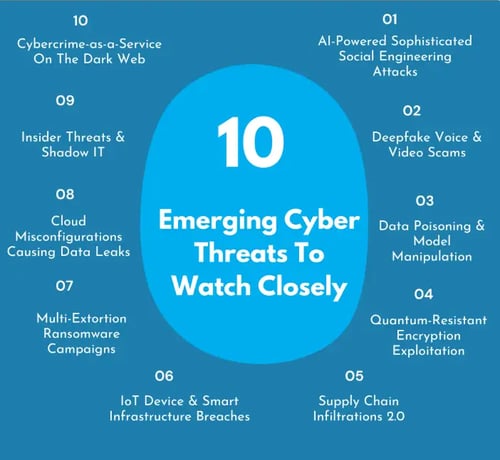
1. AI-Powered Sophisticated Social Engineering Attacks
AI is now writing the scams for us – literally. Attackers are using generative AI to build psychological profiles before reaching out. They scrape LinkedIn, Slack leaks, and even customer support transcripts to train small language models that speak exactly like your team.
When drafting phishing emails, these systems adapt tone and timing to mirror your internal culture. Some are even integrated into chatbots or fake help desks that stay active for weeks to build trust.
The AI studies responses and predicts the best trigger words to close a “social manipulation loop.” These targeted attacks are social engineering at machine speed, and they feel human enough to pass any sniff test.
2. Deepfake Voice & Video Scams
Deepfakes have gone corporate. Attackers are now running real-time deepfake calls using stolen meeting recordings and CRM voice data. With tools like real-time generative rendering and emotion-matching models, they can simulate your CFO’s voice on a Teams call, down to breathing patterns.
These scams usually hit during transaction approvals or crisis response moments – times when no one double-checks. The most advanced groups combine voice and video fakes with geolocation spoofing to appear “in-office” or “on-site.”
What used to be a fake clip on social media is now a full live con call that looks and sounds legit. We are already seeing small businesses lose control of their verified Facebook pages after attackers used cloned voices and spoofed profiles to trick admins into sharing access.
Recovering a Facebook Business page after that kind of social engineering hit is a messy and drawn-out process – it is a wake-up call that even platform-level authentication can be exploited when trust gets manipulated.
3. Data Poisoning & Model Manipulation
Cyber criminals have stopped attacking the system – they are corrupting the AI that trains it. Data poisoning is now the silent saboteur. Attackers sneak tainted records into public datasets or vendor-fed data pipelines. The goal isn’t chaos – it is influence.
Poisoned data can make fraud filters miss specific transaction types or image recognition tools misclassify sensitive visuals. Model manipulation goes deeper. Attackers tweak inference behaviour by exploiting model update APIs or injecting adversarial samples that retrain models incorrectly over time.
You end up with an AI that “fails” in convenient ways – and you won’t even know when it started.

4. Quantum-Resistant Encryption Exploitation
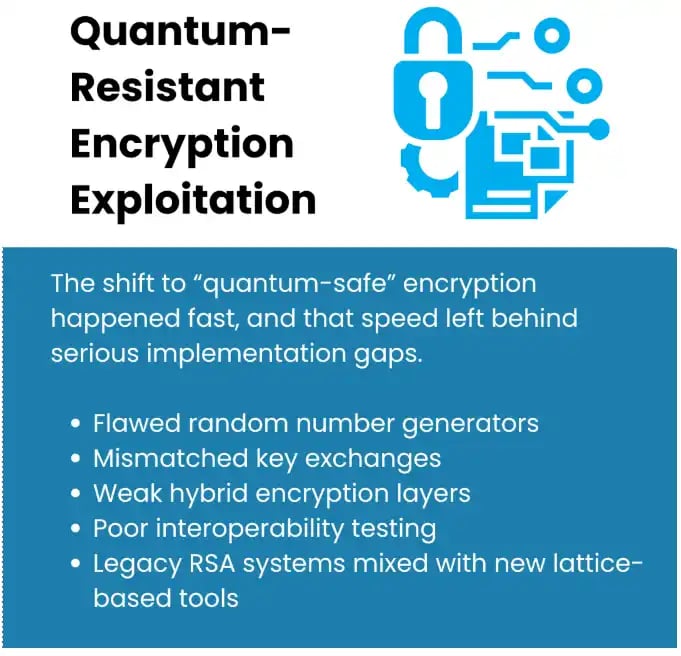
Everyone rushed to adopt “quantum-safe” encryption – and that rush created weak spots. Most 2025-era quantum-resistant tools were rolled out before proper interoperability testing. Today, attackers are exploiting mismatched key exchanges, flawed random number generators, and partial integrations between old RSA systems and new lattice-based schemes.
The hybrid encryption layers between legacy and post-quantum systems are the prime targets, especially in financial and government transitions where infrastructure can’t flip overnight. Quantum exploitation isn’t futuristic – it is already happening quietly in migration gaps.
5. Supply Chain Infiltrations 2.0
Modern supply chain breaches start in automation. Attackers compromise build systems or low-visibility container registries. Most infiltrations happen before code even ships. Threat actors inject malicious dependencies that pass checksum validation because they compromise the signing infrastructure itself.
These attacks exploit hidden supply chain vulnerabilities that traditional vendor risk audits often miss. Once inside, the payloads remain dormant until a specific event – say, a product update or an integration request.
This new wave of supply chain attacks lives between your software and your vendors’ vendors. They stay for months and exploit the trust that makes the supply chain so efficient in the first place.
6. IoT Device Takeovers & Smart Infrastructure Breaches
The Internet of Things has become the weakest link in enterprise security. And no, attackers are no longer targeting a single camera or thermostat – they are breaching IoT management platforms that control thousands of devices.
Once they compromise an MQTT broker or edge gateway, they gain unauthorised access at the command level to sensors and industrial controllers. Many of these devices still ship with hardcoded credentials or unsigned firmware updates, so persistence is easy.
In smart cities and logistics hubs, attackers are chaining IoT exploits to move from device-level control to operational networks. They shut down sensors or feed false telemetry, or even reroute automation scripts.
7. Multi-Extortion Ransomware Campaigns
Traditional ransomware now feels primitive. Today, encryption is just the opening move. Once inside, they:
- Steal intellectual property and data
- Threaten public leaks
- Hit backup systems
- Launch DDoS attacks to increase pressure
Some ransomware groups publish “proof leaks” on their own branded leak sites and time releases to coincide with quarterly reports or IPO filings. The cyber attacks run through multiple teams – initial access brokers, data extortion units, negotiators, and PR handlers who manage communication channels.
This structure means campaigns can persist for months and evade detection, while hitting several layers of an organisation – financial, reputational, and operational – all at once. The damage now extends far beyond encrypted files.
When incidents like this happen, staying silent only makes things worse. You have to be open about it– not to admit defeat, but to rebuild trust with everyone watching. Transparency helps you control the narrative before attackers or rumours do.
Take that transparency to social media. Share verified updates and outline what steps you are taking with customers and investors who might be hearing mixed stories online.
It is also a good time to strengthen your social credibility before you ever need it. The more genuine reach and trust you have across your accounts, the easier it is to get your side of the story seen and believed during a crisis. Keep your audience active and engaged long before things go wrong – that credibility becomes your strongest PR defence when they do.

8. Cloud Misconfigurations Leading To Massive Data Leaks
With hybrid and multi-cloud setups everywhere, misconfigurations have become silent landmines. One exposed S3 bucket or misaligned IAM role is enough to leak terabytes of sensitive data. The complexity lies in scale. Enterprises now run workloads across AWS and Azure, which are usually managed by separate teams using different policies.
Attackers are running automated reconnaissance bots that crawl for misconfigured assets 24/7 and instantly exploit unsecured storage or unprotected backup endpoints.
The rise of containerised infrastructure has created a heightened risk. Leaked Kubernetes dashboards and exposed service accounts are now leading to full cluster takeovers. Most of these leaks start as a small oversight that explodes into the open within hours.
9. Insider Threats & Shadow IT
The insider threat is usually careless or unmonitored. Employees spin up unapproved SaaS tools or connect personal devices to internal systems, which creates “shadow IT” environments invisible to cyber security teams.
Add hybrid work setups and bring-your-own-device policies, and you get a network that is constantly changing without centralised oversight.
Attackers exploit this chaos. A compromised employee account or unsanctioned cloud storage app can become an unguarded entry point. Insider threats are now hitting your data through collaboration tools too – copied repositories or personal drives linked to workspaces. The line between human error and exploitation is paper-thin.
10. Cybercrime-as-a-Service Expansion On The Dark Web
Cybercrime has gone fully subscription-based. Full attack pipelines are sold as monthly subscriptions. These include:
- Phishing and cyber espionage kits
- Ransomware builders
- Access brokers
- Laundering services
Anyone can launch a complex operation without writing a single line of malicious code. You can even buy access to corporate VPNs or cloud consoles through “credential vendors” with uptime guarantees. Many of these platforms now use AI-driven support bots to help customers through setup and handle ransom negotiations.
The professionalisation of cybercrime means threat groups are cheaper to fund and harder to trace. Every breach today might have started as a purchased service running at scale.

How To Spot Emerging Cyber Threats Early: 7 Steps Every Security Team Should Follow

Early detection is everything in cybersecurity. The signs are always there, but they just hide behind everyday chaos. Here are 7 security measures you should take to spot escalating threats before they turn serious.
1. Monitor Behaviour Patterns To Detect Unusual Activity
Focus on what changes, not what stays constant. Anomalous behaviour usually surfaces before a full breach – odd logins or unfamiliar device connections. Treat behavioural analytics like a live feed, not a periodic review.
What to Do:
- Build a rolling 30-day baseline of logins, data transfers, and privilege use per role.
- Tag malicious activities that break sequence – e.g., admin logins before HR file pulls.
- Use UEBA or SIEM correlation to map anomalies across time zones and devices.
- Review deviation reports daily during shift handovers, not monthly.
2. Track Dark Web Mentions For Early Breach Signals
Your data leaks long before you detect a breach internally. Monitoring dark web channels gives you an early alert window that threat feeds miss. The trick is to automate scanning and tie results directly into your threat response process.
What to Do:
- Deploy a dark web monitoring platform that tracks mentions of your domains and code repositories.
- Configure your threat intel feed to flag credential pairs (email + password) tied to your corporate addresses.
- Build a 24-hour escalation workflow: verification → IR ticket → forced password reset.
- Track repeated listings from the same seller. It usually indicates an ongoing compromise.
3. Run Phishing Simulations To Identify Weak Links
Phishing remains the easiest way in – and simulations are your best compliance audit tool. Regular internal campaigns reveal how users react under real-world conditions, where timing and urgency can cloud judgement.
This becomes even more critical for emotionally sensitive businesses. When customers are going through grief or distress, their guard drops – they are focused on the emotional moment, not the technical details. That is exactly when they can overlook red flags like mismatched URLs or urgent-sounding emails.
Look at this platform offering in-home euthanasia across the U.S. Their customers are dealing with one of the hardest experiences imaginable. In those moments, a fake “appointment update” or “payment confirmation” email could look completely believable.
And when that happens, it doesn’t just put the customer’s information at risk. One wrong click can expose the company’s internal systems, compromise vet records, or leak sensitive client data.
That is why phishing simulations are a survival skill for businesses that handle emotional interactions. Training your team to detect manipulative patterns and educating customers on safe communication practices keeps trust intact, even when emotions run high.
What to Do:
- Run surprise simulations using current attack trends (invoice scams, MFA fatigue, Slack impersonation).
- Log click timestamps, report times, and user-to-SOC escalation paths.
- Flag users who ignore or delete simulated phish without reporting – that is a silent failure.
- Use findings to update your email gateway rules and awareness content within 48 hours.

4. Scan Systems Continuously For Vulnerability Clues
Static scanning isn’t enough anymore. Threat actors exploit vulnerabilities within hours of disclosure, so your visibility window must be constant. Continuous scanning of security systems lets you identify weak configurations and unpatched assets as they emerge, not weeks later.
What to Do:
- Plug a vulnerability scanner directly into your CI/CD pipeline – fail builds with known CVEs.
- Trigger differential scans after each OS or library update instead of full rescans.
- Cross-reference scan output with your asset inventory to confirm what is actually exposed.
- Use threat intel scoring to prioritise exploitable CVEs being actively weaponised.
- Integrate insights from threat intelligence sharing groups to prioritise vulnerabilities that are being actively exploited in the wild.
5. Analyse Endpoint Data To Uncover Hidden Intrusions
Endpoints reveal attacker habits long before full compromise. Command line history, parent-child process trees, and abnormal DLL loads expose persistence. Don’t wait for an EDR alert – look at the telemetry.
What to Do:
- Collect PowerShell, WMI, and script execution logs from all endpoints daily.
- Run weekly hunts for uncommon parent-child pairs (e.g., Excel spawning cmd.exe).
- Compare endpoint DNS queries with threat intel for known C2 domains.
- Archive EDR telemetry for at least 90 days – many attackers return after initial cleanup.
6. Audit Access Logs To Catch Suspicious Identity Use
Most breaches hide behind valid credentials. The only giveaway is pattern drift – when someone starts using access differently than usual. Log analysis needs to be behavioural, not just checklist-based.
What to Do:
- Run daily diff reports on admin logins, MFA failures, and role changes.
- Build alerts for “impossible travel” – same user logging in from two regions within an hour.
- Cross-check privilege escalation events with recent ticket requests for context.
- Disable stale accounts automatically after 30 days of inactivity.
7. Use AI Analytics To Flag Anomalous Network Behaviour
AI analytics shine when you feed them clean and correlated data. They spot timing irregularities and multi-vector anomalies that manual review misses – but only if they are tuned continuously.
What to Do:
- Aggregate corporate network flow data, endpoint logs, and identity events into one analytics layer.
- Retrain detection models monthly using your own confirmed incidents.
- Assign analysts to review “low-confidence” anomalies manually – that is where new TTPs appear.
- Document false-positive patterns to refine thresholds rather than disabling noisy rules.
How To Mitigate Emerging Cyber Threats: 8 Practical Defence Strategies

Spotting cybersecurity threats is one thing – shutting down the threats posed by them fast is what really matters. Here are 8 practical ways to keep emerging threats from gaining ground.
1. Adopt A Zero Trust Security Framework Across All Systems
The idea is simple – trust no device, no user, no process by default. Everything gets verified continuously. This stops lateral movement when an attacker slips in, because access isn’t permanent – it is earned each time.
How to Implement It:
- Map your critical data flows and apply least privilege at every hop.
- Use identity-based segmentation instead of relying on traditional network zones.
- Deploy continuous verification tools that reauthenticate users mid-session.
- Monitor east–west traffic to catch policy violations in real time.
2. Enforce Multi-Factor Authentication For Every Access Point
Passwords alone are obsolete. MFA adds a friction layer attackers hate, especially when it covers every single entry point – VPNs, cloud consoles, privileged tools, and admin panels. Skipping even one weak spot (like an old SSH gateway) defeats the purpose.
How to Implement It:
- Enforce MFA globally – no exceptions for senior staff or “temporary” logins.
- Use phishing-resistant MFA methods like FIDO2 keys or hardware tokens.
- Integrate adaptive MFA that triggers step-ups for risky locations or new devices.
- Pair MFA logs with SIEM alerts to detect token reuse or fatigue attacks.
3. Patch Vulnerabilities Promptly Through Automated Updates
Attackers weaponise new vulnerabilities within days, sometimes hours. If your patch cycle still depends on manual review, you are running yesterday’s race. Automation keeps your exposure window small and predictable.
How to Implement It:
- Automate OS and app patching through orchestration tools like Ansible or WSUS.
- Prioritise exploits that are actively being used in the wild, not just high CVSS scores.
- Maintain a “patch calendar” that tracks rollout speed and exceptions per system.
- Test updates in isolated environments before pushing to production.
4. Encrypt Sensitive Data With Quantum-Ready Algorithms
Quantum computing is getting closer to real impact, and older encryption (RSA, ECC) won’t survive the transition. Adopt quantum-safe algorithms now before it becomes an all-hands emergency.
How to Implement It:
- Start migrating key management systems to lattice-based or hash-based cryptography.
- Use hybrid encryption schemes that mix classical and quantum-safe algorithms.
- Audit existing encryption layers for algorithm age and key length compliance.
- Keep an inventory of where encryption is used for a clean upgrade path.
5. Segment Networks To Conain Potential Breaches

Flat networks are a gift to attackers. Once they get in, everything is connected. Segmentation breaks that chain by isolating environments, so a breach in one area doesn’t take down the rest.
How to Implement It:
- Divide internal network infrastructure by sensitivity – user access, production, and admin zones.
- Use firewalls and microsegmentation tools to enforce strict communication rules.
- Deploy jump servers for admin access instead of direct logins.
- Continuously validate segmentation with simulated breach tests.
6. Strengthen Cloud Security Posture With Rigorous Configuration Controls
Cloud misconfigurations cause more data breaches than exploits. Most stem from small setup errors – open storage, permissive IAM roles, or missing encryption defaults. A strong cloud security posture keeps those gaps closed automatically.
How to Implement It:
- Use CSPM tools to scan for misconfigurations in real time.
- Enforce least privilege across IAM roles with automatic expiry for temporary access.
- Apply resource policies that deny public exposure by default.
- Continuously validate compliance against frameworks like CIS or NIST 800-53.
7. Train Employees Continuously To Reduce Human Error
Even the best tools fail if users keep clicking the wrong links. Continuous training builds instinct. You start recognising phishing cues and verifying unusual requests, plus you report faster. It is a culture shift, not a once-a-year PowerPoint. And the payoff isn’t just fewer security lapses. It is a strong brand identity – the kind that builds real trust with customers and partners.
How to Implement It:
- Run short, monthly cybersecurity training sessions about current threat trends.
- Include real phishing simulations and post-drill debriefs.
- Track individual risk scores and tailor content for high-risk roles.
- Celebrate early reporters to normalise proactive behaviour.
8. Test Incident Response Plans Through Realistic Simulations
A written plan doesn’t matter if it collapses during chaos. Regular and realistic cyber attack simulation drills make teams faster and calmer under pressure. They expose weak points long before an attacker does.
How to Implement It:
- Run full-scale tabletop and live-fire exercises every quarter.
- Include legal, PR, and executive stakeholders – breaches hit everyone.
- Measure time-to-detect, time-to-contain, and communication delays.
- Update your IR documents after every simulation based on real security gaps found.

Conclusion
Emerging cyber threats are multiplying and adapting faster than most cybersecurity defences ever could. Every year, the threat landscape expands, and technology alone can’t save you. Tools fail when habits don’t change.
Security awareness, automation, and adaptability are the real armor now. So, stay fast and never assume you have seen it all. The best time to act was yesterday; the second best is right now.
If you want someone walking the talk with you, we at Cyber Management Alliance can help. Our team of experienced cybersecurity professionals has trained and guided over 750 organisations across 38 countries to level up their cyber maturity.
We offer hands-on security services: bespoke cyber assessments, bespoke incident response playbooks, tabletop exercises, and even our vCISO services. Our NCSC-Assured training is globally respected, and our consultancy works across all scales.
Book a free consultation or get in touch today — we’ll work with you to turn vigilance into action.

Author Bio:
.webp?width=172&height=172&name=Burkhard%20Berger%20NovumTM%20NEW%20(1).webp)
Burkhard Berger is the founder of Novum™. He helps innovative B2B companies implement modern SEO strategies to scale their organic traffic to 1,000,000+ visitors per month. Curious about what your true traffic potential is?
- Gravatar: vip@novumhq.com
.webp)