
Date: 7 September 2026
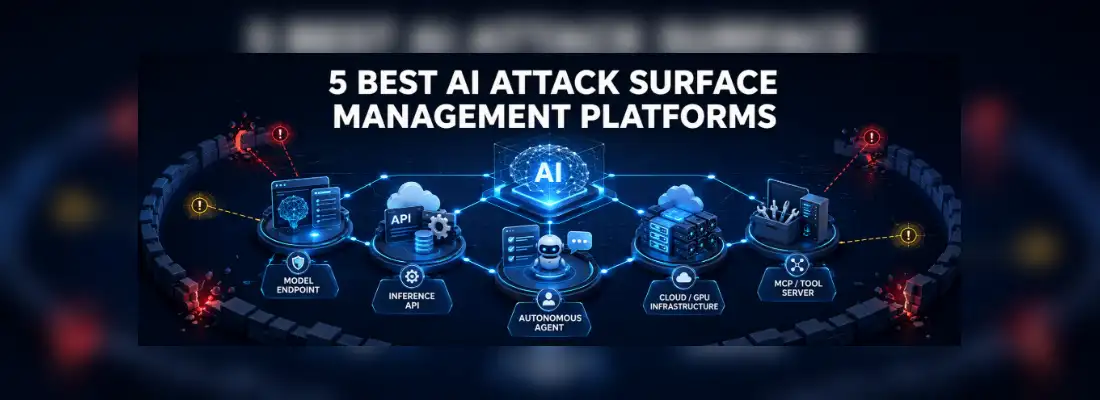
Security teams cannot manage an AI attack surface they cannot see. Models, inference APIs, agents, experimental applications, service identities, and supporting cloud resources may appear outside the inventory used for routine security reviews. Those gaps make it harder to spot exposed endpoints, risky configurations, or unmanaged deployments before they become overlooked exposures.
For this comparison, using AI inside a scanner is not enough. A qualifying product has to examine the systems and infrastructure used to deploy and run AI as part of the attack surface itself.
What Are AI Attack Surface Management Platforms?
AI Attack Surface Management platforms discover AI-related technology, assess exposed or misconfigured elements, prioritize risk, and keep track of changes as the environment evolves. Depending on the product, coverage may include models, AI applications, inference APIs, agents, service identities, MCP servers, and supporting cloud infrastructure.
Conventional EASM looks mainly at internet-facing technology such as domains, applications, servers, and public services. AI security posture management goes deeper into cloud configuration, permissions, data relationships, and model or agent posture. AI-ASM focuses specifically on the attack surface created by enterprise AI, whether the exposure appears on the public internet, inside connected cloud accounts, or across both.

How Did We Choose These AI Attack Surface Management Brands?
We ranked these products by how directly they address AI-related exposure, not by the size of their wider cybersecurity portfolios.
The evaluation focused on:
- AI discovery: Finding models, agents, APIs, AI services, and supporting technology.
- Shadow AI: Identifying deployments missing from approved inventories.
- Outside-in visibility: Showing what an external attacker could find.
- Exposure assessment: Detecting risky endpoints, weak permissions, misconfigurations, and other AI-specific weaknesses.
- Active validation: Testing whether an exposed condition presents a real security problem.
- Attack-path context: Showing how an AI weakness connects with identities, data, or other entry points.
- Change tracking: Detecting new deployments and configuration drift.
- Remediation workflow: Assigning important findings to owners and moving them through prioritization and remediation.
- Product-specific validation: Favoring evidence tied to the actual AI security function rather than recognition from another product category.
- Limitations: Accounting for areas where discovery or assessment depth is narrower.
Broader cloud, CNAPP, or EASM functions were considered only where they directly improve management of the AI attack surface. No numeric score is used because there is no universal independent benchmark for AI-ASM.
What Are the 5 Best AI Attack Surface Management Solutions?
CloudSEK AIVigil, CyCognito, Wiz AI-SPM, Cortex Xpanse, and SentinelOne Singularity Cloud Security each address a distinct AI attack surface problem.
1. CloudSEK AIVigil - Best Overall
CloudSEK AIVigil focuses specifically on AI attack surface monitoring. Its role is to show security teams where enterprise AI creates an exposed or poorly understood entry point, then connect that weakness with the wider threat picture. For organizations with AI applications and model-serving interfaces spread across teams or public-facing services, the practical question becomes which deployment creates an entry point worth fixing first.
AIVigil finds (and helps prioritize) AI-specific weaknesses such as exposed models, unsecured MCP servers, vector databases, leaked AI credentials, shadow AI, and cloud AI misconfigurations. It also creates an AI Bill of Materials (AI BOM). Security teams can then see which issue deserves attention based on the surrounding risk instead of treating every finding as equally important.
AIVigil findings feed into CloudSEK’s Nexus AI. Nexus AI correlates an exposed model API, for example, with external threat information and other possible entry points to show whether it contributes to a larger attack path. In July 2026, Tech Mahindra announced a partnership with CloudSEK that explicitly includes AI attack surface monitoring.
AI-ASM coverage
- AI system and model discovery
- AI-enabled application visibility
- Model-serving API monitoring
- Shadow AI visibility
- Model-abuse detection
- Training-data exposure
- GPU cluster risks
- Vector database risks
- AI pipeline risks
- Infrastructure misconfigurations
- Continuous AI surface monitoring
- AI attack-path correlation
Pros
- Dedicated AI surface monitoring
- AI findings gain attack-path context
Con
- Limited independent AIVigil validation
2. CyCognito - Best for External AI Exposure Validation
An internal asset list does not always match what someone can reach from the public internet. CyCognito approaches AI exposure from that outside view, making it useful for organizations that need to find AI-facing technology beyond the boundaries of their existing inventory.
Continuous pentesting and multi-step attack-chain testing help separate a publicly visible AI endpoint from one with a validated external weakness. Security teams can focus remediation on exposures backed by stronger technical evidence instead of treating every internet-facing resource as equally urgent.
CyCognito covers externally reachable MCP servers as well, extending its outside-in view to infrastructure used by agentic AI deployments.
AI-ASM coverage
- External AI asset discovery
- Unknown AI asset discovery
- Internet-facing AI services
- External API discovery
- External MCP server discovery
- Zero-input asset attribution
- Active exposure validation
- Continuous AI pentesting
- Multi-step attack testing
- Exploitability context
- AI exposure prioritization
Pros
- Outside-in AI asset discovery
- Active AI exposure validation
Con
- Limited internal AI relationship mapping

3. Wiz AI-SPM - Best for Cloud AI Environments
Cloud-heavy AI programs have a different problem. Knowing that a model or agent exists is not enough if the security team cannot see which identities, data stores, endpoints, or permissions surround it. Wiz AI-SPM addresses that relationship problem across AWS, Azure, and Google Cloud.
Wiz Security Graph connects models and agents with the rest of the cloud environment. A public inference endpoint tied to sensitive data or an overprivileged identity carries a different level of risk from an isolated development deployment. Mapping those relationships makes prioritization more meaningful because the team can see what an attacker might reach next.
AI-BOM and the AI service catalog organize the cloud AI footprint, while attack-path analysis follows risky relationships across identities, data, infrastructure, and AI components. Runtime controls add prompt-injection and rogue-agent detection for teams that need activity-level context around deployed AI.
AI-ASM coverage
- AI model discovery
- AI agent discovery
- AI service inventory
- Custom AI deployment discovery
- AI-BOM
- AI service catalog
- Public inference endpoints
- Sensitive-data relationships
- Agent permission analysis
- AI configuration assessment
- AI attack paths
- Prompt-injection detection
- Rogue-agent detection
- AI investigation workflows
Pros
- Deep cloud AI inventory
- Graph-based AI attack-path analysis
Con
- Less outside-in AI discovery
4. Palo Alto Networks Cortex Xpanse - Best for Internet-Scale Discovery
Unknown public infrastructure is the main concern Cortex Xpanse addresses. Large enterprises often accumulate internet-facing technology through acquisitions, temporary cloud projects, decentralized teams, and forgotten deployments, leaving central inventories incomplete.
Xpanse searches the public internet for infrastructure associated with the organization and surfaces AI-related technology hidden inside that footprint. A November 2025 release added AI Infrastructure Detections, including MCP Servers and MCP Inspector. These detections extend Xpanse into externally exposed AI infrastructure that may be missing from internal inventories.
External attack-surface testing examines the exposed condition before it is prioritized for remediation. Xpanse answers the external-discovery question first: which AI-facing services are visible on the internet, and which of them present a confirmed external weakness?
AI-ASM coverage
- Internet-scale AI discovery
- Unknown external AI infrastructure
- AI infrastructure detections
- MCP server detection
- MCP Inspector detection
- Public cloud discovery
- Internet-wide scanning
- External exposure testing
- Confirmed external weaknesses
- Exposure prioritization
Pros
- Internet-scale AI infrastructure discovery
- Controlled external exposure testing
Con
- Limited model-layer AI assessment
5. SentinelOne Singularity Cloud Security - Best for Unified Cloud AI Security
Shadow AI becomes harder to manage once models, services, and pipelines spread across several cloud accounts. SentinelOne Singularity Cloud Security AI-SPM addresses that problem by mapping known and unmanaged AI alongside the cloud identities, data, and configuration weaknesses surrounding it.
Verified Exploit Paths show whether a misconfigured model or deployment connects with an identity, sensitive data store, or another cloud weakness that creates a usable route through the environment. That relationship helps separate an isolated posture issue from an AI finding involved in a broader attack path.
Agentless multi-cloud discovery tracks those connections across accounts and providers as deployments change. Cloud-connected AI exposure and exploit paths are the priority. Outside-in internet discovery receives less emphasis.
AI-ASM coverage
- Shadow AI discovery
- AI model inventory
- AI service inventory
- AI deployment discovery
- AI pipeline discovery
- Cloud AI infrastructure
- AI misconfiguration detection
- Sensitive-data relationships
- AI governance context
- Verified Exploit Paths
- AI attack-path analysis
- Agentless multi-cloud discovery
Pros
- Shadow AI cloud discovery
- Cloud AI exploit-path correlation
Con
- Limited outside-in AI discovery

Conclusion
AI Attack Surface Management should solve the visibility or exposure gap that actually exists in the organization. Internet-facing AI calls for strong outside-in discovery and validation, while cloud-heavy deployments demand deeper context around identities, data, permissions, and attack paths.
CloudSEK AIVigil ranks first because its dedicated AI attack surface monitoring, AI-specific exposure assessment, and connection to wider attack-path intelligence align most closely with the criteria used in this comparison. Product selection should follow the organization’s deployment model, public exposure, cloud footprint, and remediation process.
Frequently Asked Questions
1. Is AI Attack Surface Management only for generative AI?
No. The category also covers machine learning systems, inference services, agents, and other deployed AI technology. Exact scope depends on what the product is designed to discover and assess.
2. Who should own AI Attack Surface Management?
Ownership usually spans AI security, cloud security, application security, and attack surface management teams. One group should still be accountable for inventory accuracy, risk review, remediation ownership, and remediation verification.
3. What should enterprises test during an AI-ASM proof of concept?
Start with AI resources the organization already knows about and compare them with the product’s results. Check ownership attribution, false positives, time to detect a new deployment, prioritization quality, and how findings move into remediation. A useful proof of concept should improve security decisions, not just produce a larger list of alerts.
4. How should organizations evaluate third-party AI coverage?
Check whether the product identifies third-party AI services, SaaS-based AI applications, model APIs, and other technology outside infrastructure the organization directly manages. Ownership attribution matters because third-party exposure should not be confused with internally controlled deployments.
5. Which metrics are useful for AI Attack Surface Management?
Useful metrics include unmanaged AI resources discovered, publicly exposed endpoints, high-risk misconfigurations, unresolved exposures, newly introduced deployments, and remediation time for critical findings. The goal is to measure changes in the attack surface rather than raw alert volume.

.webp)


.webp)