
Date: 30 September 2026

Cyber risk quantification is how you finally get a security budget signed off without the usual fight. For years, security teams have walked into the boardroom talking about threats and vulnerabilities. The board nods along. Then it funds something they actually understand instead. The risk was never the problem. The language was.
The fix is dead simple. Stop describing risk in vague ratings and start describing it in cold money. Once you get a firm grasp of your exposure in dollars, the whole conversation changes. This guide covers what cyber risk quantification is and why it works on a board. Then, 9 ways to use it to win the budget you need, plus the mistakes that weaken a solid case.
What Is Cyber Risk Quantification (CRQ)?
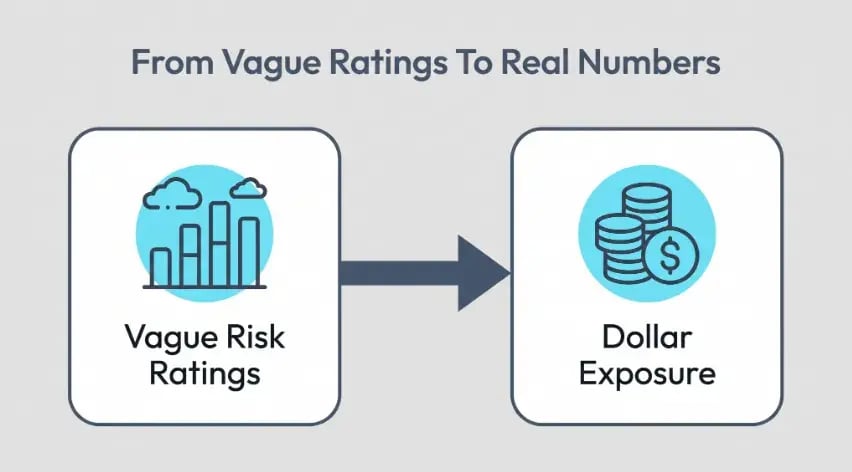
Let's keep this simple. Cyber risk quantification just means putting a real monetary value on your cyber risk. Instead of calling something high or medium, you say it could cost the business $2 million. You trade unclear severity ratings for cold, hard cash the whole leadership team already speaks.
And barely anyone pulls this off yet. Only 15% of organizations put a real financial figure on cyber threats. Yet 87% of executives say that backing the biggest risks with money is what matters most. That gap is exactly where budgets go to die.
The old approach was a color-coded heat map full of red and amber boxes. It looks neat, and it tells a CFO absolutely nothing about what to fund. A dollar figure does. It turns a vague worry into something they can weigh against every other call they make.
One quick myth to kill off. Quantifying cyber risk doesn't mean predicting the future down to the last dollar. It just means making a defensible, honest estimate that beats a gut feeling. Nobody is asking for a crystal ball. They only want a number that shows how cyber exposure feeds into wider operational risk.

Cyber Risk Quantification Vs Cyber Risk Management: Understanding The Key Differences
Cyber risk quantification and cyber risk management are closely connected, but they answer different questions. Let’s take a look.
|
Cyber Risk Quantification |
Cyber Risk Management |
|
|
Primary purpose |
Measures cyber risk in numerical or financial terms |
Identifies, manages, and reduces cyber risks |
|
Main question |
“How much could this risk cost us?” |
“What risks do we have and how should we address them?” |
|
Focus |
Risk measurement and prioritization |
Risk identification, treatment, and monitoring |
|
Typical activities |
Calculating probable losses, estimating exposure, modeling scenarios |
Assessing vulnerabilities, implementing controls, monitoring threats |
|
Key outputs |
Loss estimates, cyber risk scores, financial exposure, risk scenarios |
Risk register, security controls, risk mitigation plans, policies |
|
Decision-making use |
Helps compare cyber risks against financial impact and business priorities |
Guides security teams on which risks to mitigate, transfer, accept, or avoid |
|
Common risk assessment frameworks and methods |
FAIR Model, Monte Carlo simulations, loss-event analysis |
NIST CSF, ISO 27001, CIS Controls, Cyber risk assessments |
|
Who uses it |
CISOs, security leaders, executives, finance teams, boards |
Security teams, IT teams, risk managers, compliance teams |
Why Cyber Risk Quantification Wins Budget Approval: 4 Benefits
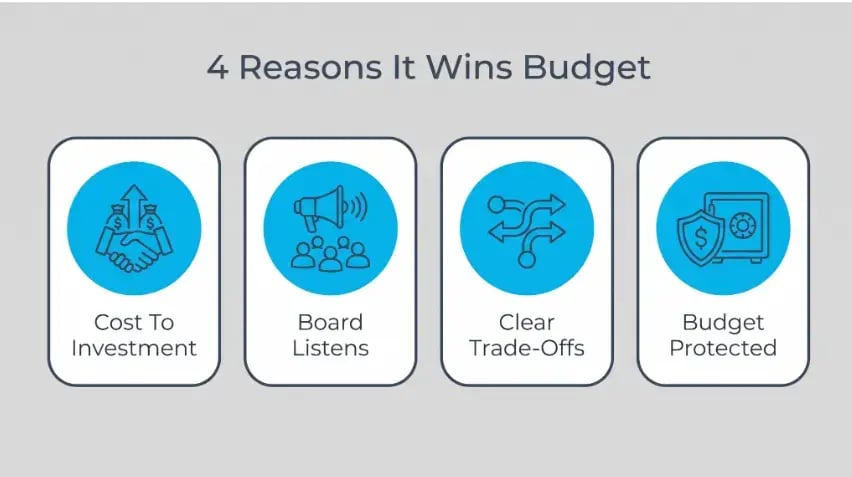
Here's why this works so well once you try it. Global security spending reached $213 billion in 2025, so the money is definitely out there. Whether your slice gets approved comes down to cyber risk quantification. These four benefits are why it works where technical explanations always flopped.
1. Reframes Security From A Cost Center Into An Investment
For years, security initiatives have been filed under unavoidable expense. A line item that only grows and never seems to pay for itself. Cyber risk quantification process changes that whole story. When you can show a control wipes out $3 million of exposure for a $200k spend, it stops looking like a cost. It starts looking like one of the smartest bets in the building.
2. Gets The Board To Actually Listen
Boards think in money and returns. That is their entire world. So the second you show up expressing cyber threats in terms they care about, they lean in. A number lets them weigh cyber against every other risk they are handling, like market risk or credit risk. It works even better once you have built a board that speaks cyber back to you.
3. Makes Trade-Off Decisions Obvious
Every security team has way more to fix than money to fix it with. Without numbers, you are choosing between projects on gut feel and who shouts loudest. With them, the choice basically makes itself. You fund whatever kills the most risk per dollar, and you can show exactly why the rest waited. No politics. Just math.
4. Protects Your Budget When The Cuts Come
Every budget gets questioned sooner or later, usually in a grim quarter. A vague program is first on the chopping block, because nobody can say what gets lost. A quantified one defends itself. When you can name the cyber risk exposure that comes flooding back the moment you cut a control, that line suddenly looks a lot harder to touch.

How To Use Cyber Risk Quantification To Strengthen Your Security Budget Case: 9 Proven Strategies
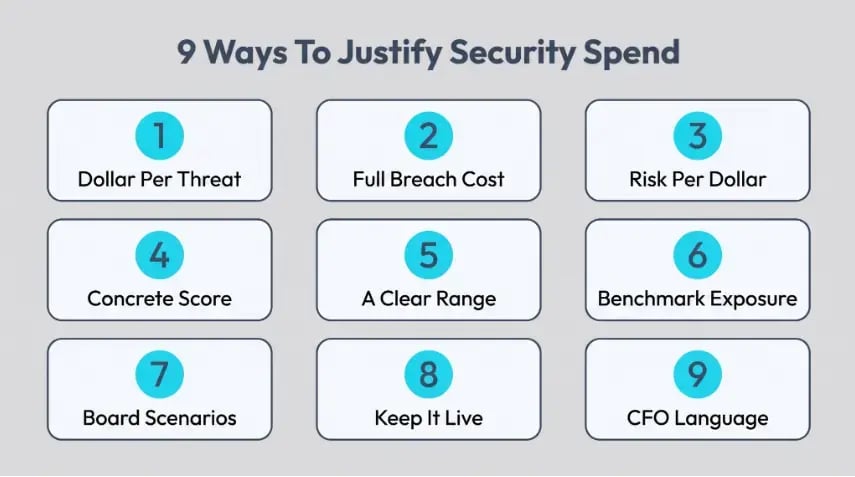
Right, this is where it gets practical. Knowing what cyber risk quantification is won't win you a single dollar. Using it well will. Here are 9 ways to turn the idea into an approved budget. Run through them in order, and the case pretty much builds itself.
1. Put A Credible Dollar Figure On Each Major Threat
This is the beating heart of the whole thing. You take a threat and work out how likely it is over a year. Then you work out what it would cost you if it hit. Multiply the two, and there is your annual figure, in plain dollars. Suddenly ransomware isn't a scary word anymore. It's a $6 million line the board can reason about.
And something shifts the moment a real number reaches the table. The argument stops being about whether the risk is even real. It jumps straight to whether the price of fixing it is worth paying. That is a much better fight to be in.
- Estimate each threat's yearly likelihood using breach data and historical data from your own environment.
- Attach a real dollar impact to every threat before you rank any.
- Multiply the likelihood by the impact to reach one annual loss figure.
- Pressure-test every single number with someone sitting outside the core security team.
2. Model The Full Cost Of A Breach, Not Just The Ransom
Most people wildly lowball what a data breach really costs. They picture the ransom and stop right there. But the ransom is usually the smallest piece of it. Downtime alone can dwarf whatever you handed the attacker. Then the legal bills and the fines come. Lost customers and months of cleanup show up long after.
The average breach now runs $4.44 million worldwide, and that is just the average. When one breach exposes millions of records, the bill climbs in a hurry. Your cyber risk quantification model has to capture all of it, not only the parts you can see coming.
This matters even more in the legal industry because the data itself is tied to active legal matters. A breach doesn’t just expose names and email addresses. It can expose medical records, financial documents, and private client communications.
Take this wrongful death legal practice. Its case files can contain sensitive information about the deceased person and their family. They may also include medical records and evidence about lost income. If ransomware takes those files offline during an active case, the problem is not limited to restoring the firm's systems.
The firm may have to bring in outside forensic specialists. Lawyers and staff may lose hours trying to recover files or reconstruct case information. A missed deadline could create another layer of legal work. Clients may also question whether their private information remains secure.
That can seriously impact business objectives and contribute to the wider financial risk even when no ransom is ever paid. Cyber risk quantification lets the firm put those scenarios into a financial view before an incident happens. And that gives business leaders something much more useful than a generic severity rating.
- Add the downtime and recovery costs on top of any ransom figure.
- Fold in the regulatory fines and the legal bills a breach creates.
- Estimate lost customers and revenue for the long months after an incident.
- Add a separate line for long-term brand and reputation damage as well.
3. Show Leadership The Risk Reduced For Every Dollar Spent
A budget ask feels completely different when it turns up with a return attached. Most requests just name a price. This one names what the money buys you… in risk removed. If a $150k tool takes $4 million of exposure off the table, that is a return any CFO respects. You are not begging for spend anymore. You are offering a trade they would be daft to turn down.
- Calculate the exposure each control removes before you ever request its budget.
- Divide the risk reduction by the cost to show a clear return.
- Present every single ask as risk removed, never just as money spent.
- Compare any two competing controls by which one buys down more risk.
4. Give Subjective Risks A Concrete Score Anyone Can Act On
Not every risk drops neatly into a dollar figure. Some are too new or too complicated to price with a straight face. The lazy move is to shrug and just call it high. But high tells you nothing on its own.
A steady score hands everyone a shared way to compare and act. Even a plain one-to-ten does the job. It beats an adjective every single time.
Not every business can judge subjective cyber risk in the same way. In some businesses, the human impact can make these cybersecurity risks especially difficult to put a number on. A system outage may look like a routine IT problem until you consider what happens when a customer can’t reach the business.
Take this in-home pet euthanasia service. If a cyber incident takes their systems offline during a busy period, staff may not know which visits are scheduled or how to reach families who are waiting for confirmation.
The financial loss may be relatively easy to estimate. The harder part is judging the subjective risk created by the disruption. A missed appointment can create intense distress for a family that has already made a difficult decision. A privacy incident can also make clients question whether sensitive information about their pet and family is being handled safely.
That is where a concrete scoring system helps. The service could score the risk based on factor analysis such as how long the system is unavailable and how many scheduled visits could be affected. It could then add a separate score for the sensitivity of the information involved and the difficulty of reaching affected clients through another channel.
The point is not to turn grief or client experience into a meaningless number. The score gives security professionals a consistent way to compare a system outage with other subjective information risks.
- Build a simple scoring scale before any risk gets rated at all.
- Define what each score number means so your ratings stay consistent everywhere.
- Score the fuzzy risks the same way across every team and quarter.
- Revisit each score whenever fresh information about the threat shows up later.
5. Express Your Estimate As A Range, Not A False Single Number
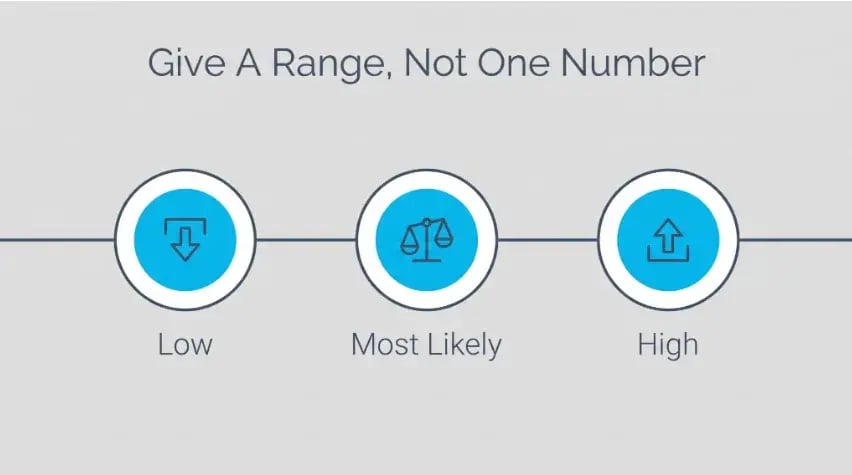
One exact number is a trap. Say a breach will cost precisely $4.24 million and someone will argue the decimals till lunch. Worse, a fake-precise figure makes you look like you are guessing in a fancy suit. A range is honest. Telling them you are 90% sure the loss falls between $2 and $2.5 million shows your working and holds up when someone pushes.
- Give every estimate a clear low and a high, not one number.
- State clearly how confident you are in the range that you present.
- Run a simple simulation to build that range straight from your own inputs.
- Explain that a wide range still beats false precision every single time.
6. Benchmark Your Exposure Against Comparable Organizations
A number on its own can be totally abstract. Ten million in exposure sounds massive, or maybe it is dead normal for your size and sector. Nobody in the room can tell until you hold it up against something.
Benchmarking against similar organizations gives your figure a frame. It also gives leadership a clearer view of your security posture against comparable organizations. This is the gap between a scary-sounding total and a clear signal you are above or below where you should be.
A number tells you almost nothing until you know how it compares with organizations facing similar exposure. That matters even more for a two-sided marketplace because the platform has to protect both sides of the transaction. A breach can affect buyers and sellers at the same time.
Let’s consider this business-for-sale marketplace, for example. The platform connects people looking to buy businesses with owners who want to sell them. That means its systems can hold information from both groups.
Listings may contain financial details about a business, while buyer accounts can contain contact information and details about what they are looking to acquire.
Now suppose an attacker gets access to seller accounts and changes listing information. Buyers could be shown false revenue figures or incorrect contact details. If buyer information is exposed at the same time, the incident affects both sides of the marketplace and creates a wider response than a breach involving one internal user group.
This is where benchmarking exposure against comparable platforms becomes useful. The team can compare its estimated loss from a compromised seller account with incidents involving similar marketplace businesses. It can also compare the potential impact of a large-scale data exposure with organizations that handle similar volumes of user and transaction data.
If the platform's estimated loss from account takeover is far higher than comparable businesses, that difference deserves investigation. It may point to weaker access controls or a larger concentration of sensitive data.
- Find breach and loss benchmarks for your own industry and company size.
- Compare your exposure against close peers before you ever take it upstairs.
- Show clearly where you sit above or below the wider sector norm.
- Use the gap to comparable firms to frame your actual budget ask.
7. Build Loss Scenarios The Board Can Picture
A number in a table is easy to forget. A story sticks. So wrap your biggest risks in a scenario the board can actually see. Walk them through the morning the ERP goes dark, and the orders stop coming. Then drop the figure at the end. A realistic tabletop walkthrough does this far better than any slide deck could.
- Pick your top few risks and build a vivid story around each.
- Describe the first hour of the incident in plain and human terms.
- Attach the full estimated financial impact to the very end of each scenario.
- Run the scenario past the board before you formally request the budget.
8. Keep The Numbers Live As The Threat Picture Shifts
A quantification done once is out of date within a few months. New threats show up, and you keep adding new systems. Attackers switch tactics without warning. Last year's number slowly slides away from reality. New cyber events can change both the likelihood of a scenario and its expected loss.
With fresh attacks surfacing every month, the board soon stops trusting a number that never moves. Figures you refresh on a rhythm keep the case believable, and threat intelligence gives you new evidence when those estimates need updating.
- Set a fixed schedule to refresh every one of your major estimates.
- Update the numbers whenever you add new systems or spot new threats.
- Track how your total exposure figure changes from one quarter to the next.
- Show the board the whole trend, not just today's single static snapshot.
9. Report Exposure In The CFO's Language Of ROI And Payback
The final stretch is all packaging. Your numbers can be flawless and still flop if they show up in security terminology. The CFO judges every cybersecurity investment on return and payback, so hand yours over in that exact shape.
Return on security investment. Payback period. Risk-adjusted return. Framed like that, your ask stops being a special case. It is just one more line they already know how to judge.
- Convert every single figure into a clear return on security investment number.
- Show a realistic payback period for each new control that you propose.
- Present your risk-adjusted returns the same way finance presents its other bets.
- Drop the security-heavy language completely and use the finance team's own words.

3 Cyber Risk Quantification Mistakes That Weaken Your Budget Case
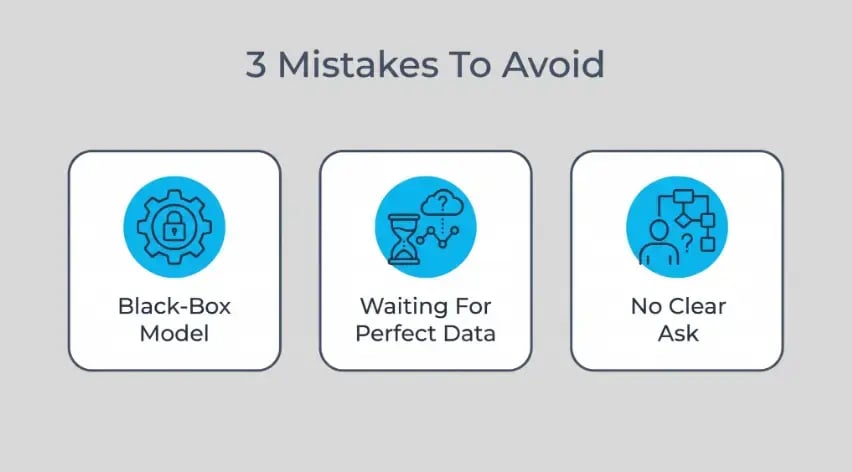
Even a solid grip on cyber risk quantification can unravel if you overlook the basics. These three mistakes weaken a good case, and every one of them is avoidable. Keep an eye out before you ever step into the room.
1. Building The Model In A Black Box Nobody Can Question
It is tempting to run your numbers through some tool and present the output like scripture. But if you can't explain how you got there, the board can't trust it. The second someone questions an assumption and you go blank, the whole figure crumbles. A number nobody can poke at is a number nobody will fund.
How to Fix: Show your assumptions and inputs out in the open. Let anyone trace how a number was built, and welcome the challenge instead of ducking it.
2. Letting Perfect Data Stall The Whole Effort
Waiting around for flawless risk data is how these projects die a slow death. There is never enough clean history to feel sure. So teams keep polishing and never present anything. Meanwhile, the budget cycle sails past, and nothing gets funded. A rough, honest estimate today beats a perfect one that turns up after the decision is already made.
How to Fix: Start with the best estimates you have and be upfront about the uncertainty. Sharpen the numbers over time, but never let missing data hold the whole ask hostage.
3. Presenting Numbers Without Tying Them To A Specific Ask
A wall of impressive figures with no actual request just informs the board. It doesn't move them an inch. If you show the exposure but never say what you need and what it buys, they will nod and do nothing. Every quantified risk has to finish with a clear and specific ask. Otherwise the whole thing was just expensive homework.
How to Fix: Close with the exact spend you want and the exposure it buys down. Make the decision a simple yes or no, not some open-ended question.
Conclusion
Cyber risk quantification helps bridge one of the most persistent gaps in cybersecurity: the gap between technical risk and business decision-making. By translating complex cyber threats into clear financial and operational impact, security leaders can give boards the context they need to make informed decisions about investment, resilience and risk.
At Cyber Management Alliance, helping leadership teams understand the real-world business impact of cyber incidents is central to what we do. Our Cyber Tabletop Exercises and Executive Cybersecurity Training bring cyber risk to life, helping boards and senior leaders understand their exposure, test critical decisions and identify where investment is needed most.
If your organisation wants to turn cyber risk into a clear, credible business case that leadership can understand and act on, speak to the Cyber Management Alliance team.

Author Bio: Burkhard Berger is the founder of Novum™. He helps innovative B2B companies implement modern SEO strategies to scale their organic traffic to 1,000,000+ visitors per month. Curious about what your true traffic potential is?
Gravatar: vip@novumhq.com

.webp)
.webp)
.webp)