Date: 24 December 2025
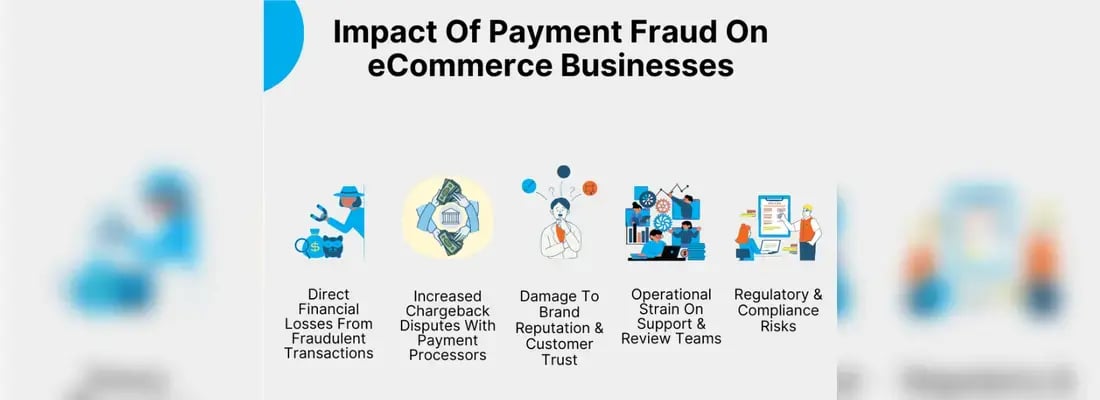
eCommerce fraud rarely shows up in obvious ways. Founders feel it when growth slows. Marketing feels it when approvals tighten. Support feels it when conversations turn tense. That is the reality most eCommerce businesses learn the hard way. And then, payment fraud prevention becomes a daily operational concern – right next to revenue and conversion.
In this article, we go beyond the usual “enable 2FA” advice. We will focus on strategies that are practical and built for real-world selling so your eCommerce business can outsmart fraudsters without turning checkout into a wall of friction.

How Does Payment Fraud Impact eCommerce Businesses: Understanding The Real Costs
Payment fraud hits every part of your eCommerce business. Let’s break down exactly where it costs you, so you know what is at stake.
1. Direct Financial Losses From Fraudulent Transactions
Every fraudulent transaction is money straight out of your pocket. When a scammer completes a purchase using stolen credit card information, you cover the cost of the goods and the shipping. On top of that, payment systems charge a fee per transaction, even if it is fraudulent, so the loss multiplies. Over time, even a handful of these transactions can erode profit margins significantly, especially for smaller eCommerce stores.
2. Increased Chargeback Disputes With Banks & Payment Processors
Chargeback fraud is the financial equivalent of a paper trail nightmare. Every disputed transaction triggers a process where your team has to submit evidence and sometimes fight the financial institutions or payment services. Even when you win a dispute, there is still a processing fee, and losing one means you eat the cost. For eCommerce merchants dealing with high dispute volumes, chargeback management software like Chargeflow can automate the entire evidence submission process, significantly reducing the time and revenue lost to each case.
High chargeback rates can flag your account as risky, which can lead to higher processing fees or even account termination. For growing eCommerce businesses, this creates constant friction with the platforms that handle your money.
3. Damage To Brand Reputation & Customer Trust
Fraud affects how real customers see you. If your system wrongly blocks legitimate buyers or delays their orders because it is catching scammers, people talk – and not nicely.
Negative reviews spread quickly. Even a handful of bad experiences online can make potential buyers hesitate right at checkout. And rebuilding trust isn’t easy – it requires giveaways, discounts, or extra support resources to repair the image.
4. Operational Strain On Support & Review Teams
Payment fraud creates constant stress on operations. Support teams spend hours explaining declined payments or investigating business email compromise incidents.
Financial professionals manually check every flagged transaction, which slows down shipping and order processing. Accounts payable teams are pulled in to verify payment requests and disputed invoice fraud transactions. That time comes straight out of projects that grow the business. Overworked teams make mistakes, which only increases the problem.
5. Regulatory & Compliance Risks
Fraud isn’t just a business problem – it is a compliance problem. Failing to follow PCI DSS standards or allowing repeated fraudulent payments can trigger fines or legal action. This becomes even riskier when wire transfer fraud is involved, as recovered funds are rare once payments leave the account.
Depending on your market, local financial regulations may impose heavy penalties if sensitive data is compromised or security measures aren’t up to code. Staying on top of regulations is expensive, but skipping them is far worse.

7 Most Common Types Of eCommerce Payment Frauds
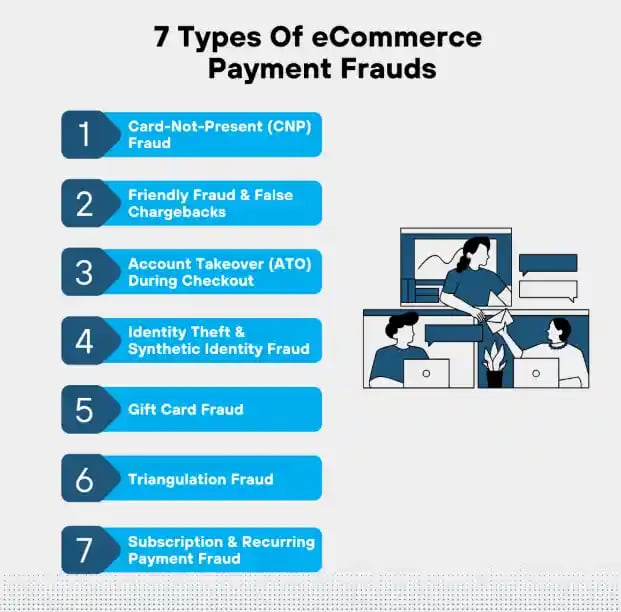
Fraudsters don’t play fair, and they have plenty of ways to creep past your checkout for financial gain. Here’s a look at the 7 types of payment fraud, so you know exactly what to watch for.
1. Card-Not-Present (CNP) Fraud
This credit card fraud is the classic online scam, but it is more sophisticated than it sounds. The fraudster has stolen card details – maybe from a customer data breach or dark web purchase. They then use them to buy products without physically presenting the card. Since there is no chip or swipe, it is up to your checkout systems to detect suspicious patterns.
Card-Not-Present fraud starts small with small orders to test validity. It then moves straight to bulk purchases of high-value items once the card works. Even with basic verification, these orders can make it through, especially if your financial fraud filters are only looking at single triggers like shipping address mismatches.
2. Friendly Fraud & False Chargebacks
Some customers order, then claim they didn’t – or didn’t authorise it. This isn’t always malicious. It can be a misunderstanding, but some do it deliberately. Either way, you end up fighting chargebacks and proving delivery.
That is weeks of work and sometimes lost revenue. If it happens a lot, processors start treating you like a risky account, which makes everything from fees to payment holds worse.
3. Account Takeover (ATO) During Checkout
Hackers love taking over legit user accounts. They gain access to stolen account information and passwords from breaches or credential stuffing. And once inside, they change shipping addresses or place large orders using saved payment methods.
The trick with ATO is that it looks like normal user behaviour at first. You see repeat purchases, but suddenly the shipping address or payment behaviour changes slightly. And if your system automatically approves saved payment methods, you end up shipping high-value items to scammers without realising.
4. Identity Theft & Synthetic Identity Fraud
Synthetic identities are a nightmare because they are half real, half fake. Fraudsters mix real social security numbers or emails with fake names and addresses. These accounts pass normal verification checks to buy expensive items and then vanish.
Unlike traditional identity theft, there is no obvious payment fraud victim until months later. Automated fraud checks usually don’t catch it, so it quietly keeps taking revenue while your team wonders why things keep slipping through.
5. Gift Card Fraud
Gift cards are an easy target. Fraudsters steal bulk card numbers or exploit promotional deals, then use them to buy products or resell them. Many stores don’t verify gift cards in real time, so fraudulent redemptions show up only during reconciliation. It is simple, but it hits profit margins hard, especially during holidays or promotions when card use spikes.
6. Triangulation Fraud
This one is multi-layered. The fraudster sets up a fake storefront with high-demand products at low prices. Customers place legitimate orders, paying the scammer. The scammer then buys the same items from your store using stolen credit cards and ships them straight to the customer.
The buyer thinks they are getting a legit deal, but your store bears the cost of the stolen payment. It is a full-circle fraud designed to obtain money and is extremely hard to detect because every transaction looks like normal customer activity.
7. Subscription & Recurring Payment Fraud
Fraudsters exploit recurring billing to drain bank accounts or commit payment fraud that is small but repeated. They use stolen payment information or fake accounts to sign up for subscriptions and let the recurring charges pile up.
Because payments happen automatically, it can take weeks or months before anyone notices. By then, multiple cycles have gone through, and your revenue is tied up in chargebacks. For subscription-based stores, this type of fraud blends right into the regular cash flow, which makes it extremely dangerous.

7 Payment Fraud Prevention Strategies Every eCommerce Store Must Implement

Preventing payment fraud is about putting the right checks in place at every step. Here are 7 security measures every online store needs to keep scammers from hitting your checkout.
1. Implement Address Verification & CVV Checks
Address verification and CVV checks are your first line of defense. They make sure the person entering the credit or debit card details actually has access to it.
AVS compares the billing address entered at checkout with the card issuer’s records, while the CVV ensures the buyer has the physical card. Together, they stop a large number of stolen card transactions before they even process payment instructions.
What to Do:
- Require full street number matching through AVS (not ZIP-only checks), especially for high-ticket SKUs.
- Make CVV entry mandatory for all card payments, even for returning customers.
- Flag transactions where AVS and CVV don’t match for manual review before shipping.
- Integrate AVS/CVV checks with your payment gateway to automate declines.
- Keep a record of all failed AVS/CVV attempts and monitor for patterns from repeated IP addresses or accounts.
Real-World Example: Wild Orchard
Wild Orchard ships different types of tea across the U.S. They noticed an increase in declined payments that turned into disputes when orders went through anyway. They dug into their payment gateway settings and realised AVS wasn’t enforcing full street number matching.
Wild Orchard switched it so the checkout must match billing street, not just ZIP, and they kept CVV mandatory for every purchase, even from repeat buyers. Within weeks, orders with mismatched addresses and missing CVVs dropped dramatically.
When mis-typed addresses came through, their system flagged them for review instead of automatically approving. These changes stopped a pattern of stolen card use being shipped to courier lockers and cut related losses almost immediately.
2. Use Multi-Factor Authentication For Payments
Multi-factor authentication (MFA) is your second gate. Even if someone has stolen a card, they usually can’t pass the extra step – a code sent to the user’s phone or email. MFA works especially well for high-value orders or suspicious payment behaviours. MFA kills account takeovers in their tracks.
What to Do:
- Trigger SMS or email OTPs for all orders over a certain amount.
- Use app-based MFA (Google Authenticator, Authy) for accounts with saved payment methods.
- Require MFA when a shipping address or device location changes from the customer’s normal patterns.
- Track and log failed MFA attempts to identify potential credential stuffing or account takeover attempts.
- Offer customers a “trusted device” option to reduce payment fraud, but limit it to devices verified via email confirmation.
Real-World Example: HomeRun
HomeRun was dealing with account takeovers where fraudsters logged into accounts with saved cards and changed addresses. They rolled out MFA on checkout for accounts with stored payment methods. Instead of only sending a text code, they layered it with app-based push notifications when the device or location didn’t match prior history.
Once logged in, if someone tried to place a payment from a new device or IP, a second code popped up before the purchase completed. After implementing this, they saw unauthorised order attempts drop quickly because stolen credentials alone weren’t enough to finalise checkout.
They also required MFA when shipping addresses changed, which stopped a wave of redirected orders.
3. Deploy Real-Time Transaction Risk Scoring
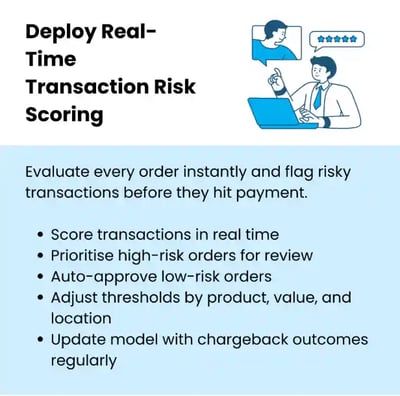
Risk scoring evaluates every order in real time to determine the likelihood of fraud. It checks everything – IP location, purchase history, device fingerprint, velocity of orders, payment method.
It then gives each transaction a score. High-risk orders can be flagged or declined instantly. This matters even more for mobile payments, where speed and limited screen space reduce friction but also reduce visible security signals. The point here: you prevent fraud without slowing down your real buyers.
What to Do:
- Score transactions before authorisation so risky orders never reach settlement.
- Weight signals differently for product category, order value, and customer age.
- Auto-approve low-risk scores and reserve manual review for a narrow middle range.
- Feed chargeback outcomes back into the scoring model weekly to improve accuracy.
- Set separate score thresholds for domestic and cross-border transactions.
Real-World Example: Sewing Parts Online
Sewing Parts Online integrated a real-time risk scoring engine that analyses dozens of signals before the payment gets authorised. When a purchase looks risky, it either blocks it outright or forwards it to a flagged queue for review.
They tuned scoring thresholds based on product type – low-value trims passed easily, while high-value machines required higher confidence scores. This reduced fraudulent orders, and they saw fewer false positives because scoring logic pulled from their own historical order data rather than a generic system.
4. Use AI For Real-Time Payment Fraud Detection
AI is basically your eyes on every single transaction at lightning speed. It picks patterns across hundreds of signals at once – device fingerprints, shipping and billing combos, order velocity, and even behaviour quirks like typing speed or checkout timing. And it keeps learning. So it gets better at spotting fraud that traditional rules miss.
What to Do:
- Use an AI tool that scores transactions instantly and flags anything unusual.
- Feed historical data – fraud cases, chargebacks, cancelled orders – so the AI knows what your day-to-day orders actually look like.
- Set thresholds for automatic blocking vs. manual review to balance protection and checkout speed.
- Track patterns over time to catch repeat fraudsters using multiple accounts or IPs.
- Run trial prototypes of your scoring models on historical data before applying rules broadly. This ensures the system flags genuinely risky transactions without blocking legitimate buyers.
Real-World Example: ClearSale For Heartbreaker Guitars
Heartbreaker Guitars, an online store selling custom instruments, partners with ClearSale’s AI-powered system. Instead of just running simple checks, ClearSale’s platform analyses patterns across device behaviour, transaction timing, past chargebacks, and order velocity all at once.
When AI spots a transaction that is unusual – like a new buyer with high-value orders coming from a foreign IP range – it automatically flags it. ClearSale then applies human review to borderline cases so legitimate customers aren’t rejected. Using this setup, Heartbreaker saw a sharp drop in chargebacks without unnecessarily declining legitimate orders.
5. Set Velocity Rules & Transaction Limits
Fraudsters love moving fast – multiple small fraudulent purchases in minutes or testing stolen card data. Velocity rules and limits slow down fraudulent activity without stopping real buyers, and they make fraud attacks visible before they spiral.
What to Do:
- Limit how many transactions a single card, account, or IP can make per hour/day.
- Cap order amounts for first-time buyers or unverified accounts.
- Watch for multiple shipping addresses tied to the same payment method.
- Trigger alerts if an account suddenly jumps in order frequency or value.
- Freeze or require verification on accounts that hit velocity thresholds repeatedly.
Real-World Example: Custom Sock Lab
Custom Sock Lab saw fraudsters making a bunch of small orders quickly to test stolen card numbers. They set up velocity rules that limited how many orders one card, IP, or account could make in a short time window. If an account suddenly tries 5 payments in 10 minutes or 3 different cards in the same hour from the same device, their system flags it for verification.
They also capped first-time buyer order value to a moderate threshold. These limits let real customers check out normally but stopped repeated test placement attempts in their tracks, and made ongoing card-testing attacks obvious before they could land larger purchases.
6. Conduct Manual Review For High-Risk Orders
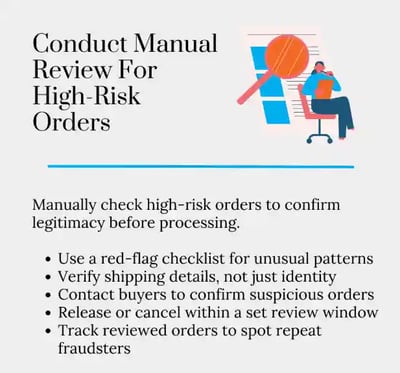
Some activities just can’t be caught by fraud detection tools. High-risk orders need a closer look. Manual review works when used like a scalpel. It confirms intent on orders that sit between safe and unsafe.
What to Do:
- Add a “red flag checklist” to your employee training program: unusual addresses, new emails, multiple cards, high-value items.
- Verify shipping logic, not identity alone. Rush shipping plus a new address matters.
- Call or email the buyer to confirm unusual orders before shipping.
- Release or cancel within a fixed review window to protect fulfillment flow.
- Keep a record of every reviewed order to identify patterns or repeat fraudsters.
Real-World Example: EXT Cabinets
EXT Cabinets handles custom woodworking pieces where orders vary drastically in size and value. Their system flags orders that hit risk thresholds – like a big ticket woodworking kit ordered by a brand new account with minimal history and a shipping address that isn’t near previous purchases.
Staff then perform a quick internal review using a checklist they created: unusual email domains, multiple new cards, or inconsistent contact phone numbers. If enough red flags stack, they reach out to the buyer via the account email.
This simple contact step often proves legitimacy without shipping. And keeping tight windows on shipping after review ensures they don’t hold orders too long.
7. Strengthen Merchant Account Security & Access Controls
Your merchant account is where all the money flows. One hacked login, and a fraudster can reroute payouts, change payment methods, or manipulate orders. Tight security stops these fraud attempts before they starts.
What to Do:
- Assign access based on task, not title. Support should not touch refunds.
- Require multi-factor authentication for anyone who can move money.
- Log every refund, rule change, and payout update automatically.
- Lock payout destination changes behind approval workflows.
- Review access after role changes, not just during audits.
Real-World Example: Blue Ridge Home Fashions
Blue Ridge Home Fashions had a scare where an admin’s old credentials were exposed – luckily they caught it before payouts were changed. They reorganised access so that only specific finance team members can initiate refunds or payout destination changes. They added MFA for all admin logins, especially for roles that touch payment settings.
Any attempt to change refund rules, raise order limits, or update payout accounts now triggers logged alerts sent to leadership. They also set role-based access so customer support can’t issue refunds independently.
These tighter internal controls made sure that even if one login was compromised, a fraudster couldn’t reroute funds or alter key payment behaviours without passing multiple safeguards.
Conclusion
Payment fraud prevention is a part of your business you can’t skip. So, the real takeaway is this: build layers that work together. The other piece is control. Do these consistently, and the pressure disappears. Chargebacks drop, and your customers stay happy without ever knowing the fight happening behind the checkout.
At Cyber Management Alliance, we have built our whole approach around making sure organisations get ahead of threats with clarity and confidence. We have helped over 750 organisations and 5,000 individuals around the world tighten up their risk management, incident response, and cyber resilience. Book a discovery call or contact us to explore how we can help you build lasting resilience.
Gravatar: vip@novumhq.com
Author Bio: Burkhard Berger is the founder of Novum™. He helps innovative B2B companies implement modern SEO strategies to scale their organic traffic to 1,000,000+ visitors per month. Curious about what your true traffic potential is?
.webp)