
Date: 24 March 2026
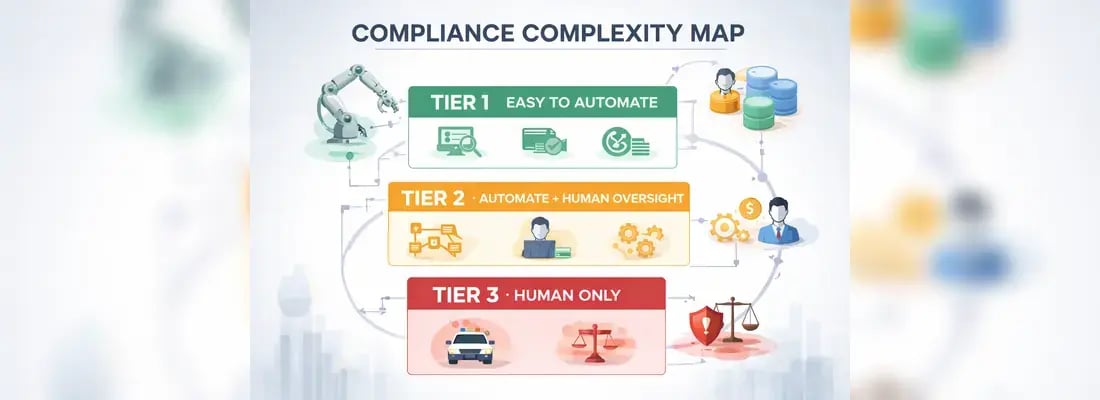
Compliance teams waste hours on the wrong tasks. Some work belongs in an automated workflow. Some work will always need a human. Knowing the difference saves time, money, and audit headaches.
Key Takeaways
- Rule-based, repetitive tasks are where automation delivers the most value.
- Human judgement is non-negotiable for governance, legal interpretation, and breach response.
- False positives erode team trust in automated systems over time.
- Data silos silently break automation — even when the tools are working perfectly.
- Most compliance failures happen in the middle ground, where teams assume automation finished a job it only started.
Tier 1: Easy to Automate
These tasks follow fixed rules. The inputs are consistent. The outputs are predictable. Automation handles them cleanly and reliably.
Access log collection runs on a schedule. It pulls the same data from the same source every time. There is no judgement involved.
Patch status reporting works the same way. A system either has the patch or it doesn't. That's a binary check — perfect for automation.
Configuration scanning can run continuously. It checks whether controls are active, flags deviations, and logs the results without any manual input.
Consent and data retention tracking also fits here. The rules are set in advance. The system checks compliance against those rules automatically.
The common thread is simple: no context needed, no edge cases, no judgement calls. If the task can be described as "check X against rule Y," it belongs in Tier 1.
Automating these tasks frees your compliance team for higher-value work. That's the real win — not just speed, but focus.

Tier 2: Automation Helps, But Humans Must Finish the Job
This is where most teams get burned. They automate a process, assume it's handled, and walk away. Then an audit reveals the gaps.
Workflow orchestration is a clear example. Automated workflows handle repeatable, linear tasks well. But compliance processes branch constantly — different rules for different jurisdictions, exceptions for legacy systems, edge cases no one documented. When the workflow hits one of those forks, it stalls or skips a step. And no one gets an alert.
Control validation has a real ceiling. Most automated tools confirm a control exists. They don't confirm it's working. A firewall rule can pass a scan and still be configured wrong. An access policy can show as active while granting permissions it shouldn't. Automation gives you a green checkmark. It doesn't give you assurance.
False positives quietly destroy team confidence. Automated scanners flag hundreds of potential issues. Many are not real. Teams that chase too many dead ends start tuning out alerts altogether. That's when genuine violations get missed — buried under noise the system created.
Regulatory change management falls here too. Frameworks evolve constantly. Every update means someone has to manually review what changed, interpret how it applies to your environment, and update your automation rules accordingly. A tool stays current with the version it was last configured for. It doesn't update itself.
The compliance complexity map looks very different at this tier. It's not a checklist. It's a process that needs a human checkpointing the output.
Tier 3: Human-Only — No Automation Can Replace This
Some compliance requirements were never designed to be automated. They require trained judgement. They involve context that no tool can read.
Incident response decisions sit firmly here. You can automate detection. You can automate ticket creation. You cannot automate the decision about how to contain a breach, who to notify, in what order, or what your legal disclosure obligations are in that specific situation. Those calls need a qualified human. They also need to be documented with reasoning — not just timestamps.
Legal and regulatory interpretation is irreplaceable human work. Regulations are written in language that requires context to apply correctly. Two companies in the same industry can read the same clause and reach different conclusions based on their architecture, data flows, and business model. No tool handles that nuance.
Vendor and third-party risk assessments require qualitative judgement. You can automate the data collection — questionnaire responses, security ratings, contract terms. Deciding whether a vendor's posture is acceptable for your risk tolerance is a human call every time.
Policy governance and executive sign-off cannot be scripted. Writing policies, assigning control ownership, running risk committees, getting leadership to formally accept risk — these are organizational decisions. Automation can surface the data that feeds those decisions. It cannot make them.
Auditors across major frameworks are increasingly asking for documented human reasoning. A person rubber-stamping automated output doesn't meet that bar. The review has to be meaningful, not nominal.

The Hidden Problem That Breaks All Three Tiers
Even tasks that belong in Tier 1 often end up manual. The reason is almost always the same: the data is scattered.
Access logs live in one platform. Patch records in another. Policy documents sit in a shared drive managed inconsistently by three different people. When you need to pull evidence for an audit, you're not running a compliance process anymore. You're running a separate data-gathering project first.
This is where the compliance automation gap quietly widens. Your tools work. Your data just doesn't connect.
Naming conventions make this worse than most teams realize. If IT calls something a "critical asset" and finance logs it under a different label, automated controls that depend on matching fields across platforms will silently fail. No error message. No alert. Just missing evidence when the auditor asks.
Poor tool integration creates blind spots in the same way. When your identity platform, cloud infrastructure, ticketing system, and policy management tool all store data in separate silos, pulling together a complete compliance picture means doing it by hand. And manual assembly is where accuracy breaks down.
The fix isn't more automation. It's fixing the data architecture that automation depends on.

FAQs
Can compliance ever be fully automated?
No. Legal interpretation, governance decisions, and breach response require human judgment. Automation handles the repeatable, rule-based work well — and that's genuinely valuable. But every compliance program still needs trained people overseeing the output.
Why do automated controls pass audits but still leave real gaps?
Because most tools confirm a control exists, not that it works. A misconfigured firewall rule can pass a configuration scan. An access policy can show as active while granting excessive permissions. Automation validates presence. Humans validate function.
What causes false positives in compliance automation, and why does it matter?
False positives happen when tools flag issues that don't meet the threshold for a real violation. They matter because teams that see too many of them start ignoring alerts entirely. When that happens, genuine violations hide in the noise.
What's the most common compliance automation mistake?
Treating automation as a finish line instead of a starting point. Teams configure a workflow, watch it run, and assume the task is done. In Tier 2, automation handles part of the process. A human still needs to review the output, validate the result, and document the reasoning.
.webp)
.webp)
.webp)