Date: 7 January 2026
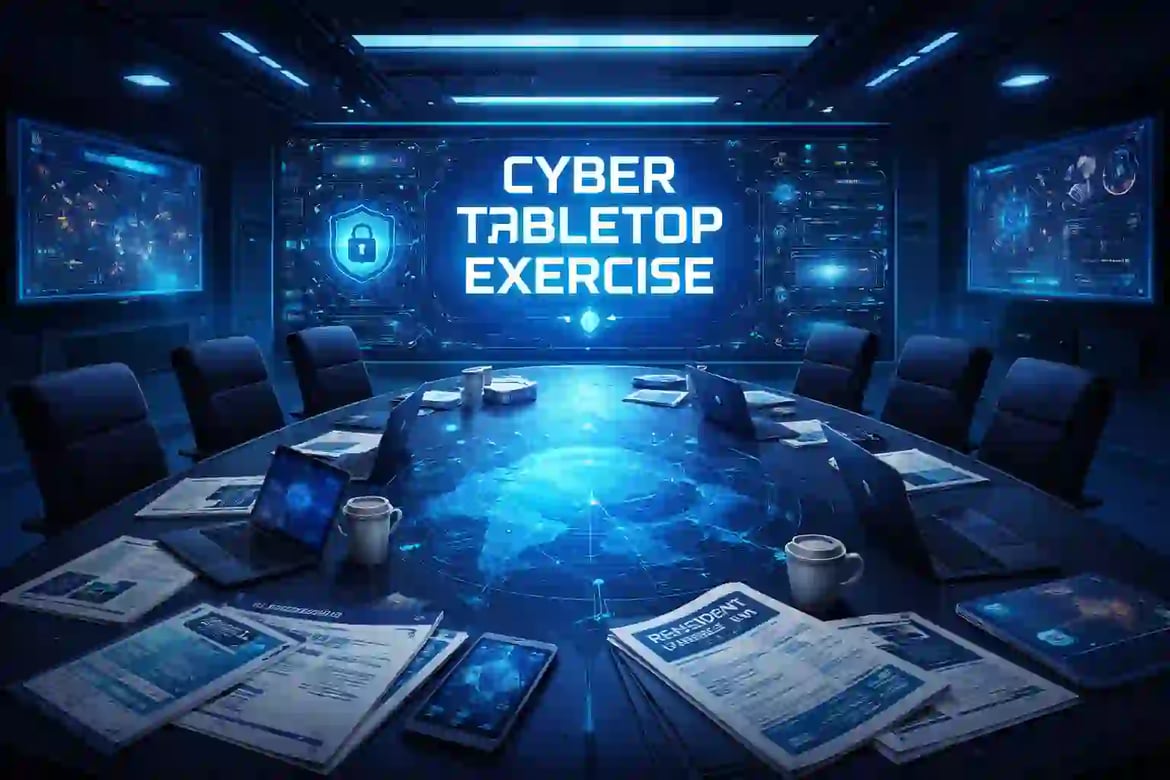
Cyber Tabletop Exercises are structured, cyber attack scenario simulations. They allow organisations to rehearse their response to cyber incidents without disrupting regular operations.
During the Cyber Drill, participants get to practice decision-making and executing their roles and responsibilities in the event of a cybersecurity incident. These drills also test the effectiveness of your organisation’s Cyber Incident Response Plan and show you the gaps that exist in your cyber resilience protocols, processes and infrastructure.

Cyber Management Alliance is the definitive world leader in planning, producing and conducting effective cybersecurity tabletop exercises. We have helped over 400 organisations in the last 10 years enhance their cyber resilience with our bespoke cyber drills. What makes our Cyber Tabletop Exercises stand out are the expert facilitation and the deep investment in creating curated scenarios for our clients.
In our experience, organisations that rehearse cyber attack scenarios regularly recover faster, communicate better, and suffer less damage from ransomware and major cyber events.
It’s also important to remember that cyber drills are no longer a “best practice”. They are regulatory and legal obligations in many cases, depending on the geography and industry your business operates in.
Most Commonly Asked Questions About Cyber Tabletop Exercises
In the next few sections, we take you through the most commonly asked questions about cybersecurity tabletop exercises. We break down the answers into simple and small nuggets so you can truly understand what cyber drills do for your business.
1. What Is a Cyber Tabletop Exercise?
A Cyber Tabletop Exercise is a guided simulation of a cyber incident. It is run in a discussion-based format where participants respond to evolving events in real time. It is always advisable to have an external, expert facilitator conduct your cyber tabletop exercise. They bring deep experience and an unbiased perspective to your cyber drill resulting in the most honest evaluation of your cyber readiness.
What a Cyber Drill tests:
- Incident response decision-making
- Executive judgement under pressure
- Legal, regulatory and communications readiness
- Cross-team coordination
- Time-to-containment and escalation clarity
What it does not test
- Firewall strength
- Malware detection accuracy
- Technical exploitability (that’s pen testing)
Essentially, a cyber tabletop exercise simulates a cyber attack to test organisational response and leadership decisions. It also checks if your crisis coordination will hold water in the event of a real-world cyber attack.
2. What to Expect During a Cyber Tabletop Exercise
A cyber tabletop exercise is a guided simulation. A Cyber Drill is not a presentation or theoretical discussion.
Participants are taken through a realistic cyber incident in real time. An experienced facilitator will unravel the scenario in stages. Your team will need to make decisions under pressure. The purpose is not to “pass” the exercise, but to surface how the organisation truly behaves when things go wrong.
At the outset, participants are briefed on the context of the scenario. It could be a ransomware intrusion, cloud account compromise, or third-party breach. This briefing is intentionally limited. Just enough information is introduced to mirror the uncertainty present during a real incident. Teams are then required to respond using their existing knowledge, playbooks and authority structures rather than being coached toward “correct” answers.
As the exercise progresses, new injects are introduced. Injects may include:
- Data exfiltration
- Media interest
- Regulator queries
- System outages
- Ransom demands.
Each inject forces participants to make decisions that have operational, legal, financial and reputational implications. Importantly, these decisions often expose gaps in ownership, priorities, or dependencies that were never previously tested.
Executives are expected to make judgement calls, not delegate everything to technical teams. Legal teams must weigh notification obligations. HR may need to address employee concerns. Communications leads must consider external messaging while facts are still emerging. This cross-functional pressure is deliberate, because cyber incidents rarely remain technical for long.
A well-run cybersecurity tabletop exercise includes active facilitation and challenge. Assumptions are questioned, timelines are tested, and participants are asked to explain why a particular decision is being made. This creates healthy tension and realism while keeping the session constructive.
The exercise concludes with a structured debrief. This is one of the most valuable phases. Your experienced facilitator will walk you through what worked, what failed, where delays occurred, and which decisions were unclear or poorly coordinated.
These insights are then translated into specific, actionable improvements. The recommendations may include playbook updates, escalation changes, or additional controls. Overall, the debrief and recommendations ensure that the exercise leads to measurable improvement rather than a one-off discussion.

3. How to Measure ROI from a Cyber Tabletop Exercise
The return on investment from a cyber tabletop exercise is often misunderstood because it does not come from preventing attacks outright. Instead, its value lies in reducing the impact, duration and chaos of incidents that are increasingly inevitable. When measured correctly, tabletop exercises deliver both quantitative and qualitative ROI.
Some of the most critical indicators of ROI of a cyber drill are the following:
- Reduction in Decision-Making Time: This is one of the most direct indicators of ROI. Organisations that have rehearsed cyber crisis scenarios consistently make faster and more confident decisions during real incidents. Time saved during containment, escalation and shutdown decisions directly correlates with reduced data loss, less downtime and lower financial impact. Comparing response timelines before and after tabletop exercises provides a clear, measurable improvement.
- Clarity of Roles and Responsibilities: Tabletop exercises expose confusion around who can authorise actions such as system isolation, regulatory notification or external communications. After remediation, organisations often see fewer internal delays and less contradictory guidance during incidents. This reduction in friction significantly lowers recovery costs and reputational damage.
- Lower Recovery Costs: From a financial perspective, tabletop exercises help organisations avoid unnecessary costs. These include costs from prolonged outages or emergency consultancy spend. Regulatory penalties arising from delayed reporting can also be very expensive. Regular tabletop exercises can help reduce these unnecessary expenses. While these avoided losses may not appear as a line item, they represent substantial risk reduction.
- Stronger insurance and regulatory posture: Insurers increasingly assess incident preparedness when underwriting cyber policies or handling claims. Organisations that can demonstrate rehearsed response, documented lessons learned and updated playbooks are in a stronger position during claims negotiations and regulatory reviews. This can influence premiums, coverage decisions and enforcement outcomes.
- Leadership confidence and organisational resilience: Boards that have participated in tabletop exercises are better equipped to oversee cyber risk. They are equipped to make informed decisions under pressure. This confidence translates into more decisive governance during real incidents. This may be difficult to quantify but is extremely valuable to organisational resilience. At Cyber Management Alliance, we offer specialised Cyber Tabletop Exercises for Executives which focus on enhanced leadership response to cyber crisis. Designed specifically for the time-crunched C-suite, this format of cyber drills consumes less time but also packs in all the relevant information.
- Continuous improvement outputs. Each tabletop exercise should result in tangible changes. Updated incident response plans, improved communication workflows, refined escalation paths and clearer third-party dependencies may be some of the improvements that an organisation sees after a cyber drill. Tracking these improvements over time provides evidence that tabletop exercises are actively strengthening the organisation rather than simply fulfilling a compliance requirement.
4. Why a Successful Cyber Drill Needs an Expert, External Facilitator
While many organisations attempt to run cyber tabletop exercises internally, the most effective and high-impact drills are almost always designed and facilitated by experienced external specialists. This is not a reflection of internal capability. It is a recognition of how cyber crises truly unfold and how difficult it is to objectively test one’s own preparedness.
Here’s a look at the main reasons why a Cyber Tabletop Exercise must always be conducted by an experienced, external facilitator:
- Objectivity: Internal teams, particularly those who authored incident response plans, are often unconsciously biased toward making the exercise “work.” They know how the story is supposed to end and may steer discussions toward familiar or comfortable outcomes. An external facilitator has no attachment to existing processes. They are free to challenge assumptions, expose blind spots, and push participants into uncomfortable but realistic decision territory.
- Real-world incident experience: Having worked across multiple ransomware cases, data breaches, regulatory investigations and executive crisis scenarios, external facilitators bring the kind of rich and diverse experience that’s impossible to replicate inhouse. They understand how threat actors behave, how regulators respond, and where organisations typically falter. This allows scenarios to be grounded in current attack patterns rather than hypothetical or outdated threats. The result is a drill that feels uncomfortably realistic, which is exactly the point.
- Authority: Senior executives are far more likely to fully engage, debate, and commit to decisions when challenged by an independent expert rather than a colleague or subordinate. External facilitators create psychological realism by introducing pressure. They add ambiguity and challenge to the exercise without the shadow of internal politics. This helps surface genuine leadership dynamics and decision bottlenecks that would otherwise remain hidden.
- Structured and paced delivery: Our facilitators have experience in conducting over 400 tabletop exercises in cyber security. They know when to accelerate the scenario, when to pause for reflection, and when to introduce new injects that force decisive action. Without this experience, tabletop exercises often become lengthy discussions that fail to test time-critical judgement or escalation clarity.
- Credible lessons learned: Feedback coming from an independent expert carries more weight at board and executive level. It enables organisations to translate observations into tangible improvements. Different teams are more inclined to accept feedback on existing playbooks, authority models, targeted investments etc from an external expert without defensiveness or blame.
In a threat landscape where cyber incidents are inevitable, the role of an expert facilitator is not to make the exercise smoother or more comfortable. It is to make it real, challenging and transformational. The idea is that when a real crisis strikes, the organisation responds with confidence rather than confusion.

5. What Makes a Good Cyber Tabletop Exercise?
Core components (non-negotiable)
- Realistic scenario
- Ransomware
- SaaS compromise
- Supply-chain breach
- Insider threat
- Cloud identity takeover
- Ransomware
- Role-accurate participants
- CEO / COO
- CIO / CISO
- Legal & compliance
- HR
- Communications / PR
- IT & Security leadership
- CEO / COO
- Time-pressured decision points
- Shut systems down?
- Notify regulators?
- Engage insurers?
- Negotiate with cyber criminals?
- Pay or refuse ransom?
- Communicate publicly?
- Shut systems down?
- Facilitated challenge
- Assumptions questioned
- Gaps exposed
- No “perfect answers”
- Assumptions questioned
- Lessons learned & playbook updates
- What slowed us down?
- What was unclear?
- What failed entirely?
- What slowed us down?
6. Are Cyber Tabletop Exercises Required for Compliance?
Increasingly, yes - either explicitly or implicitly.
Regulatory & framework alignment
- NIST CSF 2.0: “Govern” and “Respond” functions
- ISO 27001 & ISO 22301: Incident preparedness and Business Continuity/Disaster Recovery
- EU DORA: Operational resilience testing
- NIS2: Incident handling and leadership accountability
Regulators may not always mandate tabletop exercises by name. But they do expect proof of rehearsed cyber incident response. Tabletop exercises provide this proof and act as a demonstration of your commitment to cyber and operational resilience.
7. Who Are Cyber Tabletop Exercises For (and Who They’re No For)?
Best suited for
- Medium to large enterprises
- Regulated industries (finance, healthcare, aviation, energy)
- Boards and executive teams
- Organisations with existing IR plans that haven’t been tested
Not ideal for
- Very early-stage startups with no defined processes
- Organisations looking only for technical vulnerability testing

8. Cyber Tabletop Exercises vs Penetration Testing - What’s the Difference?
|
Aspect |
Cyber Tabletop Exercises |
Penetration Testing |
|
Focus |
People, processes and decisions |
Technical vulnerabilities |
|
Participants |
Executives, legal, IT, PR, risk |
Security engineers |
|
Format |
Scenario-based discussion |
Live technical testing |
|
Outcome |
Faster and more effective response. Clearer roles. Better Communication flows. |
Vulnerability findings |
|
Tests Crisis Communications |
Yes |
No |
|
Tests Decision Authority |
Yes |
No |
Key Insight:
Pen testing finds how attackers get in.
Tabletop exercises reveal what happens after they’re already inside.
Both are complementary — not interchangeable.
9. Do Cyber Tabletop Exercises Reduce Ransomware Damage?
Yes, definitely. We also offer a Ransomware Tabletop Exercise specifically targeted at reducing damage during a ransomware attack.
What tabletop-trained organisations do better in the midst of a ransomware attack
- Contain incidents faster
- Make clearer shutdown decisions
- Avoid conflicting executive instructions
- Communicate consistently with regulators and customers
- Reduce recovery time and reputational fallout
Before vs After Ransomware Tabletop Exercises
|
Without Tabletop Exercises |
With Regular Tabletop Exercises |
|
Confusion over authority |
Clear command structure |
|
Delayed containment |
Faster isolation |
|
Messaging chaos |
Pre-approved communications |
|
Panic decisions |
Rehearsed judgement |
|
Longer downtime |
Reduced Mean Time To Respond |

10. How Often Should You Run Cyber Tabletop Exercises?
Minimum recommendation: Once per year
Best practice: 2–4 exercises annually, including:
- One ransomware scenario
- One cloud/SaaS incident
- One supply-chain or third-party scenario
Trigger-based exercises
- After major organisational change
- After a real incident
- After regulatory updates
- After executive turnover
11. Common Mistakes Organisations Make with Cyber Drills
- Treating tabletop exercises as “training slides”
- Excluding executives
- Using unrealistic or irrelevant scenarios
- Avoiding uncomfortable decisions
- Skipping post-exercise remediation
- Not updating playbooks after findings
A tabletop exercise that doesn’t change behaviour, playbooks or decisions is essentially ineffective.
.webp)