Date: 23 October 2026
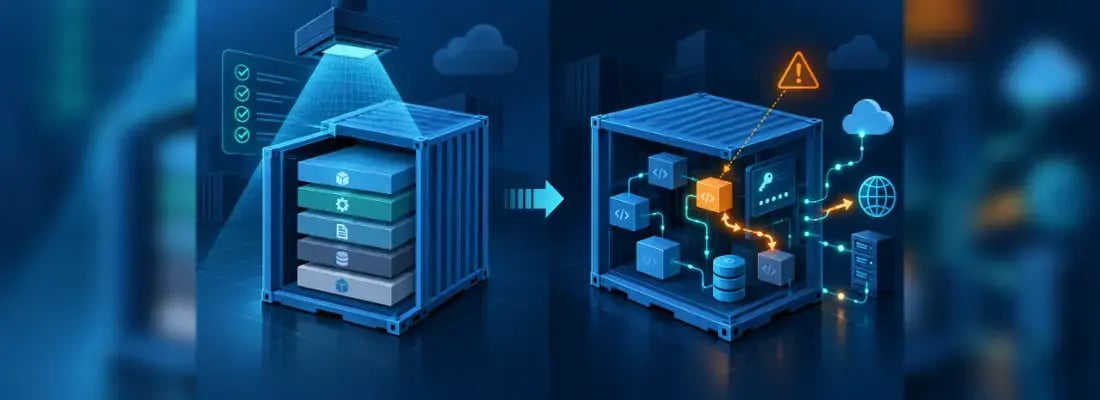
Container image scanning answers an important question before deployment: which known packages, files, and vulnerabilities are present in the image? Container runtime scanning addresses a different stage by observing the workload after it starts. Once traffic reaches the container, packages load, functions execute, credentials become available, and the application begins interacting with real systems.
That difference creates a runtime blind spot. A clean scan cannot prove that an application will behave safely in production, and a long vulnerability list cannot show which findings are reachable. Image scanning remains essential, but its evidence ends at the image boundary.

What an Image Scan Actually Measures
An image scanner inspects layers and file-system contents. It usually identifies operating-system packages, language packages, configuration files, secrets, malware signatures, and known CVEs. The result is a useful inventory tied to a particular image or digest.
The scan is a snapshot
The scanner evaluates the artifact as it exists at scan time. It cannot observe data mounted later, secrets injected at startup, packages downloaded during initialization, or code generated in memory. It also cannot see how a component behaves under real requests.
An image may contain a vulnerable library that never loads. Another image may pass every known-CVE check and then expose a dangerous code path through application logic. Both cases are invisible if the team treats the scan result as a complete account of production risk.
Inventory does not establish execution
Package presence is a useful starting point for remediation, but exploitability depends on conditions. The vulnerable module may not be imported. The affected function may not be called. A network path, feature flag, configuration, or user role may make the code unreachable.
The reverse is also true. A dependency that looked harmless during the scan can become dangerous when a new exploit technique appears or when production configuration activates a previously unused path.

What Changes After the Container Starts
Runtime introduces context that does not exist in the image. The container receives real inputs, assumes an identity, connects to other services, and shares a host kernel with other workloads.
Packages and functions begin to matter differently
A package list shows what could execute. Runtime evidence shows what does execute. That distinction helps a team determine whether a vulnerable function is active, which service calls it, and whether attacker-controlled input can reach it.
This is one purpose of runtime application security: connecting a deployed component to the execution path that gives it security significance. The value is not another copy of the software bill of materials. It is evidence about actual behavior.
Production supplies the missing conditions
Real traffic is more varied than a test suite. Production also introduces customer identities, sensitive records, cloud permissions, service credentials, and integrations that may not exist in staging. A request that looks ordinary at the edge can trigger an unexpected parser, authorization branch, or database operation inside the application.
Autoscaling and orchestration add more change. Containers start with different node placement, sidecars, mounted secrets, and network paths. A workload may live for minutes, yet still have enough access to create a serious incident.
The Gaps That Scanning Cannot Close
Several risk classes require observation during execution.
Unknown vulnerabilities
A scanner needs a known signature, advisory, or detection rule. Before a CVE exists, the affected package may appear current and approved. Runtime behavior such as an unexpected child process, outbound connection, or sensitive file read can still reveal exploitation.
Application logic abuse
Business logic flaws often use valid code and valid requests. An attacker may change an object identifier, repeat an allowed transaction, or combine features in a sequence the application did not anticipate. There may be no vulnerable package for a scanner to find.
Configuration and identity misuse
A container may start with excessive Linux capabilities, a writable host mount, an overprivileged service account, or cloud credentials that grant broad access. Configuration scanners can identify some of these conditions before deployment, but only runtime evidence shows whether the workload used them and what action followed.
Fileless and memory-resident activity
An attacker does not always add a persistent binary to the image or file system. Code can execute through an interpreter, a loaded library, a deserialization path, or an in-memory payload. Detection then depends on process and application behavior rather than artifact comparison.

Combine Scan Time and Runtime Evidence
The two layers answer different questions and work best together.
Image scanning should remain part of build and admission workflows. It can prevent deployment of disallowed packages, leaked secrets, malware, or vulnerabilities that exceed policy. Signed images and provenance controls help establish that the deployed artifact is the one the organization approved.
Runtime monitoring should then confirm how the workload behaves. Useful evidence includes:
- Which packages and modules load in the running process
- Which vulnerable functions execute and from which request paths
- Which processes, files, network destinations, and credentials the workload uses
- Which image, deployment, service, and identity produced an event
- Whether behavior persists across replicas or stops with one container
This combined view also improves prioritization. A critical package finding that executes on an internet-facing path may require immediate action. The same version in a dormant tool or unreachable function may remain important but can be scheduled differently.
Build a Continuous Feedback Loop
Runtime findings should feed back into build and deployment decisions. If a package loads unexpectedly, remove it from the image. If a function is reachable only through an obsolete feature, disable or delete the feature. If a workload uses permissions beyond its intended role, reduce them in the manifest and identity policy.
The goal is not to move security from the pipeline to production. It is to connect the two. Build-time controls reduce known risk before release, while runtime evidence tests the assumptions those controls cannot verify.
Treat the Running Workload as a New Evidence Source
An image is an artifact. A container is an executing system that receives inputs, uses identities, and changes state. Security teams need both views.
Image scanning provides a reliable inventory of what ships. Runtime observation reveals which parts become active, which paths attackers reach, and what the workload does under real conditions. Without that second layer, teams know what is inside the container but not what happened after it started.