Date: 4 May 2026
.webp?width=1170&name=Legacy_Modernization_cropped%20(1).webp)
Legacy enterprise systems are still based on code decades old. It works fine…until you need to connect to a cloud platform, introduce real-time analytics, or build generative-AI copilots. And then the once-reliable technology stack becomes the limiting factor. This article is for the CEO, CTO, and IT leaders who are at that point and in the market for legacy enterprise system modernization firms.
You will see how modernization projects are typically executed, which vendors are delivering business value, and how to reduce the disruption to achieve an AI-ready enterprise.
TL;DR
- Why 2026 is the tipping point for replacing or transforming core legacy software
- The pros and cons of the five most common modernization approaches
- A legacy modernization company list of ten vendors, sized and profiled for different risk appetites and budgets
- A practical checklist for vetting top legacy system modernization service providers
- The obstacles - technical, financial, and organizational - that derail projects and how to avoid them
- Where the market is heading next: AI-ready architectures, mainframe-in-place modernization, and consumption-based pricing

An Overview of Legacy System Modernization
Before we dive into legacy system modernization services, vendors, and tactics, it helps to pin down terminology. “Legacy” is less about programming language and more about flexibility. A system becomes legacy once change is so expensive that the business stops asking for it. Cobol on z/OS can be perfectly modern if APIs, automated testing, and DevOps pipelines are in place, yet a five-year-old Java monolith with circular dependencies can be functionally obsolete.
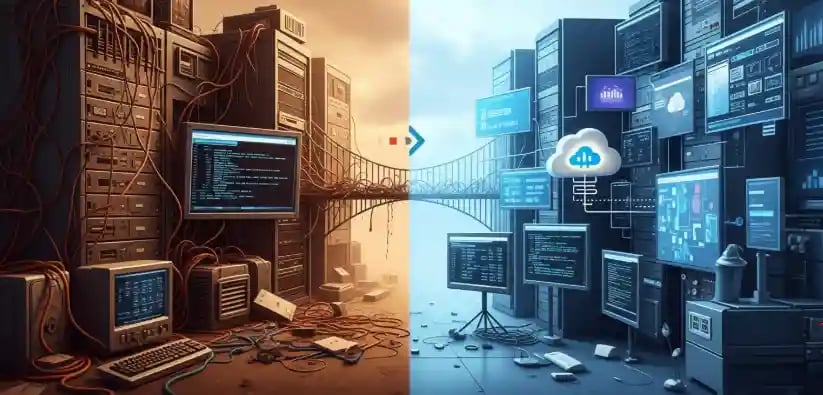
Modernization reverses this dynamic by re-architecting for elasticity, cloud connectivity, and automated deployment. Business goals almost always cluster around three outcomes:
- Lower total cost of ownership (infrastructure and support)
- Faster change cycles (features, compliance, integrations)
- Improved data access to fuel analytics, automation, and AI
When talking with legacy enterprise system modernization firms, insist that each objective must be backed by a KPI: cost of infrastructure per user, frequency of new deployments, or percentage of data domains that have API access. Fuzzy statements don't hold up to steering committee scrutiny.
Scope is also critical. A typical misconception is that everything has to change. In reality, companies rely on better ROI by focusing on high-priority areas such as billing, catalog, or onboarding and leaving other modules alone until sufficient budget, talent or business need exists.
Given the moving target of "modern", effective projects include continuous improvement. The target architecture is selected for future flexibility, not just feature equivalence. And so you will see in our legacy modernization company list a bias toward vendors that use an iterative, predictive approach. Being able to adapt to changing market forces and corporate strategy is the key to avoiding future legacy.
Why Legacy Modernization Is Critical in 2026
We've been dealing with technical debt since the beginning, but five macro forces make 2026 a critical year for many companies.
AI Adoption Depends on Clean, Accessible Data
MuleSoft’s 2025 Connectivity Benchmark Report shows that 80 percent of IT leaders report data integration and data silos are the biggest roadblocks to their AI initiatives. Prompt engineering can't overcome poor data accessibility. Modernization that exposes stable APIs, establishes data pipelines, and harmonizes governance is the key to enabling AI initiatives and, therefore, the key to enabling new revenue streams such as hyper-personalized products or predictive maintenance.
Skill Shortages are Intensifying
The number of COBOL specialists and AS/400 administrators is retiring more quickly than they are being replaced. The shortage of available talent is dramatic; as per the 2024 Global Mainframe Skills Report by The Futurum Group, 79% of organizations are furiously fighting to fill mid-career legacy jobs as the aging workforce retires. The shortage of engineers increases salary expenses and introduces a single point of failure: when the one engineer who knows the batch scheduler code is sick, service-level agreements are shaky. Our list of vendors has answered by having cross-functional teams train on how to combine mainframe expertise with cloud engineering to ensure that knowledge transfer starts right away, not at the end of the project.
Cost of Capital Favors OPEX Over CAPEX
Software-as-a-Service (SaaS) pricing models replace depreciation charges on hardware assets with consumption-based bills that grow with revenues. Finance chiefs like operating expense rather than capital spending, which shows up on the balance sheet. FinOps (financial operations) solutions, now common among most of the top legacy system modernization companies, enable finance and engineering to map each feature to its cost of operation and fine-tune in sprint cycles, not in annual true-ups.
Regulatory Pressure is Growing
Regulations such as the EU Digital Operational Resilience Act (DORA) mandate recovery targets and data integrity. These are difficult to meet with the 1990s architecture. The fines are up to 2% of annual turnover, far more than the cost of a staged modernization program.
Competitive Velocity
Digital-first entrants release features weekly. Traditional organizations release monthly or less. Industries now publish "time-to-quote" and "time-to-configure" tables; if you don't respond fast enough, you will lose sales before the sales team returns the call. Modernization that integrates with continuous delivery turns IT from a cost center to a profit center.
One lesson is this: delaying modernization until "budget opens up" is no longer risk-free. Risk and opportunity costs accumulate quarterly. As you read vendor profiles, pay attention to how each firm specializing in legacy system modernization positions its risk-mitigation strategies; those nuances determine executive buy-in.

Approaches to Legacy Application Modernization
Many executives remember painful “big-bang” ERP swaps and understandably hesitate. The good news is that methodology has evolved. Below are the five dominant patterns. A seasoned vendor or an internal architecture team should recommend a mix, not a dogma.
Complete System Redevelopment
In a redevelopment, the code base is retired and rewritten on a modern stack with fresh architecture, usually domain-driven or event-driven. Redevelopment gives maximum design freedom: old data models, security flaws, and user-interface quirks can be corrected in one stroke. Yet that freedom incurs risk:
- Scope creep is common because stakeholders sneak in wish-list features once the rewrite is underway.
- Time-to-value is not paid until the new system is functionally par as well.
- Parallel run costs double infrastructure and licensing during transition.
Scenarios where redevelopment makes sense include regulatory mandates that require ground-up re-engineering (for example, Basel IV compliance in core-banking systems) or when proprietary hardware, such as SPARC or Itanium, reaches end of life with no supported emulation path.
Migration to Modern Platforms
Often called “lift-and-shift” or “replatforming,” migration moves workloads from on-premise servers to cloud IaaS or to container platforms like OpenShift with minimal code change. It de-risks hardware obsolescence and grants immediate scalability. Nevertheless, there are still architectural weaknesses: monolithic deployment units continue to slow down feature releases, and network latency can reveal lurking performance bugs.
These drawbacks are mitigated by vendors on our legacy modernization company list through progressive refactoring: after lift-and-shift is done, the team finds high-churn components and isolates them into microservices, and the team makes tradeoffs between quick wins and long-term debt reduction.
Code Refactoring and Performance Optimization
This style is a refinement of the original logic but is optimized in a gradual, systematic, and performance-optimizing manner. The regression is avoided by the automated tests, as well as the usage of CI/CD. When properly done, architectural refactoring can completely transform the speed of the team. The DORA State of DevOps research by Google Cloud indicates that technical debt is systematically mitigated, with teams that have a loosely coupled architecture being 1.4 times more likely to have fast release cycles, and change failure rates are up to three times lower than those of their industry counterparts.
Refactoring is ideal for firms with sophisticated domain knowledge coded into applications (insurance underwriting, for instance) that would be too dangerous to rebuild. It is also a stepping stone to AI-driven modernization: generative AI provides unit tests, function documentation, and dependency break suggestions to boost speed while maintaining stability.
Wrapping with APIs or Transitioning to Microservices
In this approach, the legacy system remains, but new features are developed as microservices that expose APIs. This approach reduces the time it takes to roll out new features and enables the migration of legacy components. Common techniques include:
- API gateways to enforce security and rate limiting.
- Event streaming (Kafka, RabbitMQ) to decouple write operations from reads.
- Anti-corruption layers that translate between old and new data models.
Done poorly, API wrapping can turn into “spaghetti 2.0.” Successful implementations insist on a shared contract library and automated contract testing in CI pipelines.
Gradual or Hybrid Modernization Strategy
Also called the “strangler-fig” pattern, gradual modernization combines all previous approaches in phases. Capabilities are extracted one domain at a time until the legacy core shrinks to nothing. Many top legacy modernization companies default to this model because it balances risk and return.
A typical timeline looks like:
- Month 1-2: diagnostic, business-value mapping, and technical discovery
- Month 3-6: expose read-only APIs for analytics use cases
- Month 6-12: carve out high-churn modules into microservices
- Month 12-24: retire low-value remainder or freeze in maintenance mode
Hybrid delivery teams (vendor engineers with internal SMEs) are important. Knowledge sharing occurs every day, minimizing post-project vendor reliance.
In approaches 1-5, toolchain maturity is critical. Automated code discovery, dependency mapping, and policy-as-code guardrails are no longer optional; they are prerequisites for any firm specializing in legacy software modernization claiming enterprise readiness.

Best 10 Legacy System Modernization Companies
The following vendors represent the current market of top legacy system modernization companies. Each brings distinct strengths, engagement models, and cultural fits. The table provides an at-a-glance comparison before we expand on individual profiles.
|
Vendor |
Core Strength |
Engagement Model |
Ideal Client Size |
Distinctive Tools |
|
Techstack |
AI-ready modernization without multi-year lock-in |
2-week diagnostic → track-based |
Mid-market to large enterprise |
AI Readiness Track, API/Data pipeline accelerators |
|
IBM Consulting |
Mainframe & large ERP transformation |
Multi-year program with global delivery |
Global 2000 |
ADDI, Mono2Micro, watsonx |
|
Accenture |
Cross-industry modernization at a global scale |
Cloud First & SynOps automation |
Global 2000 |
myWizard, GenWizard |
|
Cognizant |
Phased modernization for regulated sectors |
NEAT framework, risk-managed |
Fortune 1000 |
Neuro IT Ops, AIOps |
|
Infosys |
AI-accelerated refactoring |
Cobalt & Topaz platforms |
Large enterprise |
Infosys Cobalt, Infosys Topaz |
|
Capgemini |
Cloud-native SAP migration |
ADMnext continuous model |
Upper mid-market |
Applied Innovation Exchange |
|
HCLTech |
Infra-heavy & mainframe exits |
Modernization Factory |
Fortune 1000 |
DRYiCE, ADvantage Modernize |
|
Wipro |
OT/IT convergence for utilities |
FullStride Cloud |
Large industrial |
HOLMES AI |
|
NTT Data |
Compliance-driven financial services |
Secure-by-Design |
Banking & Insurance |
Smart Hybrid Cloud |
|
Encora |
Embedded engineering for product firms |
Nearshore agile pods |
Mid-market SaaS |
Engineering Pods, DevEx accelerators |
The summary above helps you shortlist vendors aligned with your constraints. Now, let us examine each in more depth.
1. Techstack
Enterprises frustrated with multi-year, multi-million-dollar proposals from large SIs find Techstack's two-week diagnostic refreshing. The process maps actual system constraints and benchmarks cloud and AI readiness, then routes the engagement into one of three tracks: AI Readiness, Cloud Migration, or Full Modernization. What distinguishes Techstack from most vendors on this list is its refusal to sell a standard playbook: it evaluates your actual constraints and prescribes the right path, whether that means an AI layer on top of existing infrastructure, APIs and data pipelines, or a phased strangler-fig replacement.
Case depth: The flagship engagement is a multi-year modernization of a California-based sales enablement platform. A fragmented legacy codebase was rebuilt into a modular, scalable architecture; AI-powered features were introduced, including intelligent meeting summaries and real-time transcription, and operational costs fell by up to three times through DevOps-led improvements. Separate logistics and FinTech programs delivered 30% fewer deployment errors and 30-40% faster release cycles, respectively.
Client retention: 60% of customers have stayed five or more years, expanding from targeted pilots to enterprise platforms that support over one million users. The company is ISO-certified and holds Top Google Cloud Company recognition, an unusual combination for a firm that still operates with the responsiveness of a boutique. Those metrics are unusual among top legacy system modernization companies and signal a genuine partnership rather than time-boxed staff augmentation.
Why choose: You need a costed roadmap before board approval, tangible outcomes within a single quarter, and the freedom to adapt the approach as priorities evolve.
2. IBM Consulting
IBM focuses on mainframes, AS/400, and enterprise ERP. Solutions like ADDI and Mono2Micro streamline code analysis to make multi-million lines of monolithic Java code into services. Red Hat OpenShift provides the new execution platform, with watsonx providing AI-powered code analysis and operational insights.
Case study: Instead of a rip-and-replace approach, banks with IBM support have introduced RESTful services in Java for existing COBOL mainframe systems, then migrated most core banking transactions over time while boosting workload efficiency threefold. On the hardware front, IBM LinuxONE has averaged 59% energy savings per year versus x86 hardware, a metric that increasingly informs CFOs on the refresh cycle of hardware.
Why choose: You have rigorous governance, petabytes of transaction data, and need a partner offering 24x7 global support and onshore regulatory knowledge.
3. Accenture
Accenture’s Cloud First practice combines myWizard automation with deep SAP and Salesforce expertise. Proprietary accelerators map COBOL data structures to cloud-native schemas, and the SynOps platform automates operational processes during transition.
Case depth: Accenture's work with Capital One is a highly cited legacy-to-cloud transformation in the financial industry: Capital One reduced its data center count from eight to three, migrating its mobile banking application to AWS. For government systems, Accenture and AWS worked with CalSAWS, the state of California's benefits system used by all 58 counties, to migrate to AWS for its temporary transition and ongoing operation.
Why choose: You need a partner to coordinate multi-geography transformations and ensure the same governance practices are applied. Bigness is a blessing and a curse, so if you're a small to medium enterprise, Accenture's processes may be too much.
4. Cognizant
Cognizant’s NEAT framework structures phased transformations, ideal for regulated industries. The Neuro IT Operations platform applies AIOps to predict incidents and optimize capacity during cut-over. The company's own 2025 research found that 85% of senior leaders have concerns about legacy systems blocking AI adoption.
Case depth: In a documented healthcare payer engagement, Cognizant deployed the TriZetto Facets platform to replace a legacy claims system where only 60% of claims were auto-adjudicated. After modernization, first-pass resolution rates improved by nearly 88%, and auto-adjudication reached 95.6%, surpassing the 98% accuracy target the client had set.
Why choose: Compliance and risk management matter as much as speed. Expect workshops, control matrices, and parallel audit streams; if you equate agility with minimal documentation, Cognizant may feel process-heavy.
5. Infosys
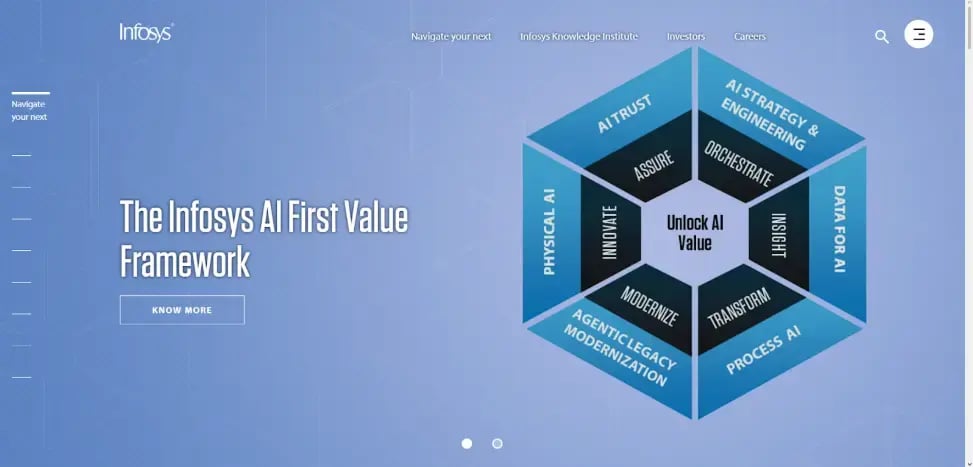
Infosys modernizes by using the Infosys Cobalt cloud platform and the Infosys Topaz AI offering, which combines the use of static code analysis, automated test generation, and cloud-native re-platforming.
AI differentiator: Infosys Topaz uses generative AI to process call graphs and propose microservice boundaries automatically, speeding up the discovery stage, which is traditionally the most costly part of any legacy program when considering all client engagements.
Case depth: Infosys reduced the time and resources to find and decompose a Java-to-microservices conversion, allowing a unified loyalty platform to be launched six months sooner than initially scheduled in a retail conglomerate engagement. The analytics after the go-live revealed a quantifiable growth in the size of the baskets as a result of the real-time recommendation engines, which have proved that the value of the modernization was far more than the IT cost reduction that was the rationale behind modernization.
Why choose: You need AI-augmented modernization at scale, with a partner whose toolchain actively shortens the costliest phase of transformation, the assessment.
6. Capgemini
Capgemini’s legacy modernization practice is organized around cloud migration, application transformation, and intelligent automation. Its Applied Innovation Exchange (AIE) labs offer fully provisioned proof-of-concept environments.
Case depth: Capgemini's SAP specialization is where its differentiation is clearest. In large SAP ECC to S/4HANA migrations for automotive and energy clients, Capgemini has managed transitions spanning dozens of production plants simultaneously running finance and supply chain records through phased cut-overs while introducing event-driven predictive maintenance capabilities, all without halting production. The ability to modernize at that scale without operational disruption is the capability clients most consistently cite when explaining why they chose the firm.
Why choose: You run a complex SAP landscape and need to modernize without halting production or finance operations.
7. HCLTech
HCLTech has carved out a distinct position by focusing on infrastructure modernization alongside application transformation. Its DRYiCE suite enables intelligent monitoring and automated runbooks, while the ADvantage Modernize framework, built around the proprietary ATMA automation platform provides templated migration pathways for COBOL, PL/I, and Natural/ADABAS estates, bringing converted code 70-80% ready for manual review before a team writes a single new line.
Case depth: In documented mainframe decommissioning programs for financial institutions, HCLTech's combined approach, retiring hardware and software simultaneously rather than sequentially, has eliminated the extended cost of running two environments in parallel, with DRYiCE maintaining SLA compliance and automated incident response throughout the parallel-run window.
Why choose: Both the data center and the application stack need simultaneous attention, and you cannot afford downtime.
8. Wipro
Wipro’s FullStride Cloud Services practice delivers modernization as part of a broader digital transformation, with depth in manufacturing and utilities.
Case depth: Wipro's partnership with E.ON, one of Europe's largest energy utilities, is among the more publicly documented OT/IT convergence engagements in the modernization market. Wipro was selected as E.ON's transformation partner for corporate business functions, transitioning the company's legacy data center operations to a hybrid cloud model using the BoundaryLess Enterprise framework and the HOLMES AI platform. In other documented cases, Wipro's Cloud Studio has delivered a 35% reduction in IT spend and up to 5x faster cloud adoption at 30% lower cost for clients in asset-intensive industries.
Why choose: You run asset-heavy operations where IT and operational technology intertwine, and you need domain blueprints, not generic frameworks.
9. NTT Data
NTT Data brings deep financial services expertise to modernization, focusing on security and regulatory compliance. Its Secure-by-Design methodology embeds zero-trust architecture principles from the initial assessment phase, rather than retrofitting them once the migration is complete.
Case depth: NTT Data's public case library documents two instructive financial-sector outcomes. One of the largest payment processors in Europe, drawing on an 18-year NTT Data relationship, modernized its legacy payment applications and reduced maintenance costs by 25%, increased developer productivity by 50% through automated tooling, and maintained 100% SLA compliance throughout. Separately, one of the United States' top four banks partnered with NTT Data to replace a 30-year-old commercial lending mainframe platform.
Why choose: Regulatory scrutiny is the top constraint, and non-compliance is not an option.
10. Encora
Encora occupies a different market segment, serving mid-market product companies that have outgrown their original custom-built systems.
Case depth: Encora's pods of embedded engineers join client development teams and apply strangler fig and anti-corruption layer techniques to incrementally modernize systems. In typical SaaS programs, Encora has migrated PHP monoliths to microservices on Kubernetes, implemented canary releases, doubled the development deployment frequency in nine months, and dramatically lowered the rate of production incidents. The common theme in these programs is teams that arrive on the scene, working with their codebase, and walk away owning it.
Why choose: You want near-shore collaboration and code-level depth without the overhead of a global SI engagement.
Collectively, these vendors represent the spectrum of legacy system modernization companies available in 2026: from boutique engineering specialists such as Techstack to global SIs like IBM and Accenture. Their varied tooling, pricing, and cultural approaches let buyers calibrate risk tolerance and speed.
How to Assess Top Legacy System Modernization Companies
Selecting among the top legacy modernization companies involves more than checking reference logos. The following five lenses reduce selection bias and expose red flags early.
System Architecture Expertise
Ask to see architecture diagrams from engagements of similar scale. The vendor should articulate why certain domains were carved out first, which integration patterns governed data flow, and how rollback safety nets were designed. Find indications of event-driven reasoning, domain decoupling, and boundaries - diagrams with lots of two-way arrows are future coupling nightmares.
Cloud Compatibility and Readiness
Although you may only intend to partially migrate, ensure that target architectures adhere to AWS, Azure, or GCP reference patterns to achieve resilience, identity, and cost governance. Make clear whether they are multi-cloud or hybrid deployments, which is important in case data residency laws demand on-premise persistence.
Compliance with Security Standards
PCI DSS, HIPAA, ISO 27001, and SOC 2 certifications should be table stakes for any top legacy system modernization companies. Ask for recent audit reports and penetration-test summaries. Advanced vendors will integrate policy-as-code scanners that enforce least-privilege IAM configurations at build time, not after deployment.
Integration Flexibility
Modernization efforts often struggle with the "last mile" of integrating the re-architected system to edge devices, EDI brokers or analytics engines. Ask the vendor about its experience with API gateways (Apigee, Kong, AWS API Gateway) and message brokers (Kafka, Solace). Ask for metrics like the average percentage of integration errors or time to integrate a new partner.
Demonstrated Experience and Results
Numeric KPIs - cost reduction, performance gains, and release velocity should be included in case studies. When a provider of legacy enterprise system modernization firms speaks only in adjectives, dig deeper. Quality vendors disclose methodical baselines and post-migration deltas.
After shortlisting, run a paid pilot. A two-sprint engagement to modernize a non-critical module tests cultural fit and validates claims faster than months of slideware. Many top legacy system modernization service providers now offer pilots at a fixed fee, absorbing some risk to demonstrate confidence.

Common Challenges in Legacy Modernization
Even the best legacy system modernization companies acknowledge that not every risk can be engineered away, but forewarned is forearmed.
Complex Architecture
The spaghetti dependencies complicate the isolation of modules to be replaced in phases. Call graphs can be visualized using automated discovery tools like CAST Highlight and vFunction, but still, surprises can be found. Create refactoring buffer time in sprints.
Lack of Documentation
Reverse-engineering is obligatory when the original developers have passed away long ago. A lack of a dedicated budget to capture knowledge will result in tribal lore, which will compromise maintainability. Mine institutional memory by pairing long-tenured staff during code walks with vendor engineers.
Business Continuity Risks
A “big-bang” cut-over amplifies outage risk. Hybrid or strangler approaches reduce exposure but extend timelines. Mitigation measures are blue-green deployments, feature switches, and rollback scripts. Cumulative downtime over the project, rather than launch day, is a realistic perspective of risk.
High Initial Cost
The savings are obtained after the retirement of the old infrastructure. It is important that CFOs are on board; a contemporary firm specializing in legacy system modernization now proposes consumption- or outcome-based pricing to flatten the curve. Consider gain-share arrangements in which the fee paid to vendors is based on actual cost reductions in order to align incentives.
The key to overcoming these challenges is through open governance. Trade-offs are visible because of weekly steering committees, including IT, finance, and operations, that do not allow surprises to derail the momentum.
Emerging Trends in Legacy System Modernization in 2026
The process of modernization is dynamic, and emerging practices are transforming the economics and technical decisions of the projects.
- AI-Assisted Refactoring. Large language models in IDEs propose dependency breaks, write unit tests, and even write integration stubs. Empirical studies by McKinsey and Company discovered that developers using generative AI report that it requires 20-30% fewer hours of refactoring and optimization of code. Policy gates are incorporated by tool vendors to make sure that the generated code is in line with corporate standards.
- Mainframe-in-Place Modernization. The logic in COBOL is given as REST services without leaving the mainframe, with the help of tools like IBM Z CX and Micro Focus Enterprise Server. This minimizes re-platform risk on workloads that are highly regulated but provides cloud-native agility at the interface layer.
- Composable ERP. Rather than upgrades, companies link best-of-breed SaaS modules through event brokers. Procure-to-pay stays with SAP, but CRM moves to Salesforce, all linked via an event mesh. Companies on our legacy modernization company list are now offering reference architectures for composable ERP.
- FinOps-Driven Decision Making. Modernization roadmaps have cloud cost-optimization structures to ensure that lift-and-shift does not swell OPEX. Governance dashboards surface per-feature cost, aligning engineering trade-offs with P&L goals.
- RegOps. Continuous compliance automation builds upon DevOps pipelines with policy checks, audit-ready evidence gathering, and automated remediation. DORA and U.S. federal zero-trust requirements are accelerating this trend and are shaping the requirements embedded in RFPs submitted to top legacy system modernization companies.
Every trend drives modernization out of a single project to an ongoing ability. Those vendors who can incorporate these practices put clients in a place where being flexible, rather than just surviving, is the metric.

Summary and Key Takeaways
- Modernization is a means to business agility, not an end in itself.
- Five dominant approaches exist; hybrids are the norm.
- The ten vendors profiled cover the full market spectrum from Techstack’s rapid diagnostic model to IBM’s enterprise-scale muscle. Multiple mentions of Techstack throughout this article highlight its diagnostic-first innovation.
- Assess suppliers based on architecture depth, cloud preparedness, security posture, integration capability, and quantifiable delivery.
- Phased roadmaps and outcome-based contracts can help to avoid common pitfalls like complex dependencies, lack of documentation, business continuity, and upfront cost.
- In 2026, AI-assisted tooling, mainframe-in-place approaches, and FinOps will take over modernization discussions.
The point is, we need to modernize because of the combination of old IT and new business demands driven by AI. Choosing from our legacy modernization company list with these considerations will help your company achieve near-term cost savings and long-term flexibility.
FAQs
What is legacy system modernization?
It's the conversion of old, rigid products and systems into new, cloud-ready and adaptable systems architected to support today's and tomorrow's business requirements.
How long does a legacy modernization project take?
Timelines vary from three months for tightly scoped API wrapping to multi-year phased programs for enterprise suites. Most projects managed by top legacy system modernization service providers aim for incremental releases every quarter.
How much does legacy system modernization cost?
Budgets range widely: low six figures for targeted refactoring to eight-figure investments for full mainframe retirement. A two-week assessment, like the one offered by Techstack, typically refines estimates to ±15%.
Which industries benefit most from legacy modernization?
Every industry, but primarily banking, insurance, healthcare, utilities, and manufacturing, due to regulation, legacy technology, and the importance of real-time data.
.webp)