
Date: 1 May 2026
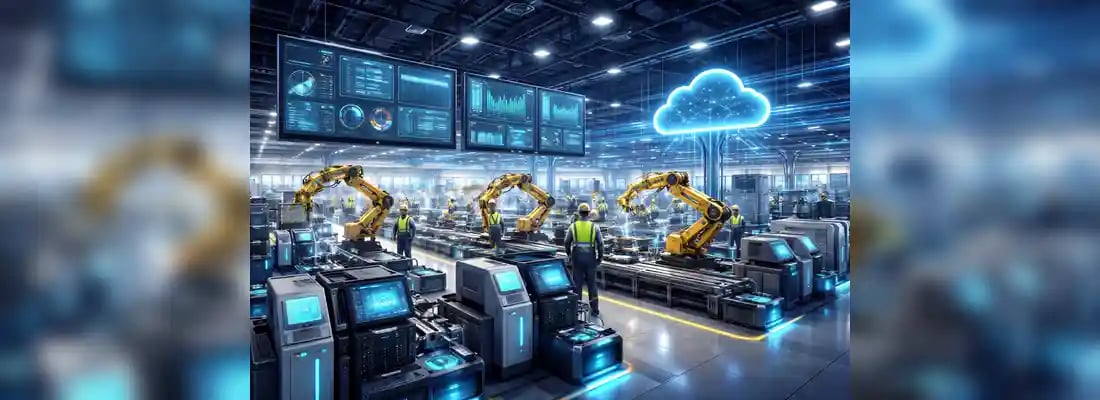
The rapid evolution of Industry 4.0 has necessitated a move away from traditional cloud-centric models toward more agile architectures. Today, businesses are increasingly adopting ai enabled iot solutions to process data at the source of generation. This paradigm shift, known as edge computing, allows industrial facilities to minimize latency and optimize bandwidth usage by handling complex computations locally.
The Shift Toward Decentralized Intelligence
As factories become more autonomous, the ability to make split-second decisions without waiting for a distant cloud server to respond has become a competitive necessity.
By integrating intelligence directly into hardware, modern ecosystems can achieve unprecedented levels of operational efficiency. This decentralization not only speeds up the response time for critical machinery but also ensures that the most sensitive data remains within the local network, reducing exposure to external cyber threats. In the context of global manufacturing, edge computing acts as the nervous system that connects disparate sensors into a cohesive, intelligent organism capable of self-regulation and proactive optimization.

Architectural Foundations of Edge-to-Cloud Integration
To understand the impact of edge computing, one must examine its structural role within a multi-tiered industrial network. Unlike traditional setups where every byte of raw data is sent to a centralized data center, edge architecture introduces a middle layer of localized processing units, gateways, and smart controllers. These components filter, aggregate, and analyze data in real-time, sending only the most relevant insights or periodic summaries to the cloud for long-term storage and heavy-duty machine learning training.
This hybrid approach solves the "data gravity" problem, where the sheer volume of information generated by thousands of sensors becomes too heavy and expensive to move across long distances. Furthermore, this architecture supports high availability; even if the primary internet connection to the cloud is severed, the edge nodes continue to manage local operations, ensuring that production lines do not grind to a halt. The synergy between edge devices and cloud platforms creates a scalable framework where real-time execution happens locally, while strategic, fleet-wide intelligence is managed globally.
Key Benefits of Edge Computing in Industrial Environments:
- Ultra-Low Latency: Critical for safety systems and high-speed robotics where millisecond delays are unacceptable.
- Bandwidth Optimization: Reduces operational costs by filtering "noise" and only uploading high-value data.
- Enhanced Reliability: Enables autonomous operation during intermittent connectivity or network outages.
- Data Privacy: Keeps sensitive intellectual property and operational telemetry within the factory walls.
- Cost Predictability: Minimizes the unpredictable fees associated with massive cloud data ingress and egress.
Operational Efficiency and Predictive Maintenance
The most tangible impact of edge computing is felt on the factory floor through the advancement of predictive maintenance and real-time monitoring. A frontline operations platform for manufacturing can complement these technologies by helping teams digitize workflows, coordinate frontline tasks, and maintain better visibility into day-to-day production activities. By deploying localized AI models, sensors can detect microscopic vibrations or temperature fluctuations in turbines and motors that signify an impending failure.
Instead of following a rigid, time-based maintenance schedule—which often leads to unnecessary downtime or unexpected breakdowns—companies can move to a condition-based model. The edge node processes the high-frequency data streams, identifies anomalies, and triggers an immediate alert or an automatic shutdown.
This proactive stance significantly extends the lifespan of expensive industrial assets and reduces the "Mean Time to Repair" (MTTR). Beyond maintenance, edge computing optimizes energy consumption by adjusting HVAC and lighting systems based on real-time occupancy and machine load, directly contributing to the sustainability goals of modern enterprises. The result is a leaner, more resilient production cycle that adapts to physical realities in real-time rather than reacting to historical data.

Comparison: Edge vs. Cloud for Industrial Tasks
|
Feature |
Edge Computing |
Cloud Computing |
|
Response Time |
Real-time (1-10ms) |
Delayed (100ms - 2s+) |
|
Data Volume |
Processes raw, high-frequency data |
Processes aggregated, filtered data |
|
Connectivity |
Operates offline/locally |
Requires stable internet |
|
Security |
Localized, physical control |
Remote, third-party encryption |
|
Best Use Case |
Motion control, safety, filtering |
Big data analytics, historical trends |
Overcoming Implementation Challenges and Interoperability
While the advantages are clear, transitioning to an edge-focused ecosystem requires navigating complex technical hurdles, particularly regarding interoperability and legacy equipment. Many industrial plants still rely on older machinery that utilizes proprietary protocols and lacks native connectivity. Integrating these "dark assets" into a modern edge network requires sophisticated gateway solutions and protocol translation (e.g., converting Modbus or Profibus to MQTT or OPC UA).
Security also takes on a new dimension; as the number of edge devices grows, so does the potential "attack surface" for hackers. Organizations must implement robust identity management, secure boot processes, and regular over-the-air (OTA) updates to ensure that every node remains protected against evolving threats.
Additionally, managing a fleet of hundreds of edge devices across different geographical locations demands a centralized management platform that can deploy software updates and monitor node health without manual intervention. Success in edge computing is not just about the hardware; it is about the software orchestration layer that harmonizes these diverse components into a unified system.
The Future of Autonomous Industrial Systems
Looking ahead, the convergence of 5G, advanced AI, and edge computing will lead to the rise of fully autonomous "lights-out" factories. 5G provides the high-capacity, low-latency wireless "pipe" that allows thousands of edge devices to communicate with each other seamlessly.
In this future, robots will not just follow pre-programmed paths; they will use edge-based computer vision to navigate dynamic environments and collaborate with human workers safely. We will see the widespread adoption of "Federated Learning," where edge devices across different plants learn from local data to improve a shared AI model without ever exchanging the actual raw data itself.
This preserves privacy while accelerating the intelligence of the entire industry. As the boundary between the physical and digital worlds continues to blur, the edge will become the primary site of industrial innovation, serving as the foundation for sustainable, flexible, and highly personalized mass production. The ability to pivot production lines instantly based on real-time market demand will define the leaders of the next industrial era.

Strategic Conclusion and Implementation Path
In conclusion, edge computing is no longer an optional upgrade but a fundamental requirement for any industrial enterprise aiming to survive in the digital age. By moving intelligence closer to the data source, companies can solve the dual challenges of latency and bandwidth while simultaneously bolstering their security posture and operational resilience.
The journey toward a robust edge-to-cloud architecture requires careful planning, starting from hardware selection and extending to the complex software layers that manage data flow. Navigating these technical waters is often best achieved through specialized https://indeema.com/services/iot-consulting, ensuring that the transition to Industry 4.0 is both efficient and scalable.
As we move deeper into this decade, the organizations that successfully harness the power of the edge will be the ones that set the standard for productivity, innovation, and global competitiveness. Embracing these technologies today ensures a future-proof foundation for the autonomous and interconnected ecosystems of tomorrow.

.webp)