Date: 1 May 2026

Most organisations put a ton of time and effort into bulking up their defences – firewalls, email gateways, web filters. These controls are important, but they're based on an assumption that the threat is coming from outside. But when a remote access trojan is secretly running away on a device inside your network and your perimeter security is largely irrelevant. The real question then is: can your team actually see what's going on on that endpoint, and how quickly can they respond?
This article explains what RAT malware actually does once it's landed on a system, why so many infections go on for months without anyone even realizing they're there, and what endpoint visibility means for closing the gap between when a breach happens and when you can actually do something about it.
What Is a Remote Access Trojan?
A remote access trojan is a type of malware that allows an attacker to take control of a machine, often without the user even noticing. Unlike other types of malicious software that might just lock you out of your files or display some ransomware nonsense, a RAT in cyber security is built to stay hidden and keep on going. The whole point for the attacker is that the RAT stays under the radar.
The name RAT malware might bring to mind a rather misleading image. Think of it like the Trojan Horse legend. Usually, the malware is disguised as something the user thought they were installing knowingly – a dodgy crack, a free utility that seemed harmless, or a game mod that looked cool. Once it gets run, it sets up a secret backdoor to the attacker's command and control center.
From there, the attacker can start doing all sorts of nasty things like logging what the user types, capturing screenshots, turning on the webcam or microphone, exporting files, moving around the network, and deploying even more malware. Some remote access trojans even let the attacker power up arbitrary commands, mess with the file system, or disable security software. Meanwhile, the user might never even know anything's amiss.
If you want to understand the removal and remediation side of a RAT infection, TrustRacer has put out a useful guide on remote access Trojan removal that is worth reading before we get into the detection side of the problem.

How Do Trojans Work Once Inside a System?
Understanding how do trojans work at a technical level helps explain why they are so difficult to catch through conventional means.
Once it's taken hold, a RAT typically follows a standard pattern:
- Establishing a foothold – the malware makes sure it sticks around even after you reboot by writing itself into the startup registry or some other hidden place. Some variants even mess with the system drivers, so they're harder to spot.
- Setting up the command channel – the trojan reaches out to the attackers' control systems, usually over the internet – and it tries to blend in with normal web traffic by using common ports (80, 443), etc.
- Deploying the payload – once the C2 handshake is complete, the attacker can issue commands, load up more tools, or start passive data collection.
- Active concealment – many RATs actively try to stay invisible – by hiding processes, disabling the security software, wiping event logs, or renaming themselves to sound like legitimate system tools.
The end result is malware that's been designed to look like normal, everyday activity to anyone not paying close attention.
Why a RAT Attack Is Hard to Catch
A RAT attack cyber security scenario is particularly challenging because the attacker's footprint can be almost indistinguishable from legitimate user behavior. A real user connecting to cloud storage, running scripts, or accessing remote servers looks, at the network level, very similar to an attacker doing the same things through a compromised account.
Several factors compound the detection problem:
- Low-and-slow activity — Rather than moving aggressively through the environment, skilled RAT operators often act in short, infrequent bursts that are easy to overlook in log noise.
- Living off the land — Many RAT operators use built-in Windows tools like PowerShell, WMI, and RDP to carry out their objectives, so there is no unfamiliar binary to trigger signature-based detection.
- Long dwell times — According to the Microsoft cyber defense report, attackers frequently maintain a foothold for weeks or months before taking any visible action.
The Huntress on RAT activity report found a sharp rise in the number and variety of RAT families in active use, with threat actors increasingly deploying remote access tools as a precursor to ransomware deployment. RATs are no longer just a surveillance tool — they have become a standard component of multi-stage intrusion chains.

The Endpoint Visibility Gap
When you can't see what's actually going on on individual endpoints, you're basically flying blind. The fundamental issue at play here is that a network-level view of things can tell you that traffic occurred between two points - but that's about it. You don't get any real idea of what was going on at those endpoints – which process started the interaction, was it something malicious? What files did it touch, and what did it spit out into the registry?
Traditional anti-virus tools generally work by cross-checking the hashes and code patterns of files against databases of known malware. That leaves them dead in the water against the likes of trojans that use fresh code, fileless execution, or inject themselves into trusted processes. If the RAT hasn't been specifically cataloged by the AV vendor, it will just sail on through unnoticed
Knowing how to detect remote access trojan activity in action calls for doing some proper endpoint-level behavioral analysis: watching for process trees unfolding, monitoring registry modifications, tracking network connections to unclassified destinations, and flagging any unusual parent-child process relationships (like a Word document suddenly deciding to spawn a command prompt). And you can't do this from the safety of the network perimeter alone.
How Endpoint Detection and Response Addresses This
Endpoint detection response platforms were developed specifically to address the gap that antivirus and perimeter tools leave open. An endpoint detection and response (EDR) solution deploys a lightweight agent on each device and continuously collects telemetry about process execution, file system changes, registry activity, and network connections.
This telemetry is the foundation of effective RAT detection, for several reasons:
|
Detection capability |
What EDR can see |
What traditional AV misses |
|
Process behaviour |
Parent-child chains, injected code |
Fileless execution, LOL binaries |
|
Registry changes |
Persistence keys, run entries |
Silent modifications |
|
Network activity |
Process-level connection data |
Encrypted or blended C2 traffic |
|
File operations |
Reads, writes, and deletions by process |
Post-execution payload drops |
|
Lateral movement |
Credential use, remote execution |
Attacker moving after initial access |
Beyond just collecting information, modern endpoint detection and response (EDR) platforms can correlate these signals with their usual patterns of behavior. If a process that doesn't usually run starts calling out to some unknown IP address and messing with the registry, it's a clear sign that something is off – even if on its own it wouldn't raise an alarm.
Recorded Future malware trends research from the first half of 2025 showed that RAT families were still among the top things being exploited in active campaigns, and people who are defending against them say time and time again that poor visibility at the endpoint level is the main reason they don't catch infections until the damage is already done.

What to Expect From a Top-Notch EDR Solution
Deploying an EDR platform is not just a technical exercise — it requires thought about coverage, tuning, and response workflow. Some practical considerations:
- You need full endpoint coverage – deploying it on a partial basis creates gaps that an attacker will sniff out and exploit.
- Baseline tuning — out-of-the-box alerts generate noise; the value comes from tuning detection rules to your environment so analysts can act on high-fidelity signals.
- Threat hunting — passive alerting is not enough. Security teams should conduct regular hunts, looking proactively for signs of RAT activity even in the absence of triggered alerts.
- Integrated response — detection without the ability to isolate, investigate, and remediate quickly only narrows the window marginally. EDR should be paired with a documented incident response process.
Red Flags to Check Before Downloading Software
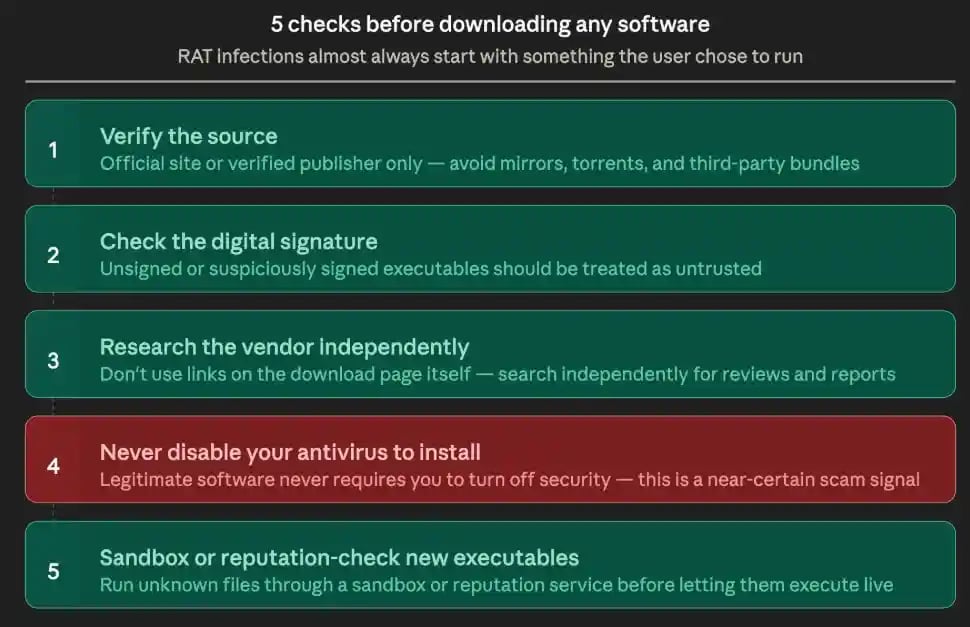
Prevention is still the best – and cheapest – way to defend against an attack. RAT infections typically start with a user downloading or executing something they really shouldn't be, so before you click the “Download” button, keep the following in mind:
- Make sure you know who the software is coming from before you download it – unofficial mirror sites and torrents are often used to spread RATs. A quick check of the source domain can save you a world of trouble.
- Check the digital signature on any executable before you run it – unsigned or dodgy signed software should be treated with suspicion.
- Do some independent research on the vendor before you dive in, and don't rely on links on the page you found the download on to do the digging for you.
- Suppose a download wants you to disable your antivirus to install, it's probably a scam. Don't ever do this – legitimate software won't need you to disable your security to install.
- Run new executables through a sandbox or reputation check before you let them run in a live environment.
These steps won't catch every threat, but they will substantially reduce the likelihood of getting hit in the first place. And that's always going to be easier to fix than trying to catch a problem after the fact.
Closing Thoughts
Getting hit by a RAT isn't a disaster... but it can turn into one pretty quickly. What usually turns a single compromised machine into a full-on network breach is often the same things that make it hard to detect: lack of visibility, dodgy or incomplete logs, and a response plan that doesn't exist or isn't up to scratch.
For security teams looking to build better detection and response capabilities, getting full visibility on every endpoint is a foundation you should be building – not some optional extra. When you can see what every process on every device is up to, the behavioral signs of RAT malware are much harder to hide.
Organizations that want to take it to the next level – reviewing their incident response plans, running some tabletop exercises, or assessing where they are with their detection maturity – will find that getting guidance from specialists in cyber incident planning and response is one of the quickest ways to close these gaps.


.webp)